Jekyll2023-08-07T07:24:03+00:00https://biblicalhistoricalcontext.com/feed.xmlBiblical Historical ContextA Christian layman's perspective on the intersection between archaeology, historical criticism, text, and faith.Biblical Historical ContextA file for the mattocks!?2023-08-05T23:01:00+00:002023-08-05T23:01:00+00:00https://biblicalhistoricalcontext.com/artefacts/a-file-for-the-mattocksI was recently looking for an example of a biblical passage that used to be translated one way, but, after an archaeological discovery, was translated a different way. Ideally the discovery would be well documented in the relevant journals, and its implications explained in technical commentaries.
The search didn’t take long…
An obscure passage in I Samuel
Jonathan’s victory at Michmash in I Samuel 14 is set against a background of an Israelite population unable to create or maintain metal weapons – the Philistines didn’t allow it. This situation is described at the end of chapter 13 with the rather pathetic note that, as the King James Version translates it,
1 Sa 13:19–21 Now there was no smith found throughout all the land of Israel: for the Philistines said, Lest the Hebrews make them swords or spears: 20 But all the Israelites went down to the Philistines, to sharpen every man his share, and his coulter, and his axe, and his mattock. 21 Yet they had a file for the mattocks, and for the coulters, and for the forks, and for the axes, and to sharpen the goads.
A pretty sorry situation. Thankfully though, at least they were able to do some of the maintenance at home – they were allowed files for sharpening various farming implements, saving them the hassle of visiting the Philistines for the more trivial work… or so the KJV would have us believe.
We now get to the point of this post – the word whose translation was changed after an archaeological discovery. It’s in verse 21.
The Hebrew
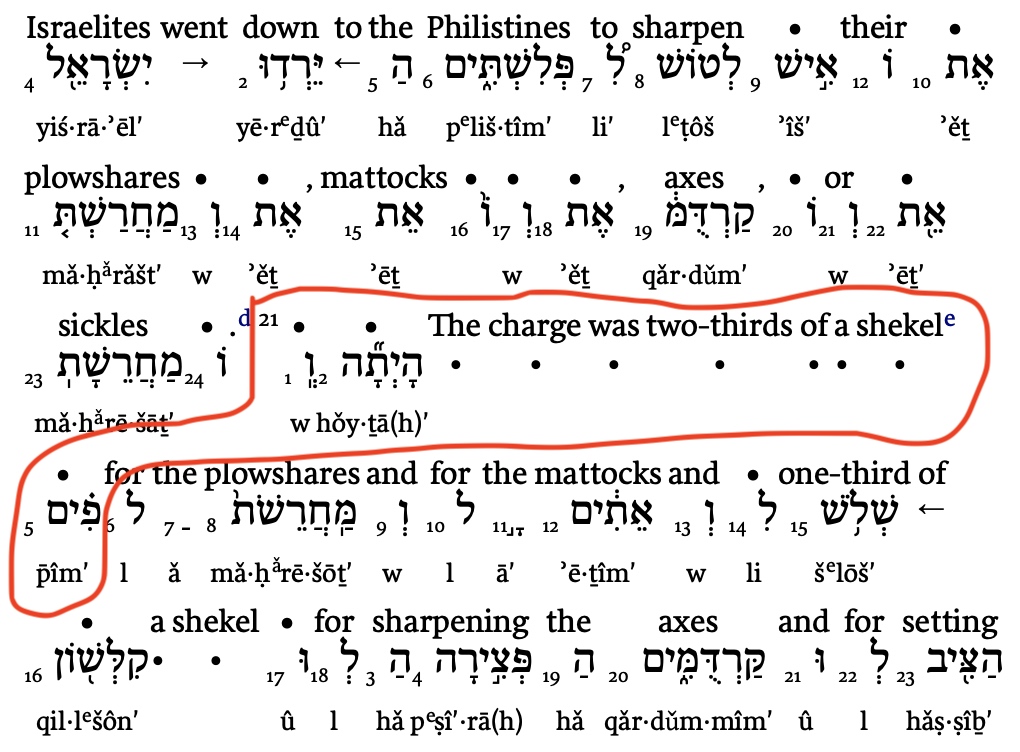
The thing is, the Hebrew underneath the English translation of verse 21 is pretty tricky. And when I say “pretty tricky”, the verse opens with not one, but two hapax-legomena (“Words which occur only once in the Bible”1), one after the other (highlighted in bold text):
As McCarter explains, the meaning of the first hapax-legomenon (פְּצִ֣ירָה, “p’tsirah”) remains a mystery3; in modern translations it’s rendered something like “The charge/cost/price was…”4
The second hapax-legomenon (פִ֗ים, “pim”) is the word the KJV translators rendered “file”. Rather like the word that comes before it, translators had no idea what to do with it. Other translations up to the first decade of the 20th century rendered the word either the same way the King James Version had it5, or they took some other guess.6
And so, for centuries, translations of this passage were pure guesswork.
Archaeological discovery
The first step made toward working out the meaning of “pim”, our second hapax-legomenon, was a discovery made during the summer excavation season at Gezer in 1907:
Inscribed weight found at Gezer
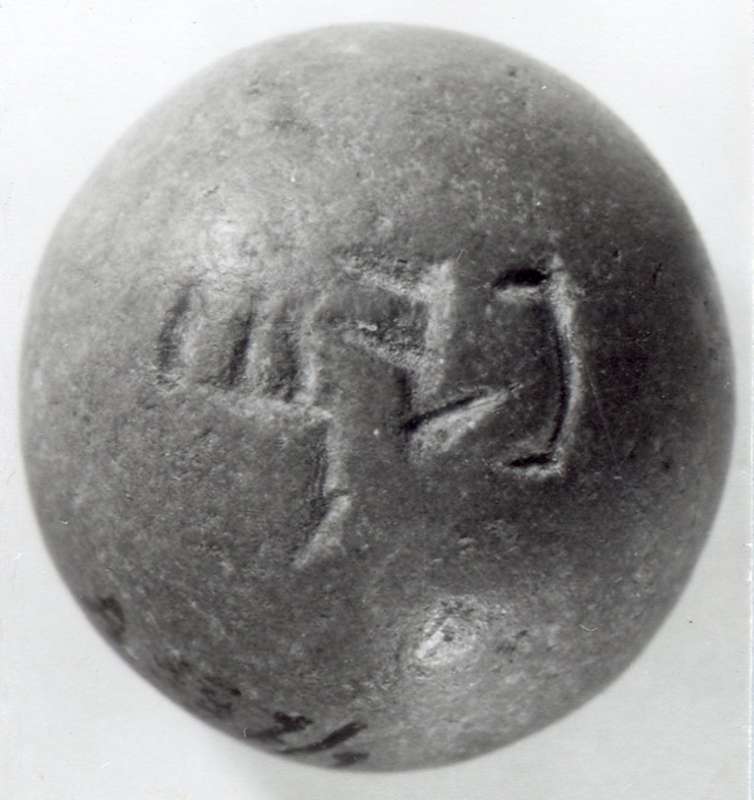
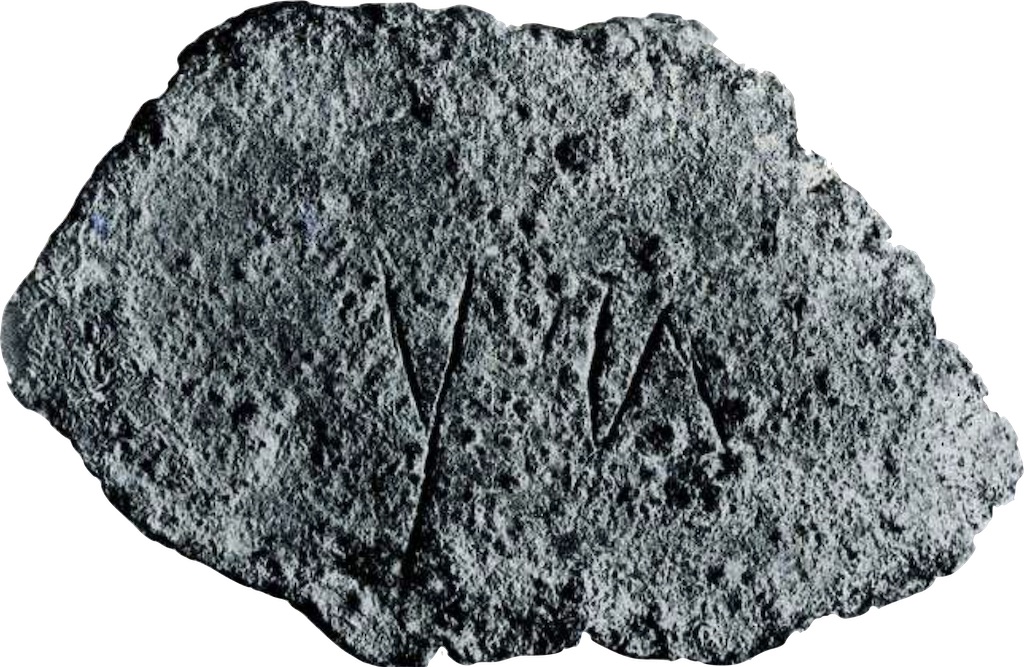
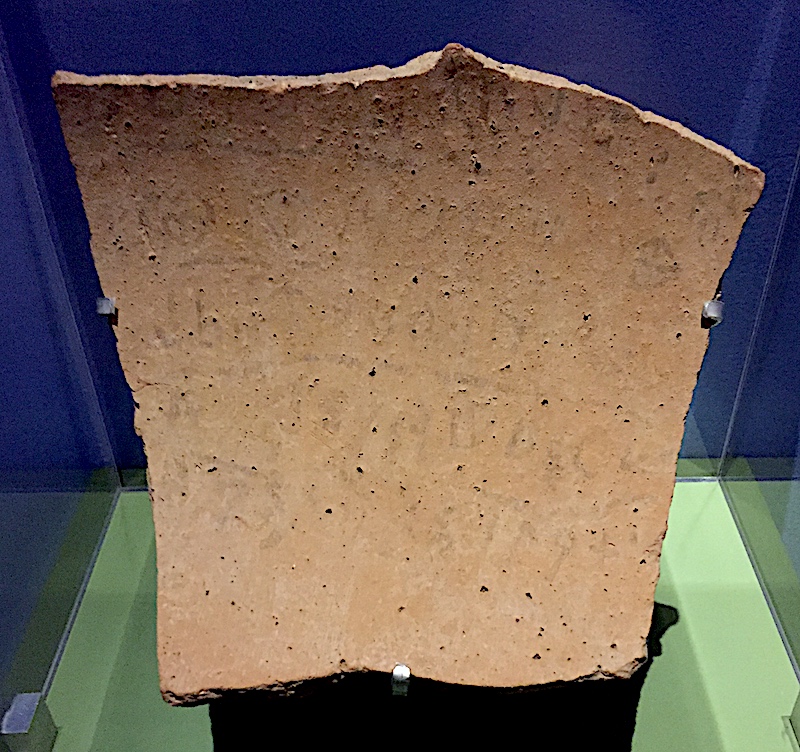
Amongst the season’s discoveries published by excavation director, Stewart Macalister, was a tiny, marble, dome-shaped weight of 7.27 grams, inscribed on which were the Hebrew letters פימ (“pim”).7 The significance of the artefact, at least as far as 1 Sa 13:21 goes, wasn’t realised at the time.
A few years later, in 1914, one E. J. Pilcher published the thoughts of Samuel Raffaeli, a money-changer-turned-antiquities-dealer-turned-travel-agent-turned-Keeper-of-the-Coin-Collection-of-the-Palestine-Archaeological-Museum.8 Raffaeli had been approached by a resident of village of Silwan in Jerusalem wanting to sell a small red stone weight inscribed with the Hebrew letters “pim”, weighing 7.75 grams. Raffaeli quickly made the connection between the “pim” in the biblical text of 1 Sa 13:21 and the “pim” on the weight he held in his hand. Based on this connection he suggested the following translation:
“And the payment was a payam for the mattocks and for the coulters, and a third of a shekel for the axes, and to sharpen the goads.”9
The word “payment” was a guess, as it remains to this day, but since the context is one of a weight it’s a pretty sensible guess.
The important point is this: “pim” could now be translated based on hard evidence, not just guesswork.
Effect on Bible translations
The discovery, linking “pim” with a weight, was picked up by bible translators very quickly indeed.
Only 3 years after Raffaeli’s thoughts were published in Palestine Exploration Quarterly, the Jewish Publication Society of America published The Holy Scriptures according to the Masoretic Text10 in 1917 and translated the verse in question,
“And the price of the filing was a pim for the mattocks…”
That’s a pretty short lag between archaeological discovery and influence on a bible translation.
Several decades later the Revised Standard Version included “pim” in its 1952 translation, removing “file” altogether:
“…the charge was a pim for the plowshares and for the mattocks…”
Now, instead of Israelites being able to do the maintenance of some of their farming implements at home, they can’t do any of it. There’s no more “Yet they had a file…” – the Israelites need to go to the Philistines for everything. That’s an important difference.
Further discoveries and clarification
Though “pim” is an improvement on “file” (!), it’s still not all that meaningful.
As usual, further discoveries helped to clarify things a little. Over time, more and more “pim weights” were discovered all over the Holy Land. Here just three of the more well known sites where excavators found them:
Having so many pim weights available for analysis, the relevant scholars found that they all weighed pretty much the same so they were able to confirm what Pilcher first claimed back in 1914, namely that:
“A pim, as we have seen, was the name for 2/3 shekel weight, or a little more than 14 oz.”14
Dictionaries, lexicons, and encyclopaedias started listing the same information:
Dictionary of Classical Hebrew: “equivalent to two thirds of an Israelite shekel”15
HALOT: “measurement of weight, two-thirds of a shekel”16
The New Encyclopedia of Archaeological Excavations in the Holy Land, Volumes 1–4 (Glossary): “ancient Judean weight, probably 2/3 of a shekel”
AYBD: “It is not impossible that it represents ‘two-thirds’ of the ‘shekel’ norm in the 11–13 gram range”17
Now practically certain that a pim weight represented two thirds of a shekel, translators started using that language:
NIV (1984): “The price was two thirds of a shekel for sharpening plowshares…”
NRSV (1989): “The charge was two-thirds of a shekel for the plowshares…”
NASB (1995): “The charge was two-thirds of a shekel for the plowshares…”
ESV (2016): “and the charge was two-thirds of a shekel for the plowshares…”
Is that an improvement on “pim”? Not everyone walks around with shekel-to-ounce/gram conversion tables in their head allowing them to read this passage without needing to check the footnotes/open a commentary. But, at least shekel is a common term in scripture that most bible readers have come across before and so have something to compare our passage’s “two thirds of a shekel” to.
Zooming out a little, it’s worth pointing out that the translation “The charge was two-thirds of a shekel for…” begins with a guess (“charge”), and continues with words that simply aren’t in the underlying Hebrew at all (“two-thirds of a shekel”).
In fact, the example of 1 Sa 13:21 is a case where the most meaningful translation is so foreign to the underlying words that you’d be forgiven for thinking that creators of interlinear bibles must have had some sort of stroke:
The interlinear function in Logos showing the complete mismatch between the English and Hebrew
And yet “The charge was two-thirds of a shekel for…” is a pretty accurate translation. Its only real flaw is that it doesn’t let the reader know that 2/3rds of a shekel was an exorbitant price to pay for the services the Philistines delivered.1819
Conclusion
So, this is all pretty interesting, at least if you’re me. Though I’ll admit that it might be a bit niche, this translation-by-archaeological-discovery is quite instructive. There are quite a few things this exercise can teach us:
There are words in scripture that no one knows the meaning of
It’s not unheard of for scholars to simply guess at the meaning of some words
Archaeological discoveries can shine a light on text that would otherwise remain beyond our comprehension
Sometimes “word-for-word” translation doesn’t give the reader the sense of a passage
Sometimes the best translation is one that doesn’t translate the original language at all but substitutes something altogether different to what a “word-for-word” translation would allow
Throw away your Strongs Concordance
Featured image
My (terrible) photo of three weights in the Israel Museum; the middle one is a pim weight discovered at Tel Arad.
Footnotes
Frederick E. Greenspahn, “Hapax Legomena,” The Anchor Yale Bible Dictionary (New York: Doubleday, 1992) 54. ↩
Biblia Hebraica Stuttgartensia, electronic ed. (Stuttgart: German Bible Society, 2003), 1 Sa 13:21. ↩
“The word is otherwise unknown, and the present translation is a guess from context.” P. Kyle McCarter Jr., I Samuel: A New Translation with Introduction, Notes and Commentary, vol. 8 of Anchor Yale Bible (New Haven; London: Yale University Press, 2008), 238. ↩
Jewish Publication Society of America, Torah Nevi’im U-Khetuvim. The Holy Scriptures according to the Masoretic Text. (Philadelphia, PA: Jewish Publication Society of America, 1917) ↩
Moshe Dothan, “Ashdod,” The New Encyclopedia of Archaeological Excavations in the Holy Land (New York; London; Sydney; Tokyo; Singapore; Toronto; Jerusalem: Israel Exploration Society & Carta; Simon & Schuster, 1993) 100. ↩
McCown, Chester C., Tell en-Naṣbeh: Excavated Under the Direction of the Late William Frederic Badè, Vol. 1: Archaeological and Historical Results (1947), 163-164. https://hdl.handle.net/1813/103953↩
Dever, William G., “Iron Age Epigraphic Material from the area of Khirbet el-Kom,” Hebrew Union College Annual 40/41 (1969-1970): 180. https://www.jstor.org/stable/23503260 Dever, William G., “Iron Age Epigraphic Material from the area of Khirbet el-Kom,” Hebrew Union College Annual 40/41 (1969-1970): 180. https://www.jstor.org/stable/23503260↩
Clines, David J. A. (Sheffield, 1993) Dictionary of Classical Hebrew, Vol. 6, 682. ↩
Ludwig Koehler et al., The Hebrew and Aramaic Lexicon of the Old Testament (Leiden: E.J. Brill, 1994–2000), 926. ↩
Marvin A. Powell, “Weights and Measures,” The Anchor Yale Bible Dictionary (New York: Doubleday, 1992) 906. ↩
“Virtually all versions leave uncertainty in the minds of the reader as to whether the charges of the Philistines were reasonable or exorbitant. This would not have been a question to the original readers and hearers. They would have known that the prices were unreasonably high.” Roger L. Omanson and John Ellington, A Handbook on the First Book of Samuel, UBS Handbook Series (New York: United Bible Societies, 2001), 268. ↩
“Since the customer had no other option, a high price could be asked.” Joyce G. Baldwin, 1 and 2 Samuel: An Introduction and Commentary, vol. 8 of Tyndale Old Testament Commentaries (Downers Grove, IL: InterVarsity Press, 1988), 114. ↩
]]>Biblical Historical ContextThe Black Obelisk’s journey from Nimrud to London2022-12-31T23:01:00+00:002022-12-31T23:01:00+00:00https://biblicalhistoricalcontext.com/artefacts/black-obelisk-journey-from-nimrud-to-londonWhile preparing my next Beyond Apologetics video on the Black Obelisk of Shalmaneser III, I got a bit distracted reading up on how the artefact was transported from Nimrud in Iraq where it was discovered to the British Museum. One minute I’m reading about the trench it was found in, the next minute I’m reading 19th century shipping logs of the East India Company. Since all the info I found was completely inconsequential to the stuff I usually cover in the Beyond Apologetics videos, I decided to split this stuff out into a separate, uber-niche, and super-nerdy post dedicated to the Obelisk’s journey. It should be interesting to about 3 people.
So, why write this up at all? Well, because it’s given me a new perspective: I’ve visited many museums around the world; I’ve seen a bazillion artefacts; I’ve read up on their significance; I’ve made little notes in my bible about the context they add to whatever passage I’m looking at; and I’ve spoken at various churches showing how archaeological artefacts can help us interpret scripture better than we otherwise might.
But, I’ve never once considered how these artefacts actually got from where they were found, to the museum they’re displayed in. At least, not until I recently read through Austen Henry Layard’s “Nineveh and its Remains”. The book is pretty wild –the man was a proper adventurer it seems, –a real Allan Quatermain figure– but the bit that piqued my interest was his description of how he transported the obelisk. It’s crazy stuff.
But, as far as Layard’s book goes, as soon as the obelisk is sent from Nimrud the trail goes cold. Wanting a little more detail, I decided to pick up the obelisk’s trail and see how things turned out. And, well, it turns out that it’s a miracle that the obelisk made it to London at all.
Let’s get started.
Discovery
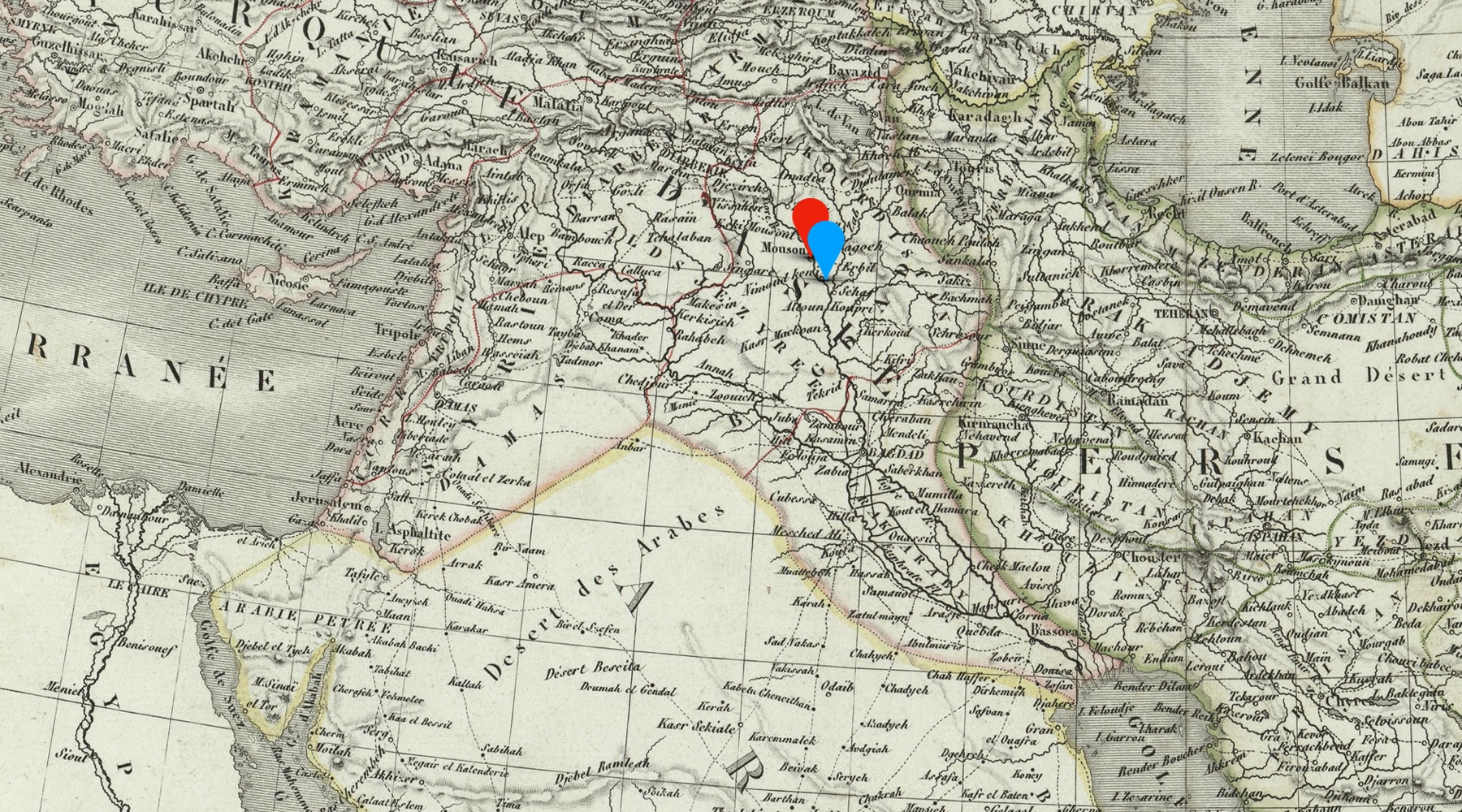
In November 1845, a man whose name is well known to anyone with even a passing interest in Assyriology, arrived in Mosul – a town in modern day northern Iraq, in the area known at that time as “Turkish Arabia”.
Red pin is Mosul, Blue pin is Nimrud. Lapie, M. (Pierre), 1779-1850. Carte de la Turquie D’Asie de la Perse de l’Afghanistan et de l’Arabie / dressée par M. Lapie, Colonel et M Lapie fils Capitaine d’Etat Major ; gravé par Pierre Tardieu. Paris: Imprimé chez Kaeppelin, 1842 Scale [ca. 1:10,400,000].
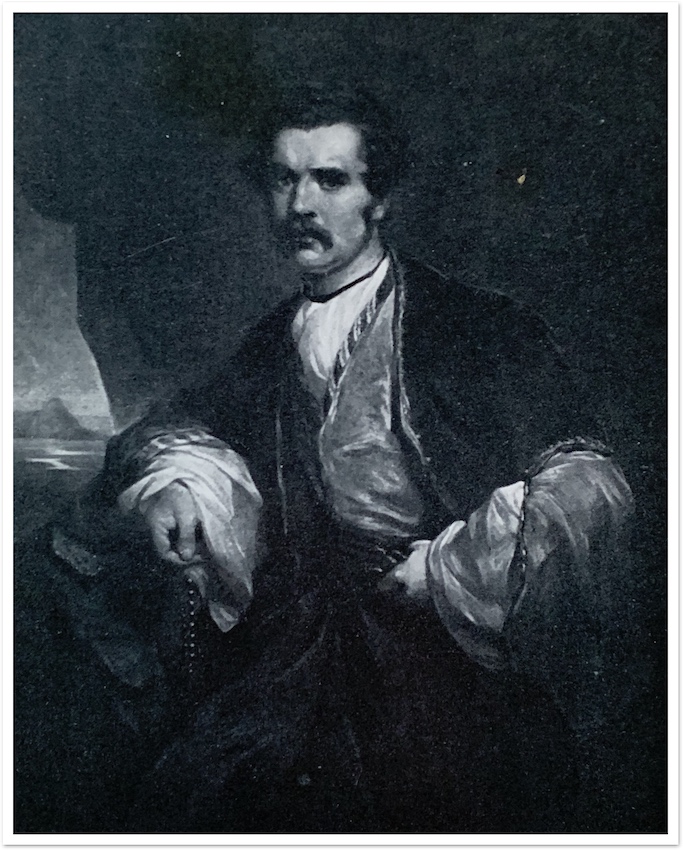
Austen Henry Layard, according to one of his friends, was the man for the task at hand. He was described by one guy as being “excellently fitted for the work of an explorer and excavator, strong, robust, determined, … active, energetic, and inured to hardship by his previous travels in wild regions.”1
Our protagonist, Austen Henry Layard in Albanian dress. Austen Henry Layard, Nineveh and its Remains, ed. H. W. F. Saggs (New York: Praeger, 1970).
And that’s what Layard had come for – to excavate a site he’d come across on his previous trips. Funded by Sir Stratford Canning, the British ambassador to Constantinople2, Layard’s objective was to excavate Nimrud, a site down the river from Mosul that at the time he thought was Nineveh. It would be quite a while before he figured out that Nimrud wasn’t Nineveh, but that’s a different story.
On November 8th 1845, after presenting his credentials to the local government3 and telling the locals that he was sailing downstream to hunt wild boars, Layard hopped on a raft he’d hurriedly built for the occasion, and floated down the Tigris. Around 5 hours later Layard arrived at Nimrud, disembarked, and had a wander around.4
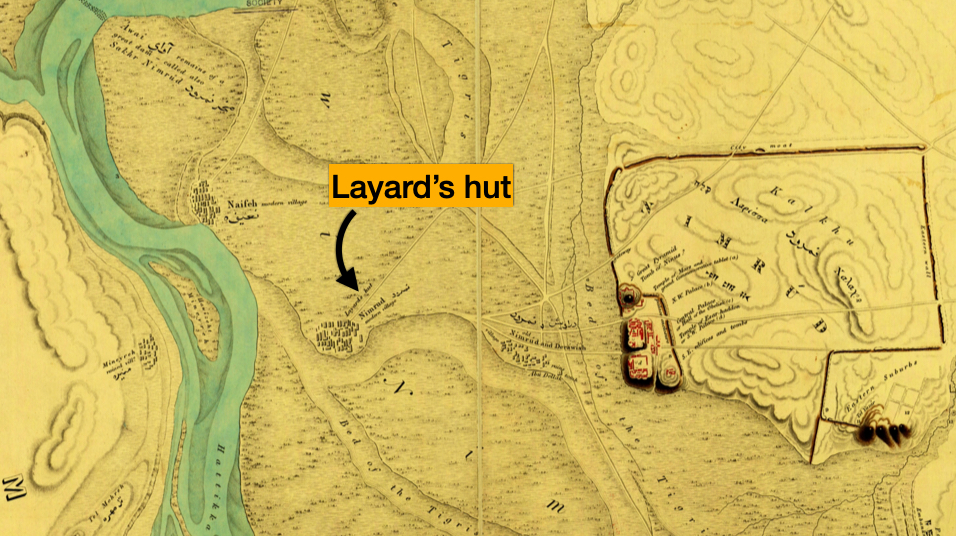
After a few days poking around, he set up camp – you can see it on the following map, very close to the mound of Nimrud where he was excavating.
An early map of Nimrud - note the Tigris river, Layard’s campsite, and ancient Nimrud. Felix Jones, ‘Vestiges of Assyria, sheet 2d shewing the positions and plan of the ancient cities of Nimrud and Selamiyeh’ (1855).
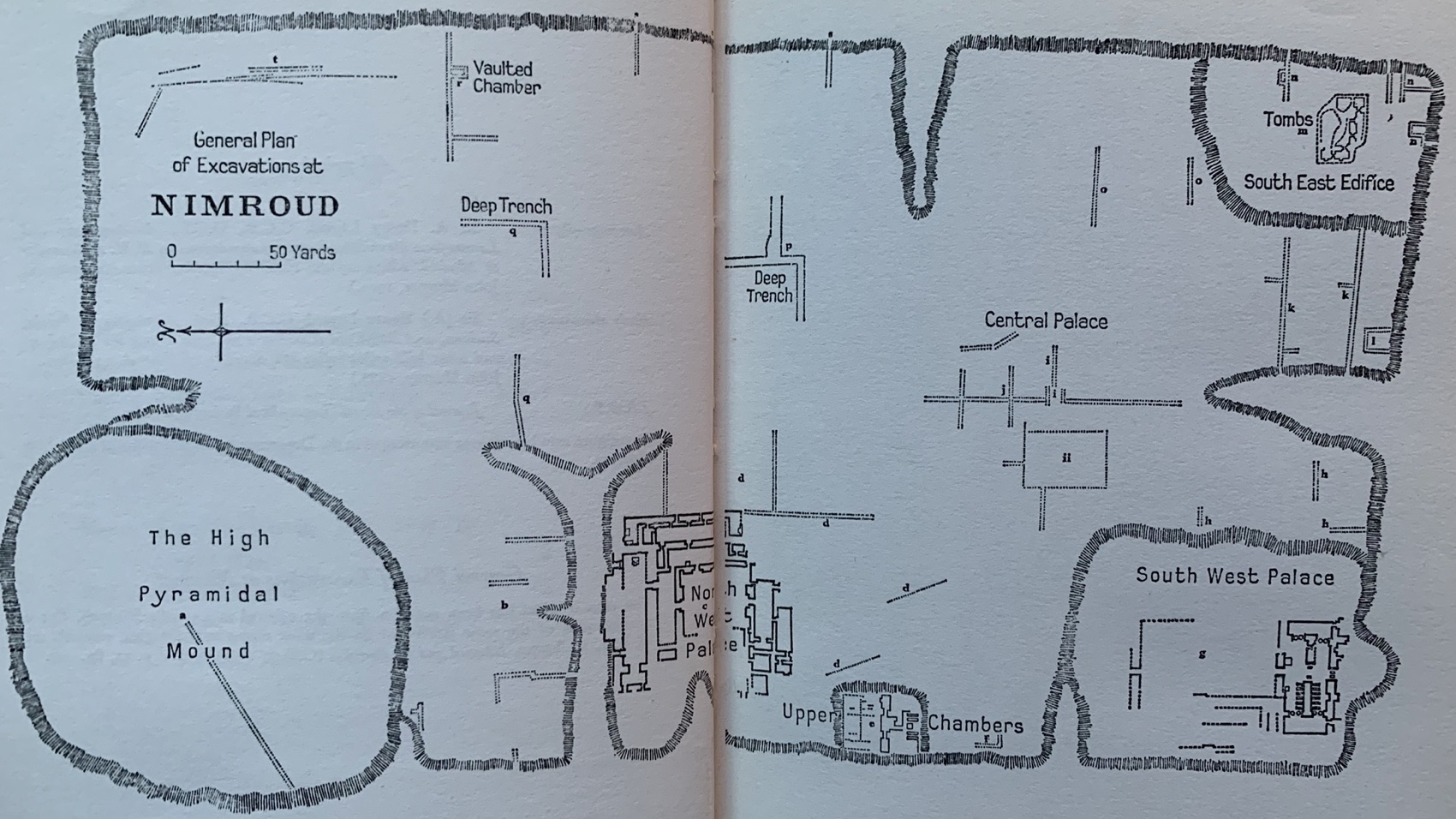
For several months he and the local workmen he’d hired for the job made great progress, focusing mainly in a couple of areas – excavating what are now known as the North-West and South-West palaces. He also opened experimental trenches all over the mound5 and found some pretty awesome stuff in them too.
‘General Plan of Excavation of Nimroud’ - Austen Henry Layard, Nineveh and its Remains, ed. H. W. F. Saggs (New York: Praeger, 1970), Plan 1.
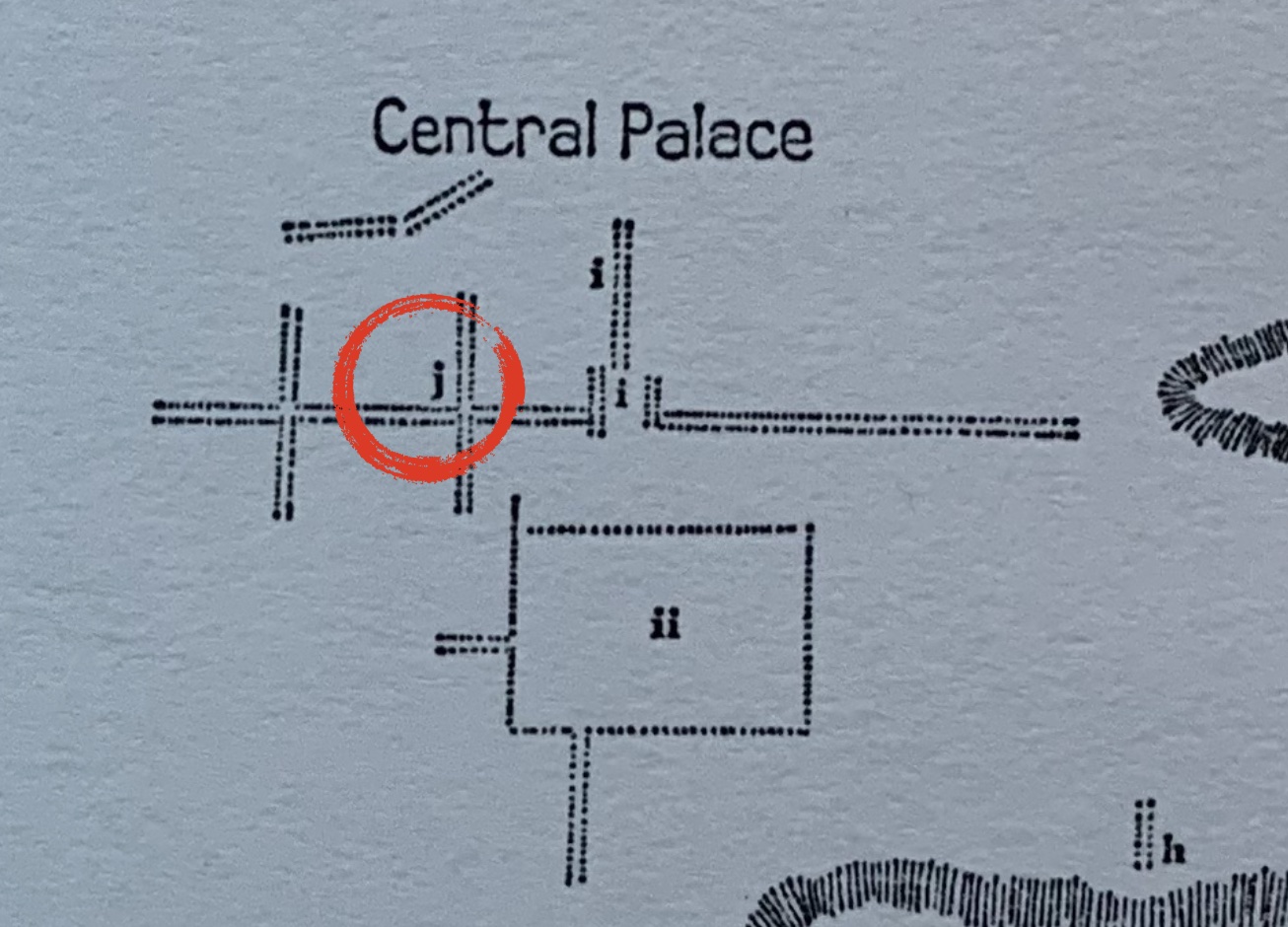
One of these experimental trenches was dug in the “central area” of the mound, marked ‘J’ on Layard’s maps:
Area J from the map above.
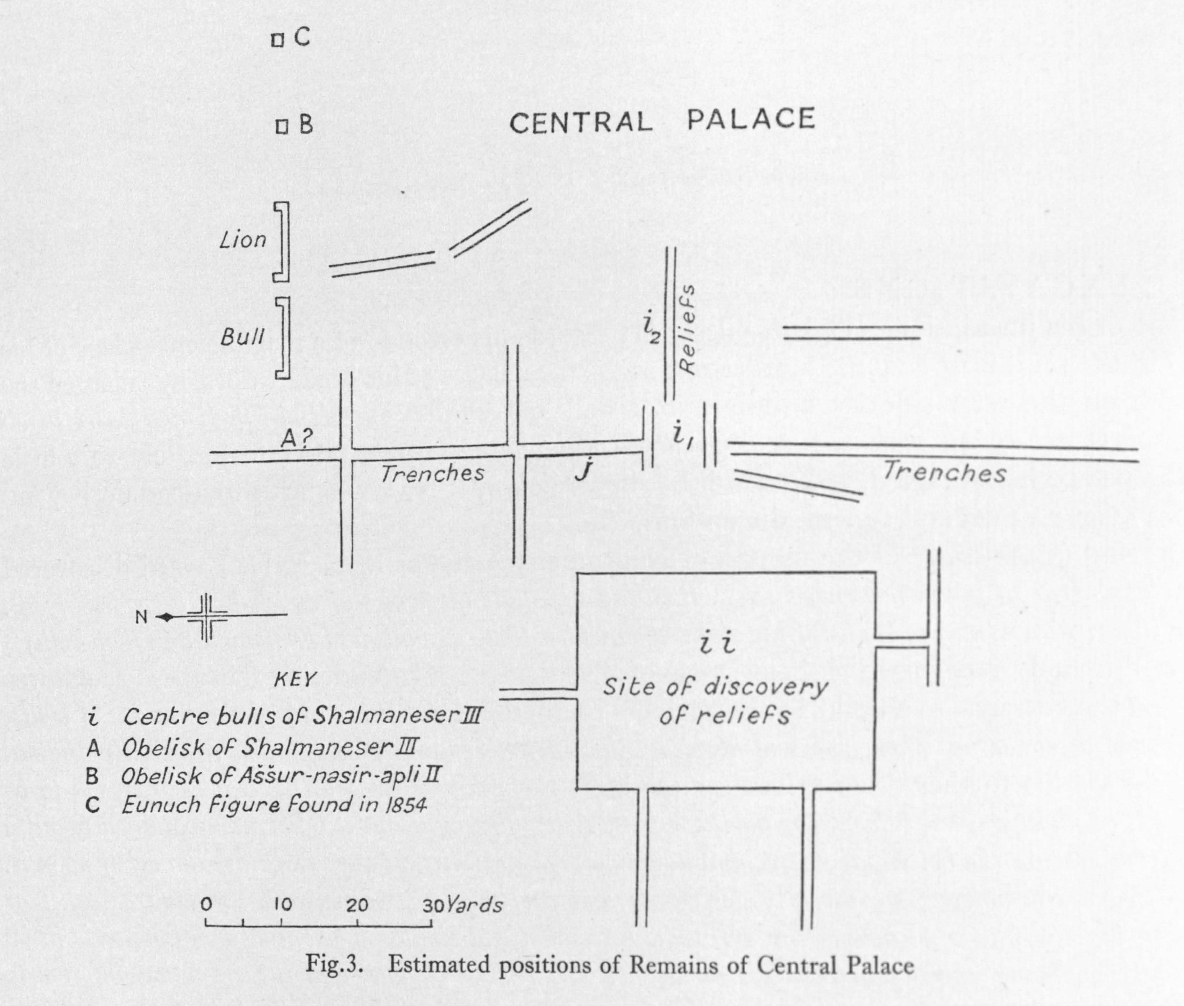
There they found “part of a pair of gigantic winged bulls, the head and half the wings of which had been destroyed”.6 Bizarrely, because Layard’s maps weren’t all that accurate, nor was his description of where the “central area” was located on the mound, excavators that came after Layard couldn’t locate these “central area” trenches. It would be more than 125 years after they were first dug that the trenches would be rediscovered in the Polish excavations of 1974-1976’ second season.7
Note annotation ‘A’ from ‘Fig. 3. Estimated Positions of Remains of Central Palace’, Barnett, R.D. & Falkner, M. (1962) - The Sculptures of Assur-nasir-apli II, Tiglath-pileser III, Esarhaddon from the Central and South-West Palaces at Nimrud.
Over the course of his excavations Layard suffered various delays, mainly at the hands of the local authorities. The worst of it was over the summer of 1846 when he was completely stalled, but, after some negotiations Layard was able to get back to it.
On November 1st 18468, he had his working parties start digging at a number of different places on the mound, including back in the trench marked “J” in the “central area” where around the same time the year before he’d found the remains of those two winged bull statues.9 Nothing of any interest was found there, so he had his men dig a trench behind one of the bulls and follow it along for several days. When it reached around 50 feet long, Layard almost gave up on the trench. He let the workmen continue with it while he had business for a day back in Mosul deciding that if they’d still found nothing by the time he returned that he’d give up on the trench.10
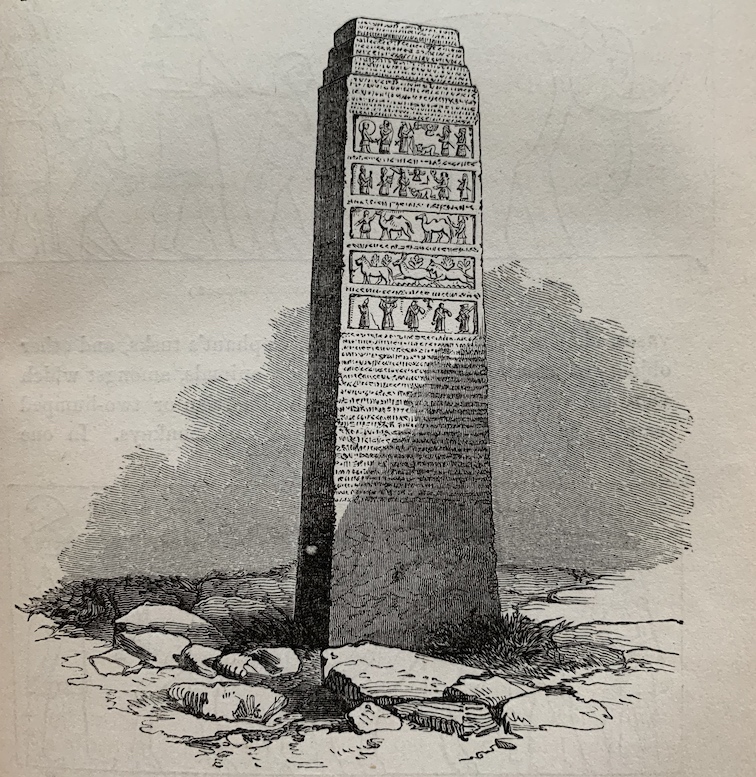
After giving his men instructions Layard galloped off for Mosul. He’d hardly gone far at all when, back in the trench, his workmen found the corner of what ended up being the Black Obelisk. They uncovered the 6 foot length of it and the superintendent sent someone after Layard, who turned back straight away. On his return Layard and his men pulled the obelisk out of the trench using ropes, and stood the obelisk upright.11
The Black Obelisk standing upright. Austen Henry Layard, A Popular Account of Discoveries at Nineveh (London: 1851), 225.
And, that was the only thing they found in that 50 foot long trench. The excavations run by the British School of Archaeology in Iraq in 1952 dug in what they hoped was the same area of Layard’s “central area” trench but also found nothing.12 The trench produced one obelisk. That’s it.
But what an obelisk! In a letter to his aunt Sarah Layard wrote that the “most remarkable discovery”, referring to the obelisk, was “one of the most interesting and unique monuments of antiquity”.13 Layard’s colleague Rawlinson, downriver in Baghdad, who we’ll meet in a couple of minutes, wrote to Layard exclaiming that he considered it, “the most notable trophy in the world and would alone have been well worth the whole expense of excavating Nimrud.”14 So, the obelisk was a big deal, and remains a big deal to this day.
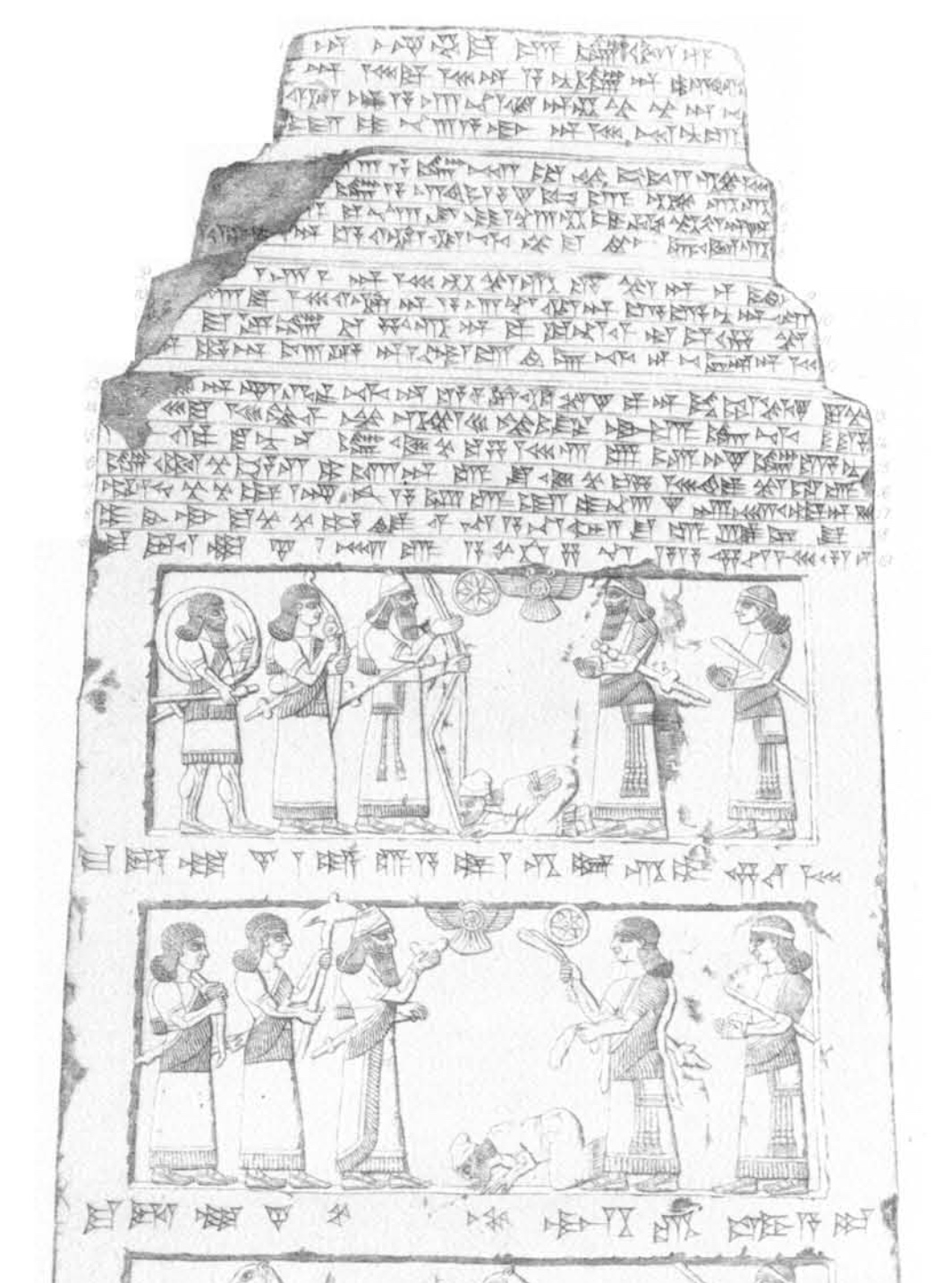
As soon as Layard and his men had yoinked the obelisk out of the trench, he set about taking rubbings of it, as well as sketches which he published a couple of years later in a beautifully produced book, imaginatively named “The Monuments of Nineveh, from drawings made on the spot”.15
Sketch of the Black Obelisk in Austen Henry Layard, The monuments of Nineveh, from drawings made on the spot (1849), Pl. 53.
After making his sketches, Layard packed up the obelisk ready to be transported with the next batch of artefacts addressed to the British Museum, and, as he explains in his book, “A party of trustworthy Arabs were chosen to sleep near it at night; and I took every precaution that the superstitions and prejudices of the natives of the country, and the jealousy of rival antiquaries, could suggest.”16 He wasn’t taking any chances. The obelisk was not going to get robbed.
From Nimrud to Basrah
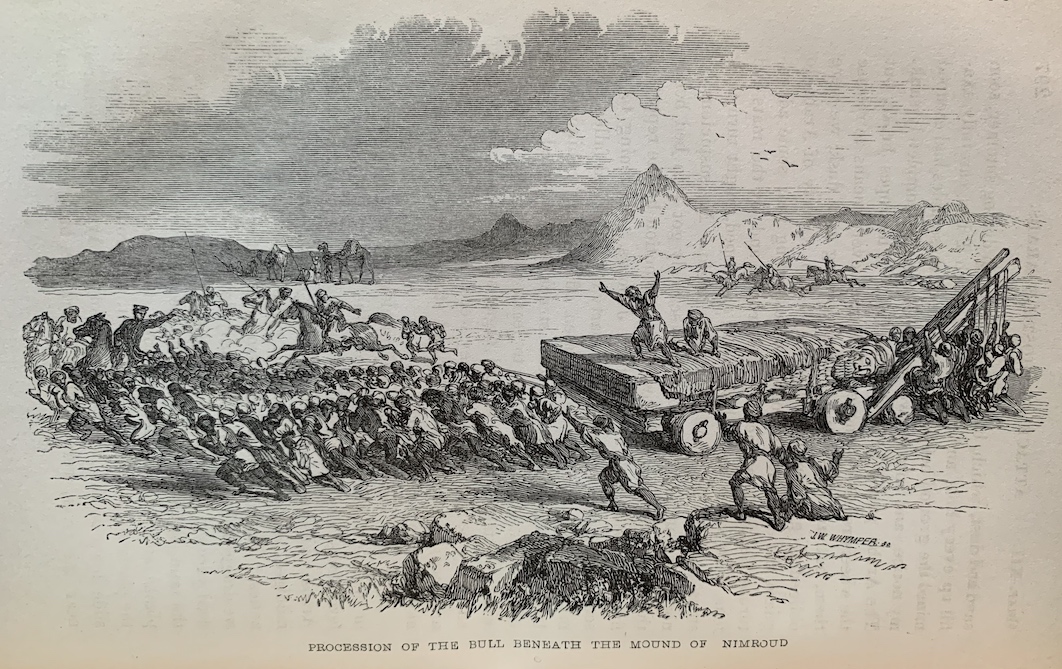
A few weeks later the consignment was ready – Christmas day was the day. In what is the closing scene of his book Layard describes how he had his men load all the artefacts onto what he described as “rotten and unwieldy” buffalo carts that would cover the short distance from the mound of Nimrud to the Tigris river, and how at the river bank he had them loaded onto rafts bound for Baghdad.17
The buffalo carts being used to transport one of the bull statues; the transportation of the obelisk would have been a similar sight. ‘Procession of the Bull beneath the mound of Nimroud’, Austen Henry Layard, A Popular Account of Discoveries at Nineveh (London: 1851), 296.
The last line of his book goes like this: “I watched them until they were out of sight, and then gallopped [sic] into Mosul to celebrate the festivities of the season, with the few Europeans whom duty or business had collected in this remote corner of the globe.”18 What a life.
As mentioned previously, this is where the obelisk’s trail goes cold in Layard’s book. Thankfully, at least for this nerd, there’s a whole ton of documentation that illustrates what happened to the obelisk between Nimrud and the British Museum. We’re going to get into that now.
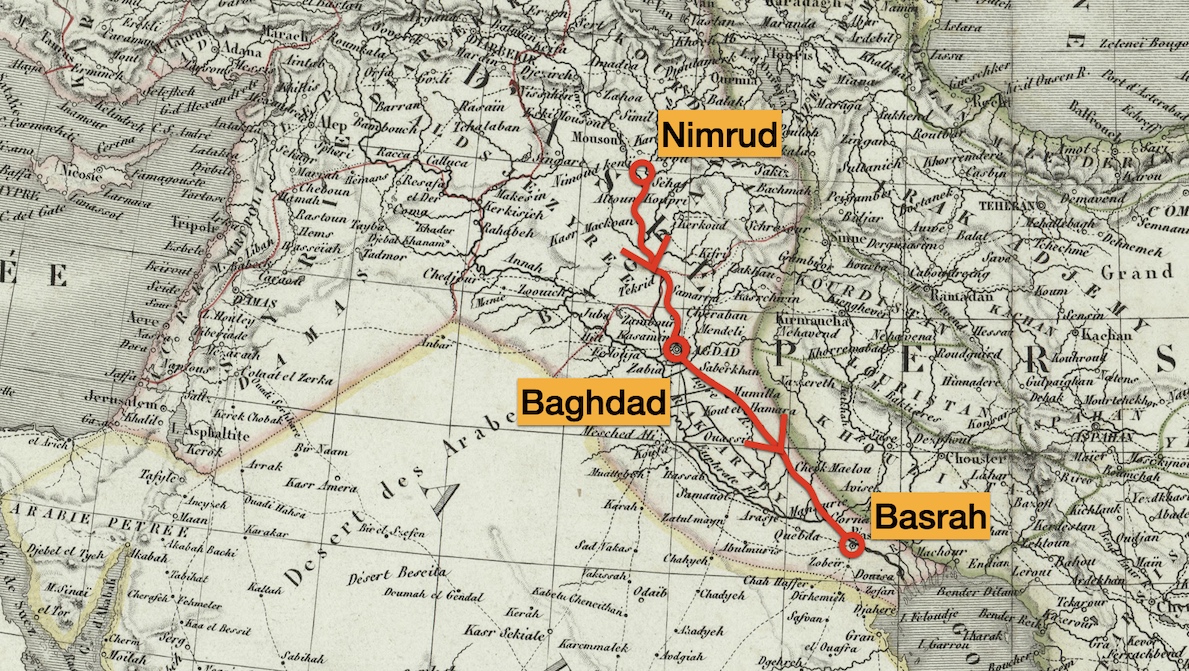
The obelisk’s journey from Nimrud to Basrah, via Baghdad.
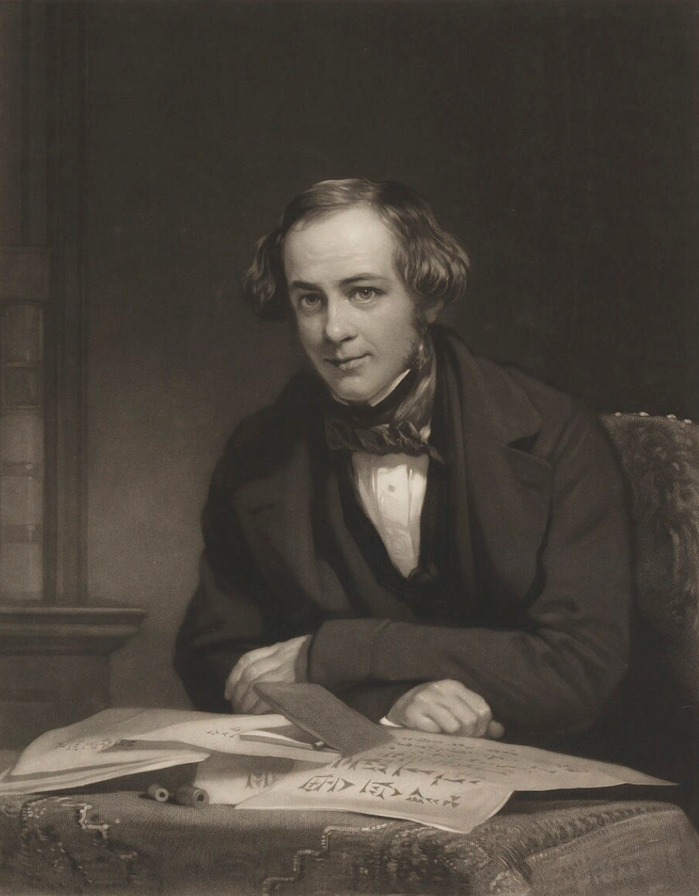
The first stop on the journey was the capital, Baghdad. When the rafts from Nimrud arrived in early January 1847 they were received by Sir Henry Creswicke Rawlinson, a political agent and employee of the British East India company, stationed in Baghdad. He was also quite the “Orientalist”, and explored ancient sites, copied inscriptions, and worked on the decipherment of cuneiform writing – there’s a bit of intrigue in that last bit, with Rawlinson getting a bit more credit than he actually deserved, but that’s a story for another time.
Sir Henry Creswicke Rawlinson, by Samuel Cousins, published by Paul and Dominic Colnaghi & Co, after Henry Wyndham Phillips.
With Rawlinson stationed at Baghdad, he took charge of the artefacts Layard had floated downstream, sending them on to the port city of Basrah. But, before sending them on, Rawlinson took some liberties. British Assyriologist Cyril Gadd writing a couple of generations later tells us that Rawlinson inspected the artefacts “with the interest of one who was conscious that they meant more to him than to any other man living”.19 Rawlinson’s son, in his father’s biography wrote that, “Rawlinson was enjoying the full advantage of free access to the Ninevite treasures on their passage through Baghdad to England… In letters to the Royal Asiatic Society dated January 23, June 19, and November 3, 1847, he began the publication of his views on the subject of the Assyrian alphabet and language, and especially gave an account of the inscription of the famous ‘Black Obelisk’…”20
It does seem like in at least the first of these letters to the Royal Asiatic Society he requested that their contents remain confidential21, but still that’s out-and-out intellectual property theft, and from other stuff I’ve read it seems pretty characteristic of Rawlinson. Not sure that sort of thing would be tolerated in academic circles today…
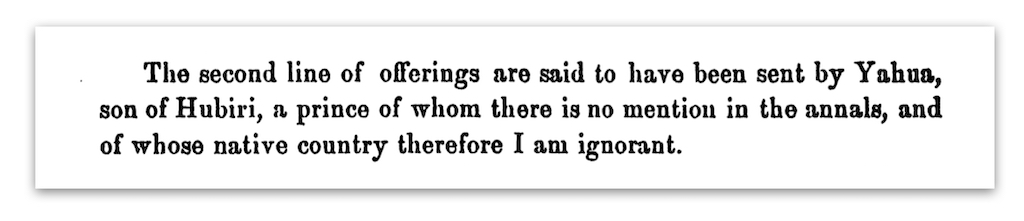
Rawlinson’s thoughts on the sentence on the Black Obelisk that mentions ‘Jehu son of Omri’, or, as Rawlinson translated it, ‘Yahua son of Hubiri’. Close, but no cigar. Henry Creswicke Rawlinson, ‘On the Inscriptions of Assyria and Babylonia,’ Journal of the Royal Asiatic Society of Great Britain and Ireland, Vol. 12 (1850): 447.
So, the obelisk’s journey didn’t get off to a good start. But, at least once Rawlinson was done taking his liberties, he did put the artefacts back on “native river craft” and sent them downstream to Basrah, and on arrival in April (1847) they were stored in the East India Company’s naval depot ready for onward shipping.22 And that was the next hurdle.
To Bombay after long delay
Steam ships weren’t really yet a thing, and it would be more than 20 years before the Suez Canal was opened, so to get to London the Obelisk was to take the normal form of global transport in what was known as the Age of Sail – a sailing ship. But to get on a proper sail ship the obelisk first had to make its way to a major port. The closest one to Basrah was 3,000 km away in Bombay, or as it’s known today, Mumbai. So, getting to Bombay was the plan.
But, for now, the obelisk along with the rest of the artefacts it floated down river with, was stuck in Basrah. As Gadd notes, “conveying [the obelisk] farther, on the way to Bombay or England, proved a difficult problem,”23 because “trade was almost completely stagnant in the Gulf at that time, and the visit of any European vessel to Basrah a rarity.”24 So the artefacts collected dust in some storage unit in Basrah’s East India Company naval depot. Occasionally a ship large enough to transport the artefacts came into port, but for one reason or another the instruction to transport the artefacts wasn’t received by the captain, or was just plain ignored.25
Spring turned into summer; autumn came and went, and by December Layard was back in London having travelled via Constantinople, Italy, and Paris.26 In the same month, out of exasperation I presume, Rawlinson came down from Baghdad to Basrah. In what was great timing, while he was there the East India Company Sloop-of-War Clive arrived at the port. Rawlinson instructed the captain to transport the artefacts to Bombay who responded that he’d do the best he could. But, Sloops-of-War weren’t big ships and he was only able to take 20 cases, and, only as far as Bushehr in what today is modern Iran – a measly 350km of the 3000km journey to Bombay.27
At least, the obelisk was finally on its way – a good job too as the next shipment of artefacts wouldn’t take place for another year!28
A Sloop-of-War (not the Clive)
As the captain of the Clive agreed, they transported the cases as far as Bushehr, unloading Layard’s artefacts there. Fortunately for Layard, Senior Naval Officer Captain William Lowe had sailed into Bushehr harbour on the 1st of January 1848 after a successful mission retrieving a couple of boats that had been stolen by some local sheikh.29 Layard’s artefacts, including the obelisk, were loaded onto Captain Lowe’s ship; another Sloop-of-War named the Elphinstone.
An obscure passage in Volume 2 of Charles Rathbone Low’s History of the Indian Navy explains that sometime in January the Elphinstone set off with the obelisk on board, arriving in Bombay sometime later in January.30 (Not the same Low as captained the Elphinstone)
And it’s in Bombay where things really start going wrong.
Barbarity in Bombay
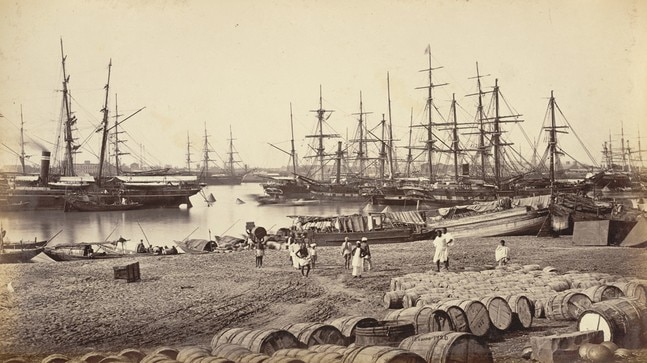
It’s not exactly clear what precise date the Elphinstone arrived in Bombay harbour, but a report on the 5th of February 1848 in the Fine Arts column of the London paper The Athenaeum reports on a report in the Bombay Times reporting on the arrival of “cultured slabs from Mosul, forwarded by Major Rawlinson to the Governor”.31
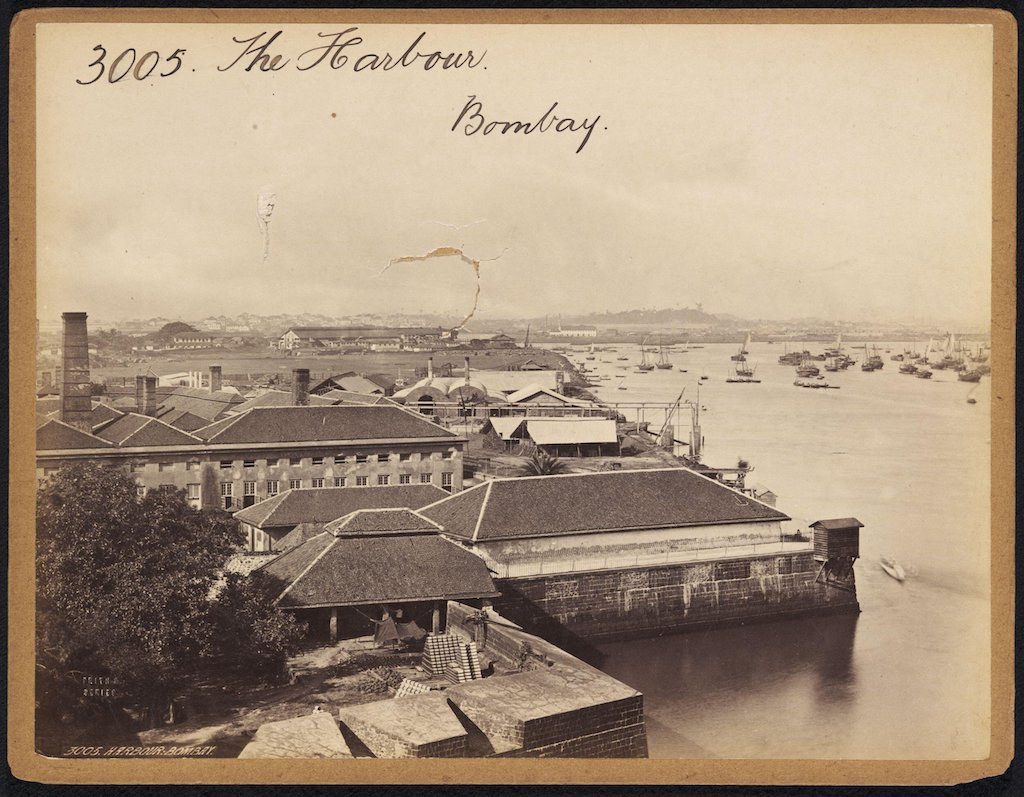
Bombay Harbour, Francis Frith
When Layard first read this report he was so confused by its garbled details that he didn’t know if the report in question was about his artefacts at all!32
It was the chain of command in the British Empire’s hierarchy that the Resident at Baghdad reported to the Governor at Bombay,33 so regardless of the fact that the cases of artefacts were addressed to the Trustees of the British Museum, Rawlinson had sent the artefacts to Bombay for the attention of “The Governor”34. The Governor of Bombay was one George Russell Clerk.35
On the Ephinstone’s arrival the cases that had been so carefully packed by Layard and repacked by Rawlinson were unloaded onto the dockside and unceremoniously opened by Clerk’s people.
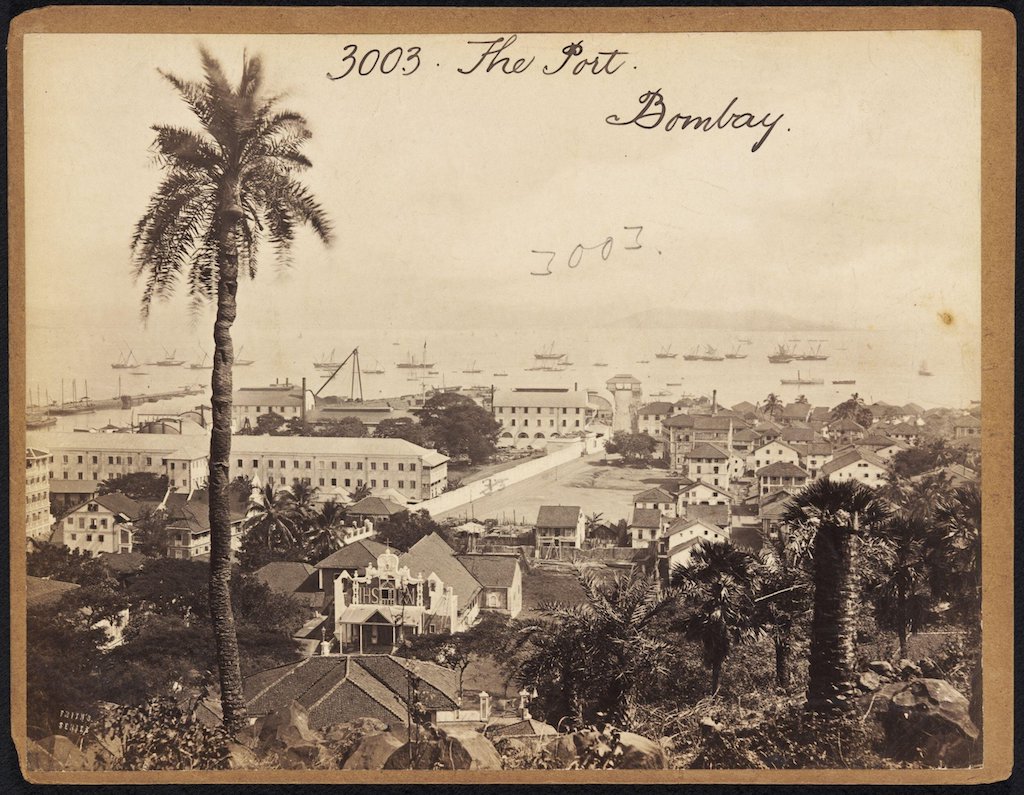
The Dockyard in the Port of Bombay, Francis Frith
Again, a note in The Athenaeum’s “Fine-Art Gossip” column helps to fill in the gaps. June 24th 1848’s column36 brought its readers’ attention to a Bombay Times article mentioning an exhibition of Layard’s Artefacts. And, it wasn’t just one or two small items that were on display; from the description given in the Bombay Times article quoted by The Athenaeum, it was loads of items. But for our purposes, here’s the interesting part: after listing off all sorts of items the Bombay Times article mentions,
“The principal object of attention was a beautiful obelisk of black marble, six feet high, and in the most perfect state of preservation, – the polish unaffected by three thousand years of inhumation, and the lustre hardly gone”37 and then it goes into an accurate description of the Black Obelisk.
Now, if you think these objects were displayed in some temporary exhibition in a properly equipped museum, you’d be wrong. They were displayed in the dockyard.38
The person responsible for the artefacts’ display was one Dr. George Buist: a preacher, the Editor of the Bombay Times39, “the city’s leading scientist”40, a frequent contributor of scholarly articles to the Journal of the Bombay Branch of the Royal Asiatic Society, and a Fellow of the prestigious Royal Society41. Not only did he exhibit the artefacts on the dockside, he lectured on the Obelisk at the monthly Meeting of the Bombay Royal Asiatic Society.42
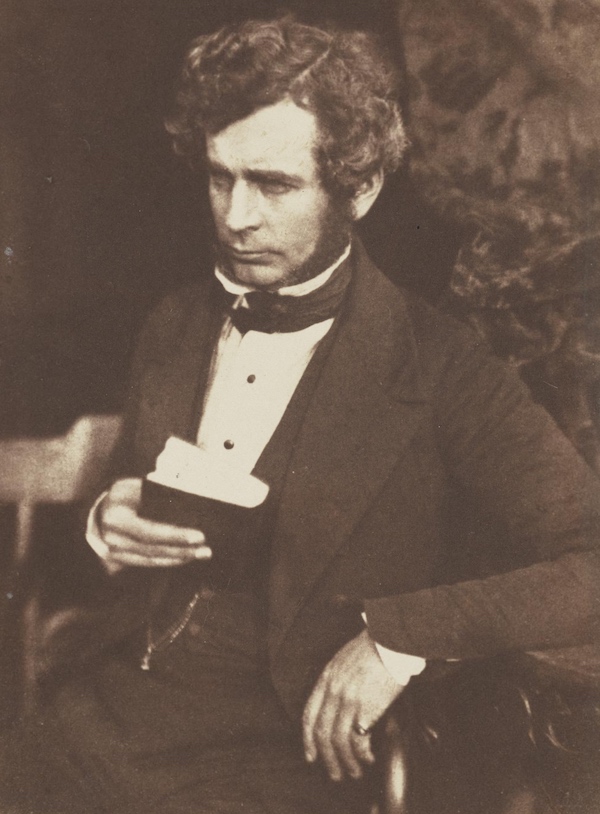
Dr George Buist, 1805 - 1860. Editor of the Bombay Times.
Then, after not only exhibiting the obelisk at the dockside and lecturing on it, Dr Buist had the audacity to add yet further to the “unjustifiable liberties”43 he’d taken with Layard’s discoveries. Instead of shamefacedly and very carefully repacking the obelisk and other artefacts and sending them on their way, he arranged for a number of plaster casts of the obelisk to be taken. But, of course, this was fine because before doing so he gave “a personal pledge that no harm could result”44 from taking an unpublished artefact delicately inscribed in a writing system that had yet to be properly deciphered and covering it with Plaster of Paris, waiting for it to dry, and then ripping it off.
What a cretinous collection of colonialist clowns.
Thankfully, nothing did go wrong with the plaster casts. Sadly, some of the artefacts displayed at the dockside didn’t fare so well at the hands of those who came to look at the artefacts – many of them were stolen. A few of the items have been tracked down and retrieved or handed back in; so let’s go on a museum junky tangent…
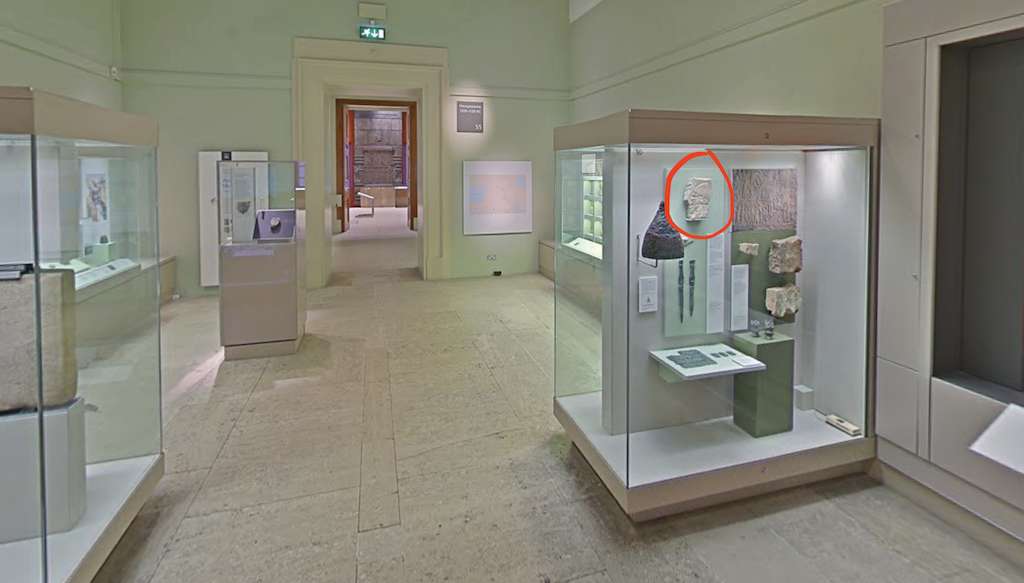
More than fifty years after their discovery, in 1897, one Miss H. G. Wainwright “donated” to the British Museum a number of artefacts that she’d inherited from her father, William Wainwright, who’d been in Bombay at the time Layard’s artefacts were being exhibited in the dockyard.45 Most of the artefacts she donated are boxed up in the museum’s archives, but a couple of them are on display.
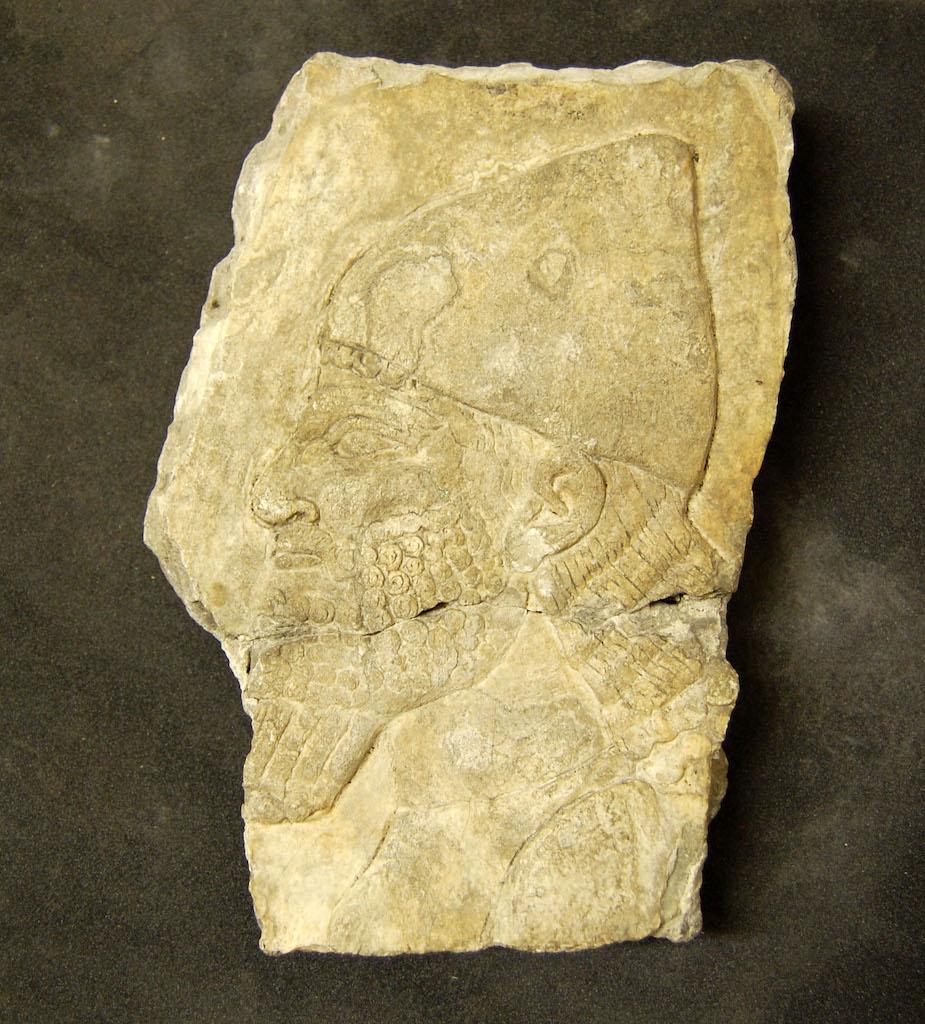
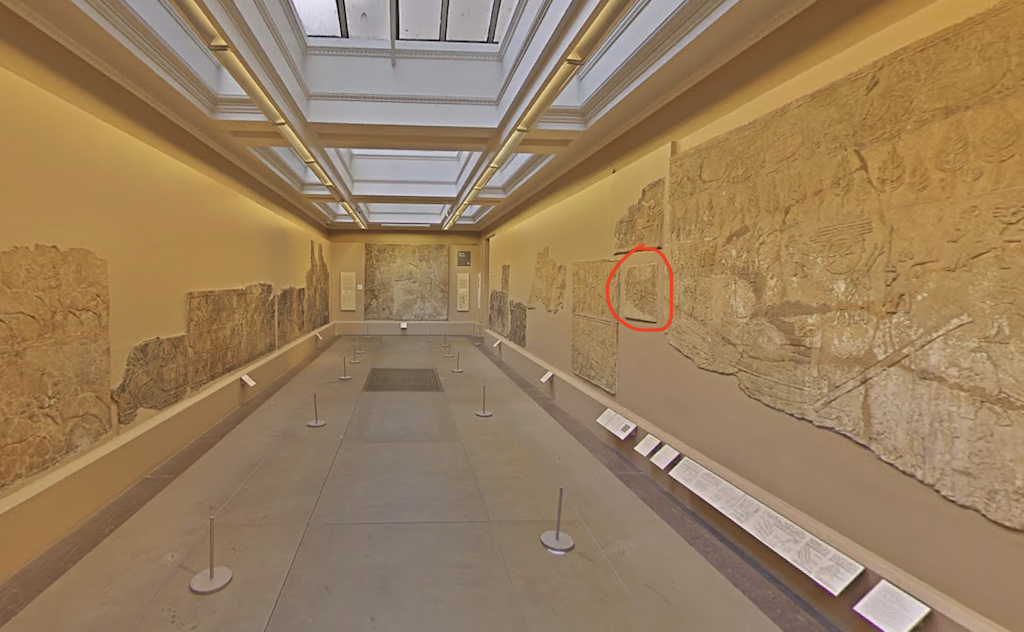
The first of these artefacts that you can go see for yourself is a cracked relief of some guy’s head46, on display in room 56, very close to the famous Flood Tablet:
The location in the British Museum’s Room 55 of the limestone relief of a male head ‘donated’ by H. G. Wainwright. Screenshot from Google Maps
I’ve not been able to find anything that explains why the relief is cracked, so I like to imagine it’s because William Wainwright couldn’t otherwise fit it under his jacket as he wandered away from the dockside where he robbed the artefacts, so he quietly karate chopped it behind the Black Obelisk before stuffing it under his jumper and sauntering off.
Limestone relief of a male head, handed in by H. G. Wainwright decades after her father allegedly robbed it from the Bombay dockyard.
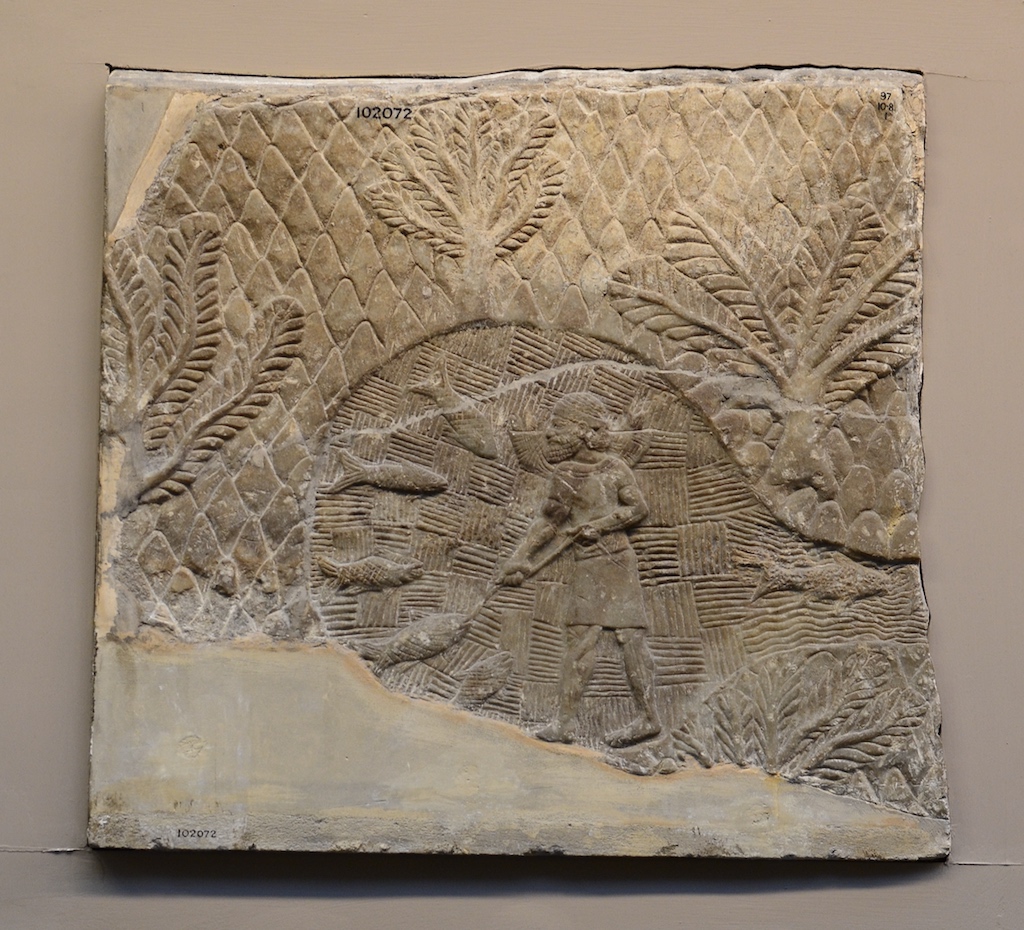
The second of the artefacts Wainwright pilfered is displayed in the Museum’s “Assyria: Nineveh” area near the end of room 9, directly below the well known Phoenician ship relief:47
The location in the British Museum’s Room 9 of the ‘Man catching fish’ relief ‘donated’ by H. G. Wainwright. Screenshot from Google Maps
It’s of an Assyrian male fishing in a pond. It’s quite cool to see it listed on Layard’s manifest in his book – it’s item 74.48 It’s a beautiful little fragment – for years I’ve enjoyed it every time I’ve walked through this gallery though I never knew the backstory to it.
The ‘Man catching fish’ relief
Cyclones to Ceylon
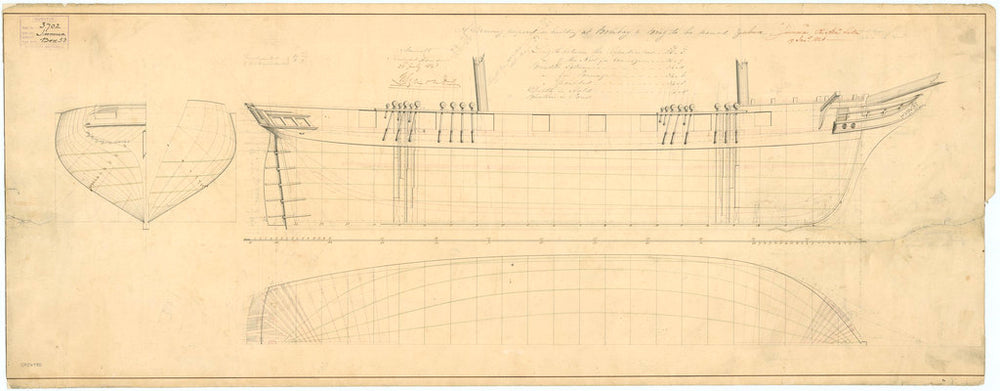
Anyway, all this time that the Obelisk had been on the dockside at Bombay harbour, workmen in the same harbour had been finishing off the construction of a new brig for the Royal Navy, the HMS Jumna;49 it was this ship that was to transport Layard’s artefacts to London.50
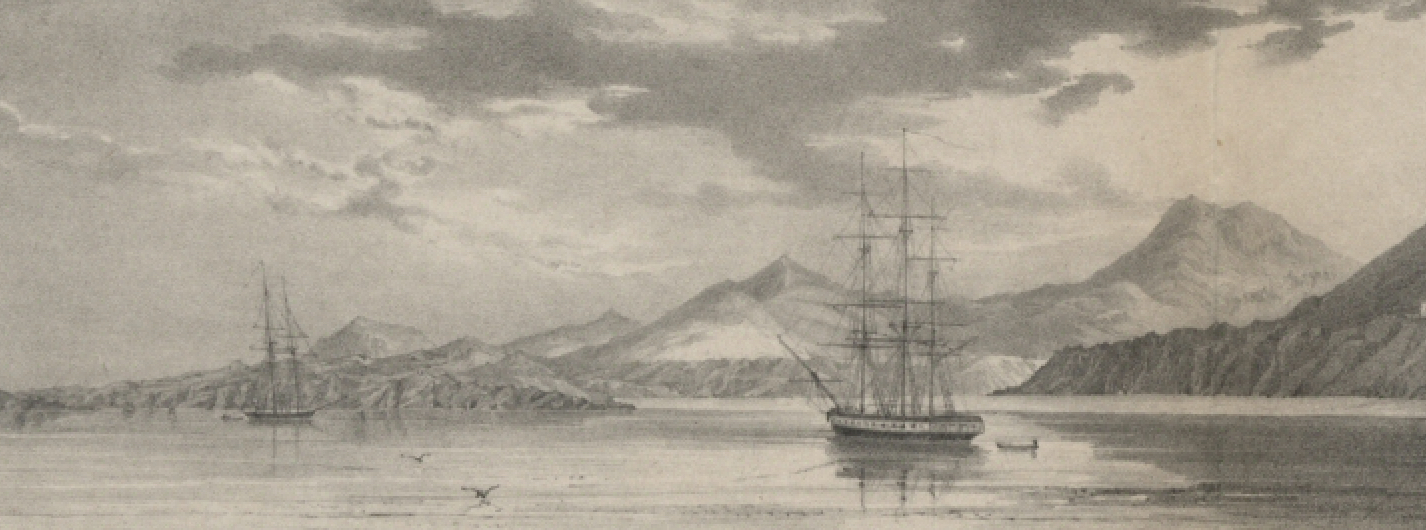
HMS Jumna, the Royal Navy brig that carried the Black Obelisk to London
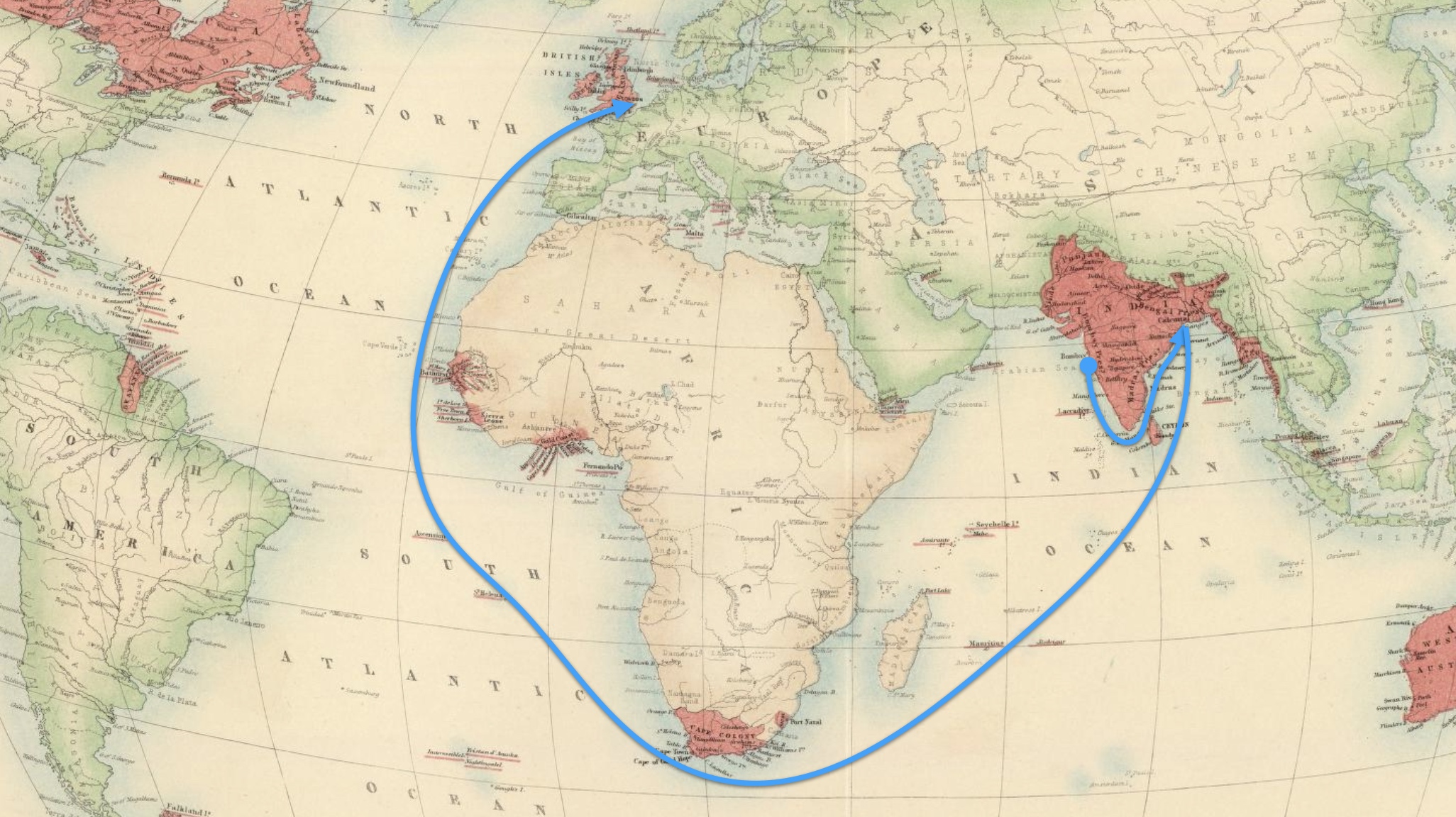
From Bombay, ships would sail to London by first sailing around the bottom of the Indian subcontinent and up the other side, picking up goods from port cities like Calcutta (now Kolkata). From there it would sail south down India’s eastern shore for Ceylon, modern Sri Lanka. Off the Sri Lankan coast the ships would pick up the trade winds that would blow them down past Madagascar, and around Africa’s southern tip at the Cape of Good Hope. From there the ship would sail north through the Atlantic around Western Africa, past Spain, eventually reaching Chatham Docks, just east of London in the Thames Estuary.
The route in the Age of Sail from Bombay, via Calcutta, to London. Map is from A. Fullarton, ‘British Empire Throughout the World Exhibited In One View’, in The Royal Illustrated Atlas Of Modern Geography (1872), 23. (Source)
But, the HMS Jumna’s maiden voyage would not be so idyllic. In fact, the ship’s story begins and ends in disaster. We’ll get into its disastrous maiden voyage carrying the obelisk in a minute, but it’s worth knowing about the ships’ poignant end.
The Jumna had a 33 year long career. Its final voyage began in Hobart on the island of Tasmania – south of the Australian mainland. It had arrived there from Mauritius laden with sugar, but after unloading it wasn’t able to pick up any new cargo, so its sailors filled it with 60 tons of ballast –far too little for a ship of its size– and set off westward for the port of Fremantle on Australia’s western seaboard. It never made it. None of the sailors survived whatever the ship’s fate was, and though some wreckage was found on a beach near Fremantle it couldn’t be shown for sure that it came from the HMS Jumna. People who knew the ship theorised that the ship must have capsized in a squall and sank, but we’ll never know for sure.51 Whatever happened, it wasn’t a happy ending.
So, back in Bombay harbour at the beginning of the Jumna’s career… The ship was loaded up with 55 of Layard’s cases52 of discoveries – things had taken so long that by now there was a bit of a backlog of them on the Bombay dockside. The ship, under the direction of one Captain Lieutenant Rodney, set off for London on the 12th of April 1848.53 As planned, it headed south-east.
The first few days were uneventful. As it happened, 3 days into the voyage, on April 15th, Layard happened to be lecturing in London at the Royal Asiatic Society – he had no way of knowing that his artefacts had begun the last leg of their journey to the British Museum. He discussed the particulars of the dating of the various artefacts, with people in the audience disagreeing on just how old the artefacts were.54 Little did he know what was in store for the very artefacts he was busy chatting about.
Calcutta harbour
The Jumna had sailed around the bottom of the Indian subcontinent and up the other side, arriving in the port city of Calcutta. The next day, the 22nd of April, after loading up more goods bound for London it set off again heading south for Ceylon.55
That evening, the Jumna encountered bad weather; such bad weather in fact that it got written up in an article in the 1850 Journal of the Asiatic Society.56 And, when we say bad weather, the Jumna managed to sail straight into the point where three57 cyclones collided, and it was stuck in that tempest for the best part of two days58 almost sinking to the bottom of the sea. Here’s how it played out.
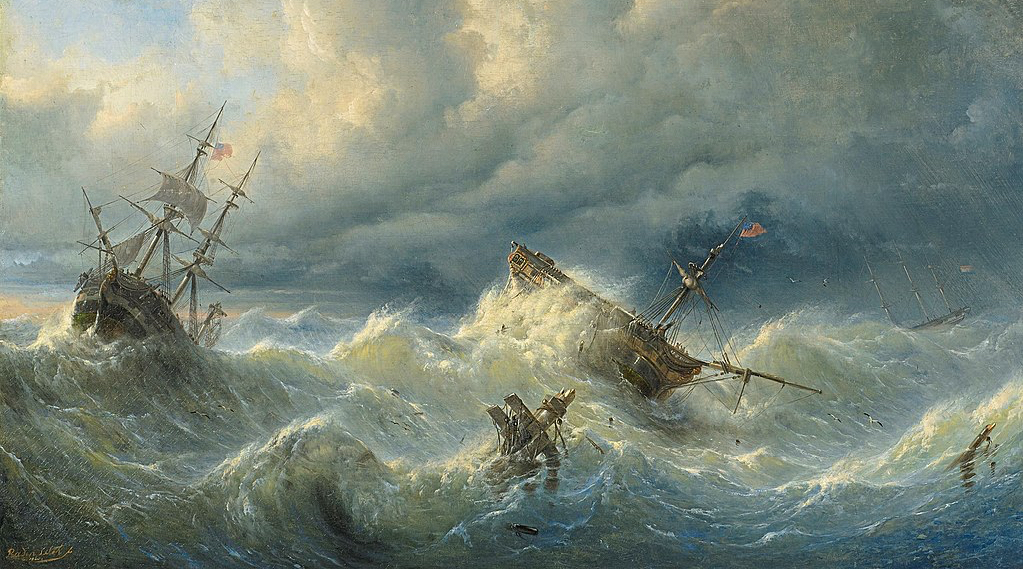
At 3am on April 23rd, the gale force 5 cyclone with its thunder and lightning increased to a gale force 7 or 8. As the hours wore on it got worse and worse such that at 8:45am the next morning the storm was a gale force 10. It stayed at that level until 3pm when it dropped to a mild force 9 gale, until the ship sailed into the eye of the storm where it was all calm at 4pm. At 4:30pm they were back in a force 6 cyclone, and at 7pm they were back in force 10. From 8pm to midnight the storm was between a force 10 to 12, but was “said to be higher than the figures can express” – the storm was literally off the scale. This lasted for quite a few hours, and at 10:45am the next morning, according to the ship’s logs, the ship “broached to and went over and the mainmast was cut away to right her”.59
(not our) Storm at sea, by Raden Saleh (1840)
In non-sailor speak “broached to” means that as a result of being pushed from behind either by a massive wave or a particularly hellish gust of wind, the boat was flipped over, landing upside down. And, because this was in the days before boats were self-righting, the crew had to cut away the mast to get the ship the right way up again. Later in the day the storm finally calmed.60
This, it’s probably fair to say, is not really what you want happening to one of the most important archaeological finds ever.
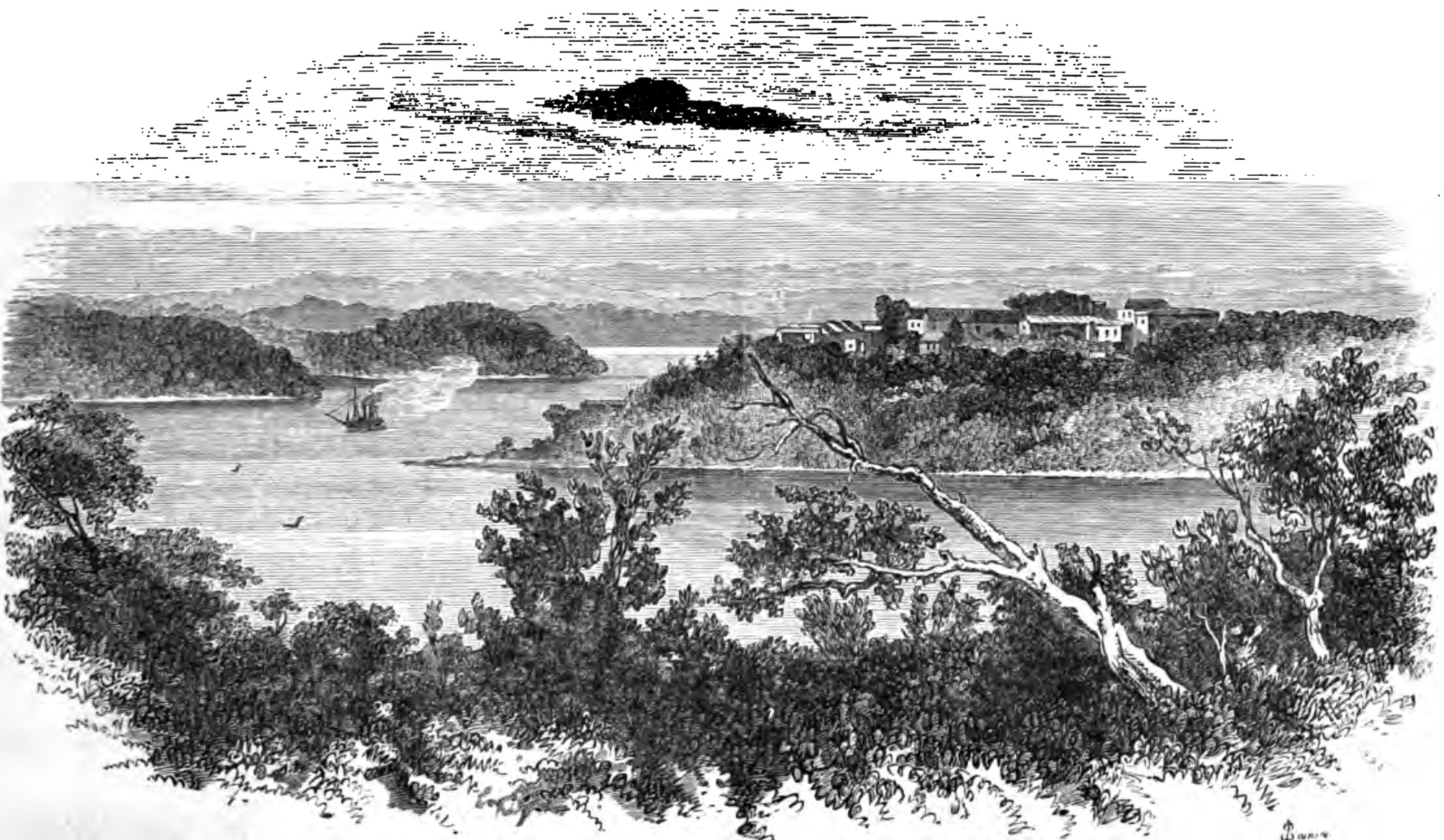
What remained of the Jumna then limped through the water “under jurymasts” –that is, makeshift masts made out of bits of the ship– and after a few days it slunk into the port of Trincomalee in Ceylon, modern Sri-Lanka.61
A ship at the entrance to Trincomalee Harbour. Alastair Mackenzie Ferguson, Souvenirs of Ceylon: A Series of One Hundred and Twenty Illustrations (London: 1869), 47.
The ship needed refitting, and this caused quite the delay.62 Thankfully, none of Layard’s artefacts had been lost – all was well.
But this is not the news that reached Layard’s ears in London. On August 12th 1848, the Athenaum newspaper, Layard’s source of news about his precious artefacts, printed a summary of an article in the Bombay Times:
‘Fine-art gossip’, The Athenaeum, No. 1085 (Saturday August 12th, 1848), p. 810.
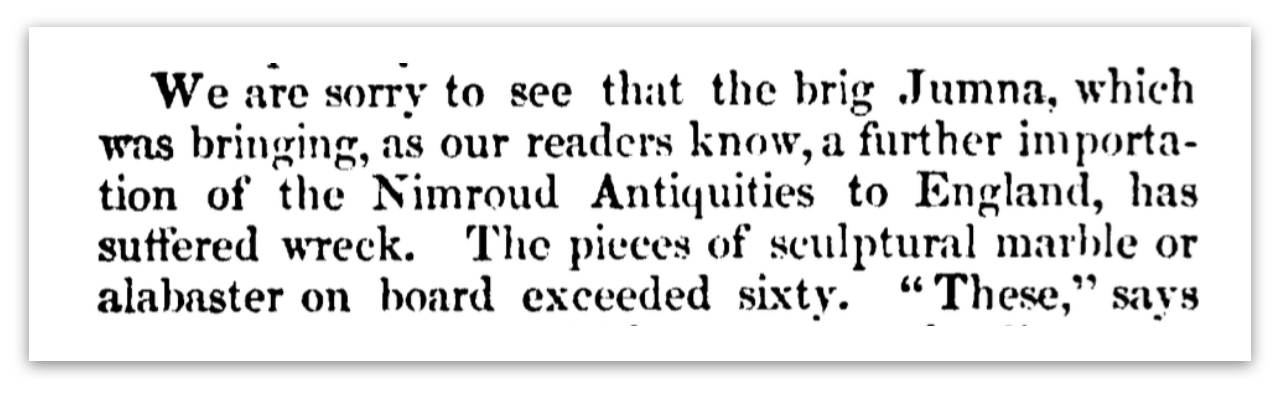
“We are sorry to see that the brig Jumna, which was bringing, as our readers know, a further importation of the Nimroud Antiquities to England, has suffered wreck. The pieces of sculptural marble or alabaster on board exceeded sixty.”63
It’s hard to imagine Layard reading that report and him not having a stroke.
First the artefacts suffered intellectual property theft in Baghdad. Then they were stuck in Basrah for the best part of a year. Then they were robbed in Bombay. And now they’re at the bottom of the ocean! Poor Layard – unknown to him he was an early victim of Fake News.
The final leg to London
It now being midsummer after spending a couple of months under repairs in Trincomalee, the Jumna set off for London on July 1st 1848.64 It picked up the trade winds, sailed past Madagascar and around the Cape of Good Hope, arriving on August 20th on the tiny southern-Atlantic island of St Helena.65 Five days later, on August 25th, the Jumna sailed past Ascension Island66, an even smaller rock sticking out of the ocean than St Helena is.
Six more weeks went by, and on October 3rd the Jumna lowered its anchor at Spithead just outside Portsmouth Harbour.67 Finally, 10 days later, on the 13th of October 184868 the HMS Jumna reached its final destination and sailed into Chatham Docks, east of London.69
Reporting on the event, the Athenaum wrote,
“The long-expected marbles from Nimroud, embarked on board the Jumna and which were reported to have been lost at sea, have, we are happy to say, at length arrived…”70
Normally, goods entering England would be inspected by customs officials on arrival at the docks. But for Layard’s 50 cases, special provision was made. They were were transported “under seals” from the docks to the British Museum, accompanied by customs staff. On arrival at the museum the crates were unsealed in the presence of the customs staff, the museum trustees, and of course, Austen Henry Layard.71
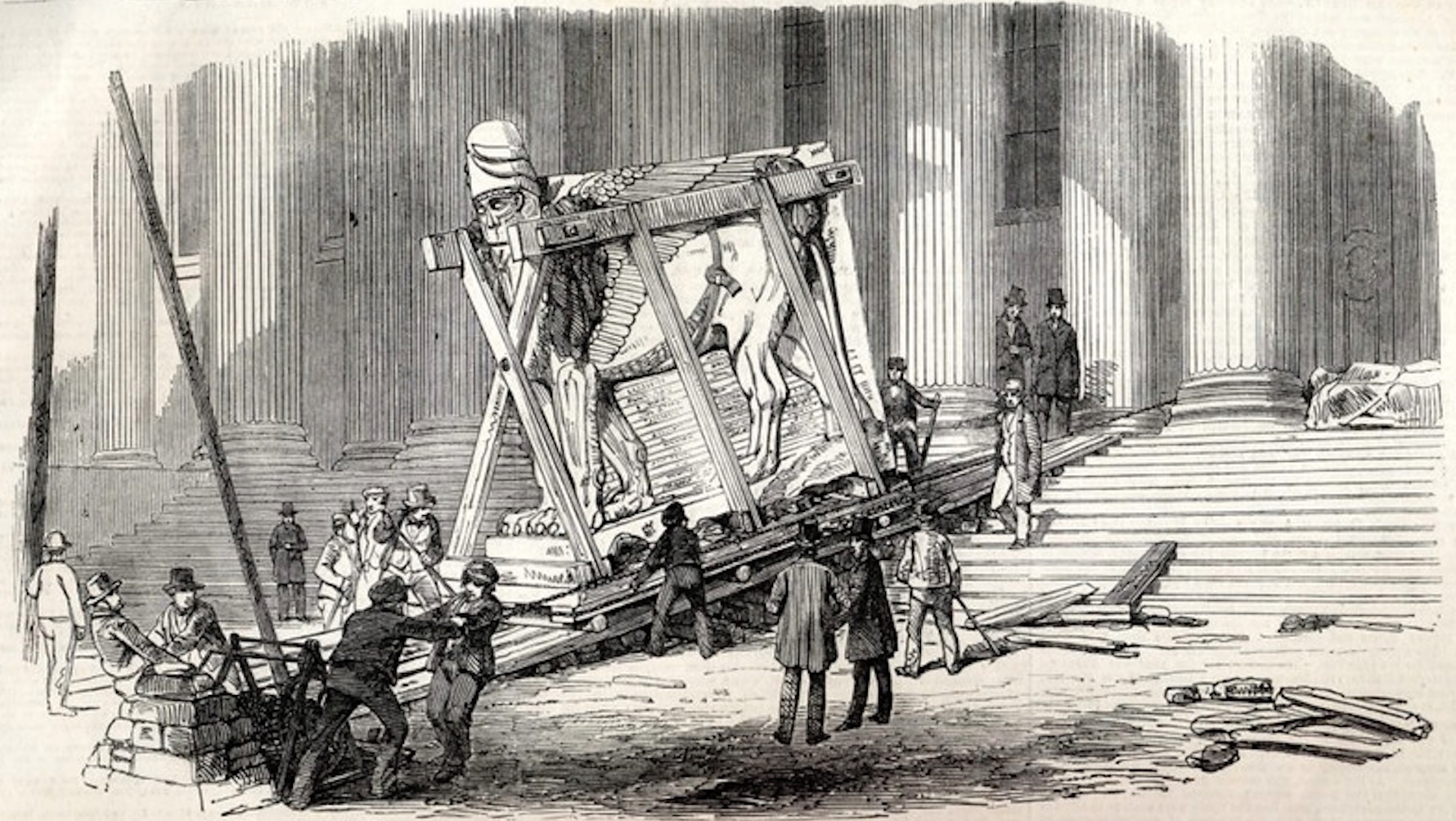
Artefacts from Nimrud arriving at the British Museum (obviously not the Obelisk). The Illustrated London News (Feb 28th, 1852), 184.
Layard’s initial relief at receiving his artefacts back from the dead very quickly turned to outrage. To quote Gadd,
“…the state of the contents of the thirty boxes of small objects was such as to evoke the strongest expressions of indignation. Privately he used much more emphatic language…”72
The artefacts had been terribly packed; any order Layard had put them in was gone. Some of the artefacts had been smashed. Some of the smaller artefacts had been stolen.
Furious with what they’d found, the Trustees of the Museum wrote off to the Governor at Bombay asking what on earth had happened. In reply they received a report mentioning some of the events we saw took place in Bombay.73 I imagine that things weren’t helped when the ship “went over” in the cyclones either, so the disorganised mess wasn’t completely the fault of Dr Buist’s men in Bombay, but it was certainly almost entirely their fault.
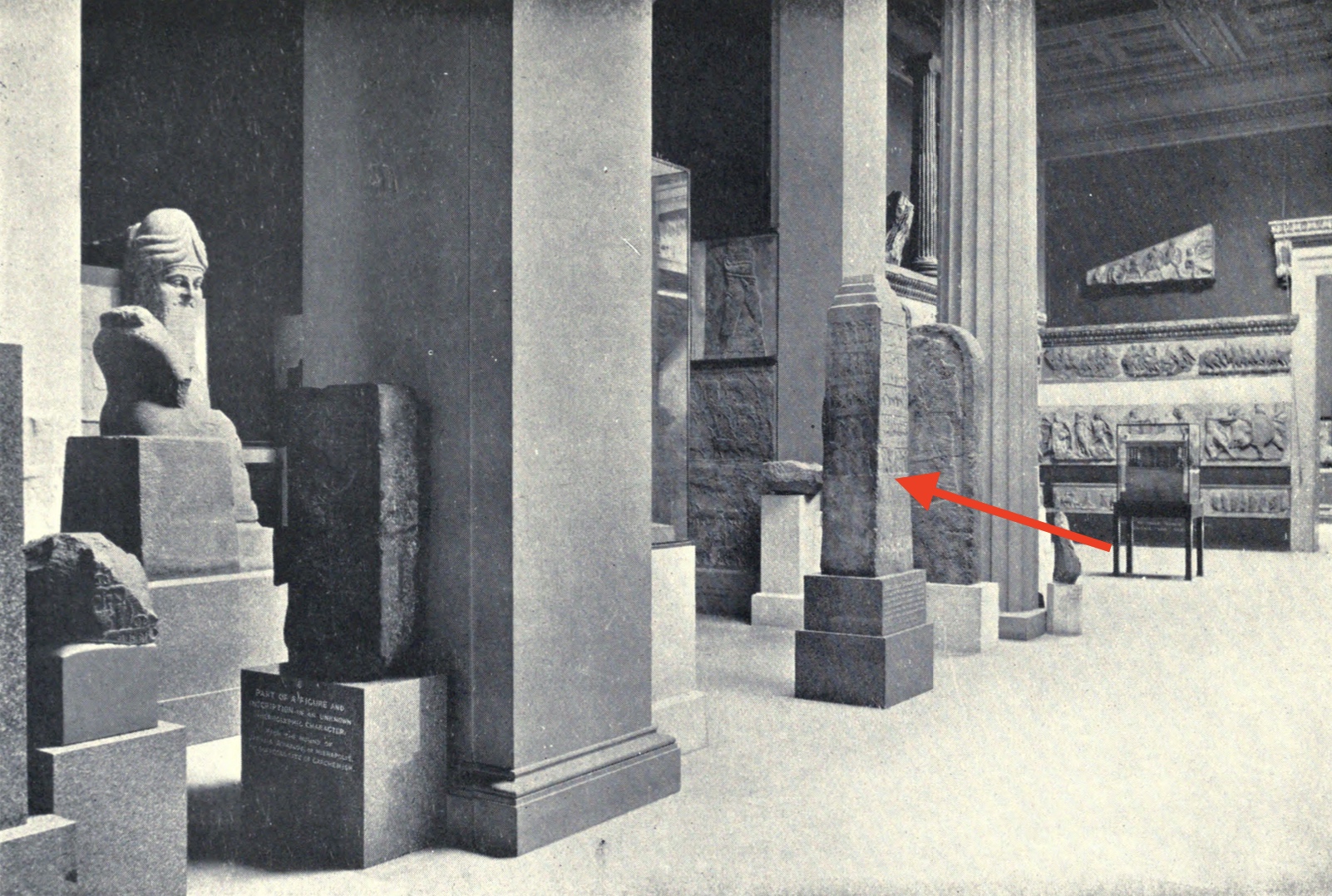
And so, the customs officials went back to their docks. At last Layard’s artefacts were brought into the museum. They were put on display in the Nimroud Saloon, with pride of place going to the Black Obelisk.74 Almost two years after its initial discovery, and after many adventures, the artefact could finally rest.
After coming through many trials the Black Obelisk finally rests in the British Museum’s ‘Nimroud Saloon’. Ada R. Habershon, The Bible and the British Museum (London: Morgan & Scott, 1909), 50 (Plate IV).
And, it’s bizarre to think about it now, but the obelisk was on display for more than three years before scholars worked out that the “bearded figure” “in the attitude of awe”75 was none other than the Israelite King Jehu. More about that in the next Beyond Apologetics video.
Featured image
My photo of the Black Obelisk superimposed on Layard’s map of Nimrud (public domain) and Raden Saleh’s “Ships on a Stormy Sea” (public domain)
Cyril John Gadd, The Stones of Assyria (London, 1936)
Footnotes
George Rawlinson, A Memoir of Major-General Sir Henry Creswicke Rawlinson (London, 1898), 151. ↩
Austen Henry Layard, Nineveh and its Remains (London: 1849), 16-17. ↩
Austen Henry Layard, Nineveh and its Remains (London: 1849), 19 & 21. ↩
“On the 8th of November [1845], having secretly procured a few tools, and engaged a mason at the moment of my departure, and carrying with me a variety of guns, spears, and other formidable weapons, I declared that I was going to hunt wild boars in a neighbouring village, and floated down the Tigris on a small raft constructed for my journey. I was accompanied by Mr. Ross, a British merchant of Mosul, my Cawass, and a servant. At this time of the year more than five hours are required to descend the Tigris, from Mosul to Nimroud.” Austen Henry Layard, Nineveh and its Remains (London: 1849), 21-22. ↩
“I continued to employ a few men to open trenches by way of experiment, and was not long in discovering other sculptures…” Austen Henry Layard, Nineveh and its Remains (London: 1849), 46. ↩
“In the centre of the mound we uncovered part of a pair of gigantic winged bulls, the head and half the wings of which had been destroyed. Their length was fourteen feet, and their height must have been originally the same.’ Austen Henry Layard, Nineveh and its Remains (London: 1849), 46. ↩
“During the next campaign in 1975, east of this relief two Lamassu-bulls of Shalmaneser III were found; the form an entrance to a building lying more to the west. These sculptures were known from Layard’s time and were called “The Centre Bulls”, but their exact position was unknown till our excavations.” A. Mierzejewski & R. Sobolewski, “Polish Excavations at Nimrud/Kalh 1974-1976: Some preliminary remarks on the new discovered neo-assyrian constructions and reliefs,” Sumer 36 (1980), 152-153. ↩
“The excavations were recommenced, on a large scale, by the 1st of November.” Austen Henry Layard, Nineveh and its Remains (London: 1849), 332. ↩
“My working parties were distributed over the mound – … [including] in the centre of the mound near the gigantic bulls (* at i and j, plan 1)” Austen Henry Layard, Nineveh and its Remains (London: 1849), 332. ↩
Austen Henry Layard, Nineveh and its Remains (London: 1849), 344-347. ↩
Austen Henry Layard, Nineveh and its Remains (London: 1849), 344-347. ↩
“Trenches were also dug in two other areas on the Akropolis. First of all some digging was done in what is known as the centre palace of Tiglath-pileser III on the square where it was believed Layard had found the black obelisk of Shalmaneser III. Here, however, work was not prolonged because it was found that what was left of the building was in a ruinous and badly damaged condition. Indeed to recover more of the old plan and the alignment of the street would have been a major operation. Our efforts were needed elsewhere.” Max Edgar Lucien Mallowan, “The Excavations at Nimrud (Kalhu), 1952,” Iraq 15.1 (1953): 5. ↩
Correspondence in Gordon Waterfield, Layard of Nineveh (London, 1963), 168. ↩
Correspondence in Gordon Waterfield, Layard of Nineveh (London, 1963), 168. ↩
Austen Henry Layard, Nineveh and its Remains (London: 1849), 348. For the sketches themselves see Austen Henry Layard, The Monuments of Nineveh, from drawings made on the spot (London, 1849), Pl. 53-56. ↩
Austen Henry Layard, Nineveh and its Remains (London: 1849), 348. ↩
Austen Henry Layard, Nineveh and its Remains (London: 1849), 348. ↩
Austen Henry Layard, Nineveh and its Remains (London: 1849), 372. ↩
Cyril John Gadd, The Stones of Assyria (London, 1936), 41-42. ↩
George Rawlinson, Memoir of Sir Henry Rawlinson (1898), 153-154. ↩
From the archives of the Royal Asiatic Society: ‘Addressed to “E Norris [as above] Baghdad 27th Jany 1847 My dear Sir” Marked “Confidential” The recent extraordinary discoveries by Layard at Nimrud have caused him to set aside his work on the Persian vocabulary and set about Assyrian in earnest. Description of a black marble obelisk, but asks Norris not to publish this for fear of upsetting Layard and the Trustees of the British Museum. Gives some of the results of his Assyrian researches including the identification of a genealogical series of the four primeval kings of Assyria but concludes that he was wrong in his last letter in stating that there were two king Nebuchadnezzars [Norris adds the note “see letter R”.] Comments on the “extraordinary laxity of the Assyrian character”. He can read much of the script phonetically, but can get no further because the materials for comparison are too scanty. He is not prepared to publish his key yet unless “Dr Hincks or the Savans of France & Germany are prepared to come forward” as “I should like to penetrate a little deeper into the primitive Assyrian records before I give up the keys of the enquiry.” He will also need to consult Layard and the Commissioners of the British Museum before publishing any results derived from a study of the inscriptions on the items which are their property. Encloses a letter to the Commissioners for that purpose. [Letter P in III/04]’. See https://royalasiaticsociety.org/list-of-the-ras-collections-of-sir-henry-creswicke-rawlinson-bart-1810-1895/↩
Cyril John Gadd, The Stones of Assyria (London, 1936), 41. ↩
Cyril John Gadd, The Stones of Assyria (London, 1936), 42. ↩
Cyril John Gadd, The Stones of Assyria (London, 1936), 42. ↩
Cyril John Gadd, The Stones of Assyria (London, 1936), 43. ↩
Gordon Waterfield, Layard of Nineveh (London, 1963), 179-180. ↩
“…when Rawlinson was at Basrah in December 1847 he had the satisfaction of seeing, one day, the Company’s sloop-of-war Clive arrive at the port, and he found that the commander, in accordance with his instructions, was prepared to take on board such antiquities as he had the capacity to carry, but he was to take them only as far as Bushire, where they would be trans-shipped to the Elphinstone and by her carried to Bombay. Unfortunately these sloops were only small craft and it was found that the Clive’s utmost capacity was twenty cases, the Black Obelisk… and all the portable boxes of small objects; these were accordingly stowed aboard in the driest and most sheltered positions” Cyril John Gadd, The Stones of Assyria (London, 1936), 42. ↩
Cyril John Gadd, The Stones of Assyria (London, 1936), 44. ↩
‘Persian Gulf Captain Lowe’s proceedings during his late tour of the Persian and Arabian Coasts. Vol: 2’, British Library: India Office Records and Private Papers, IOR/F/4/2260/114569, in Qatar Digital Library https://www.qdl.qa/archive/81055/vdc_100098593048.0x000001 (pdf page 8) [accessed 30 September 2022] ↩
“In this year the ‘ Elphinstone’ brought from the Persian Gulf, some of the sculptures collected by Mr. Layard and Major Rawlinson for the British Museum…” Charles Rathbone Low, History of the Indian Navy (1613-1863) Volume 2 (London, 1877), 201. ↩
“Fine Arts,” The Athenaeum, February 5, 1848, pp. 146-147. ↩
“The first quarter of 1848 passed away thus in rather waning hopes at Basrah, while at home there came reports of an arrival of antiquities from Nimrud at Bombay, namely, those taken on board the Clive. The accounts of them furnished by the local press were so garbled that Layard at first did not think it could be his discoveries at all, but later he received news from Rawlinson that some of his cases had indeed been sent.” Cyril John Gadd, The Stones of Assyria (London, 1936), 44. ↩
“1552. ‘Does not the Government of Bombay also correspond with the Resident at Bagdad?’ ‘Yes.’ 1553. ‘And which Resident at Bagdad reports to the Government of Bombay the despatches which he writes to the English Ministers at Teheran and at Constantinople?’ ‘He does.’” Minutes of Evidence taken before the Select Committee, Examination of Sir George Russell Clerk K. C. B. 24th May 1852, Session 4 November 1852–20 August 1853, Reports from Committees: Thirty-Two Volumes, Vol. 30., 145. https://www.google.co.uk/books/edition/Parliamentary_Papers/1ZcSAAAAYAAJ↩
“Fine Arts,” The Athenaeum, February 5, 1848, pp. 146. ↩
“Clerk, Sir George Russell (1800-1889)… He was Lieutenant-Governor of the N. W. P., June to Dec. 1843: Provisional Member of the Supreme Council, 1844: twice Governor of Bombay, from 1847 to 1848: K. C. B.: and from 1860-2.” C. E. Buckland, Dictionary of Indian Biography (London: 1906), 84. https://archive.org/details/dictionaryofindi00buckuoft↩
“The Bombay Times gives some account of a portion of the last packages of Nimroud marbles despatched from thence for England, on board the Jumna. The articles there exhibited were “a fragment – the feet and ancles [sic] – of a gigantic ox, and the head of a king in relief, in very fine preservation, both cut in gypsum. Besides these, was a basket full of vases, lamps, and other utensils, mostly in terra cotta, and of very elegant patterns. One small urn was of fine white alabaster. The principal object of attention was a beautiful obelisk of black marble, six feet high, and in the most perfect state of preservation, – the polish unaffected by three thousand years of inhumation, and the lustre hardly gone. This marble is much more perfect than any of the gypsums with which it is contemporaneous. About one-third of it is covered all round with inscriptions in cuneiform characters; the other two-thirds are decorated with sculptures in compartments. There are five compartments on each side, – twenty, consequently, in all. They are sunk about one-forth of an inch, and occupied by figures of men, horses, camels, tigers, deer, and monkeys, in relief. The whole seems to represent a procession bringing gifts to the king, – who, along with his courtiers, is represented at the top of the stone.” Castings in plaster of Paris, for the study of the local antiquaries, were taken from the obelisk while at Bombay.” “Fine-art gossip”, The Athenaeum, No. 1078 (Saturday June 24th, 1848), 635. ↩
“Fine-art gossip”, The Athenaeum, No. 1078 (Saturday June 24th, 1848), p. 635. ↩
“…certain of the cases had, in fact, been opened at Bombay. It was stated that the contents of five only had been exhibited to the public in the Dockyard, and that this had occurred only in the course of their being re-packed…” Cyril John Gadd, The Stones of Assyria (London, 1936), 50. ↩
Charles Rathbone Low, History of the Indian Navy (1613-1863) Volume 2 (London, 1877), 203. ↩
Julian Reade, “Nineteenth-Century Nimrud: Motivation, Orientation, Conservation,” in New Light on Nimrud: Proceedings of the Nimrud Conference 11th-13th March 2002, eds. J.E. Curtis, H. McCall, D. Collon and L. al-Gailani Werr (British Institute for the Study of Iraq, 2008), 16. ↩
‘The Bombay Monthly Times. From 20th May to 18th June, 1848 contained a report on the monthly Meeting of the Bombay Royal Asiatic Society of 11 May 1848, at which Dr. Buist gave a paper on The Nimroud Obelisk of which plaister casts had been made. … In the meanwhile on the Bombay docks “it was the most anxious wish of the late Governor –and we believe of every member of the Council– that [the antiquities] should be exhibited to the public and casts in plaister taken of them. After some six weeks’ delay a single obelisk with some fragments were shown: the rest were at once sent on board as soon as they could be returned – the public saw nothing of them whatever.”’ Geoffrey Turner, The British Museum’s Excavations at Nineveh, 1846-1855 (Brill, 2020), 78. ↩
Cyril John Gadd, The Stones of Assyria (London, 1936), 49. ↩
Cyril John Gadd, The Stones of Assyria (London, 1936), 50. ↩
“Among…[those] who participated in the Bombay incident and maltreated the contents of Layard’s packing cases there was, it is proposed, one William Wainwright who appropriated the eight relief fragments his daughter H. G. Wainwright handed back to the British Museum in 1897.” Geoffrey Turner, The British Museum’s Excavations at Nineveh, 1846-1855 (Brill, 2020), 79. See https://www.britishmuseum.org/collection/term/BIOG63132 ↩
Austen Henry Layard, Nineveh and its Remains (London: 1849), 399. ↩
David Lyon and Rif Winfield, The Sail and Steam Navy List: All the Ships of the Royal Navy, 1815-1889 (Chatham, 2004), 128. ↩
“… it was decided that they should be forwarded to England in one of the new sailing-ships then being built for the Royal Navy at Bombay. For this purpose H. M. brig Jumna was selected: she took on board all fifty-five cases which had reached Bombay, and sailed on April 12th, 1848.” Cyril John Gadd, The Stones of Assyria (London, 1936), 49. ↩
“The Lost Brig Jumna,” The Mercury (Hobart, Tasmania), Saturday 22 April 1882, 2. ↩
Cyril John Gadd, The Stones of Assyria (London, 1936), 49. ↩
Charles Rathbone Low, History of the Indian Navy (1613-1863) Volume 2 (London, 1877), 200. ↩
“Societies”, The Athenaeum, No. 1095 (Saturday May 20th, 1848), 510-511. ↩
“Shipping Intelligence”, Liverpool Albion (Monday April 24th, 1848), 7. ↩
Henry Piddington, “A Nineteenth Memoir on the Law of Storms in the Indian and China Seas, being the Cyclones of the Sir Howard Douglas and of H. M. Brig Jumna in the Southern Indian Ocean. January to April, 1848,” Journal of the Asiatic Society 50 (1850), 349-389. ↩
“…the brig Jumna, under the command of Lieut. RODNEY, from Bombay to England, on the 23rd April, at 3 A.M. … was between or near the tracks of two larger Cyclones, travelling down to the S.S.E., while she herself was on the verge and within the influence of a much smaller one…” Henry Piddington, The Sailor’s Horn-Book for the Law of Storms (London, 1860), 209-210. Also, “…the Jumna was bringing down with her another small Cyclone, and… we can easily understand that at the point where the two [large cyclones] approximated and combined, the fury of the tempest might be much augmented and the track subject to some variation.” Henry Piddington, “A Nineteenth Memoir on the Law of Storms in the Indian and China Seas, being the Cyclones of the Sir Howard Douglas and of H. M. Brig Jumna in the Southern Indian Ocean. January to April, 1848,” Journal of the Asiatic Society 50 (1850), 381. ↩
Henry Piddington, “A Nineteenth Memoir on the Law of Storms in the Indian and China Seas, being the Cyclones of the Sir Howard Douglas and of H. M. Brig Jumna in the Southern Indian Ocean. January to April, 1848,” Journal of the Asiatic Society 50 (1850), 380. ↩
“When the three Cyclones met, the fury of the wind became irresistible, and H. M. Ship was upset, but fortunately righted, by cutting away her mainmast.” Henry Piddington, The Sailor’s Horn-Book for the Law of Storms (London, 1860), 210. ↩
Henry Piddington, “A Nineteenth Memoir on the Law of Storms in the Indian and China Seas, being the Cyclones of the Sir Howard Douglas and of H. M. Brig Jumna in the Southern Indian Ocean. January to April, 1848,” Journal of the Asiatic Society 50 (1850), 358-359. The article also provides extracts from the ship’s logs giving the ship’s coordinates at various points in the storm: [23rd April 0300 – 8.59 S, 85.34 E; 23rd April 1200 – 10.28 S, 85.0 E; 23rd April 1600 – 11.08 S, 85.0 E; 24th April 1045 – 11.31 S, 84.54 E; 24th April 1200 – 10.14 S, 85.50 E] ↩
“On the 23rd she was caught in a great storm, dismasted, and in considerable danger of floundering, but succeeded at last in weathering the tempest, and making Trincomalee in Ceylon, where she was ordered to refit.” Cyril John Gadd, The Stones of Assyria (London, 1936), 49. ↩
“…and making Trincomalee in Ceylon, where she was ordered to refit. After much delay occasioned by this necessity she set sail again…” Cyril John Gadd, The Stones of Assyria (London, 1936), 49. ↩
“Fine-art gossip”, The Athenaeum, No. 1085 (Saturday August 12th, 1848), p. 810. ↩
“The new 16-gun brig Jumna, built at Bombay, arrived at Spithead on Wednesday, from Trincomalee, into which port she was driven in May last, much damaged, by a hurricane or monsoon. We hear she has brought home some of the late crew of the Cruiser, 16, found defective. She sailed for Chatham on Thursday morning to be paid off, and fitted for permanent commission. The Jumna sailed from Trincomalee on the 1st of July, on which day the Inflexible left for China. The Jumna arrived at St. Helena, August 20, and Ascension on the 25th.” “Portsmouth Herald”, The Hampshire Advertiser (Saturday October 7th, 1848), 8. ↩
“Portsmouth Herald”, The Hampshire Advertiser (Saturday October 7th, 1848), 8. ↩
“Portsmouth Herald”, The Hampshire Advertiser (Saturday October 7th, 1848), 8. ↩
“The Jumna, 16, Acting Commander M. Rodney, anchored at Spithead, on Tuesday evening from Bombay. She had a most boisterous passage. She has ben ordered to Chatham to be paid off, and was to have left last evening.” “The Navy,” London Evening Standard (Thursday Oct 5th, 1848), 8. ↩
Holger Hoock, “The British State and the Anglo-French Wars Over Antiquities, 1798-1858,” The Historical Journal 50.1 (2007), 67, n. 85. ↩
“The new brig Jumna, 16, from Bombay, is paid off at Chatham.” The Hampshire Advertiser (Saturday October 14th, 1848), 8. ↩
“Fine-art gossip”, The Athenaeum, No. 1095 (Saturday October 21st, 1848), p. 1057. ↩
“The packages, fifty in number, were permitted by the authorities at Sheerness to be at once sent up to London under seals, to undergo the Custom-house examination in presence of the authorities of the Museum, with a view to avoiding the risks attendant on the disturbance of articles of their valuable character and fragile nature.” “Fine-art gossip”, The Athenaeum, No. 1095 (Saturday October 21st, 1848), 1057. ↩
Cyril John Gadd, The Stones of Assyria (London, 1936), 48. ↩
“A letter was written to the Government of Bombay and it was discovered that the cases, while lying on the wharf at Bombay, had been opened by members of the British community.” Gordon Waterfield, Layard of Nineveh (London, 1963), 188. ↩
Synopsis of the Contents of the British Museum, 55th ed (British Museum, 1850), 112. ↩
“Fine-art gossip”, The Athenaeum, No. 1099 (Saturday November 18th, 1848), 1152. ↩
The inscription on the Merneptah Stele is well known for containing the oldest mention of “Israel” outside the Bible. It’s frequently brought up by apologists as proof for the existence of the Israelites in Canaan and therefore of the historical reliability of the Old Testament. But, dig a little deeper and the sentence that “Israel” appears in will prompt us to look at how the Bible employs the language of annihilation; a common feature of ancient texts that doesn’t work in the way we modern laypeople expect it to. When we become aware of it we’ll know to look out for it and interpret it in the way the original writers used it - not as statements of fact, but as hyperbole.
The Merneptah Stele is well known in apologetic circles as the inscription that contains the oldest mention of “Israel” outside the Bible. It’s often cited to “prove” the historical accuracy of biblical books like Exodus, Deuteronomy, Joshua, and Judges. But, just like we saw with the Tel Dan Stele in previous videos in this series, there’s much more to the Merneptah Stele; we just need to get past the shallow level that apologetics often leaves us at and get into the details. When we do that we’ll find that the Merneptah Stele points to scriptures we often read one way, and shows us how to read them a little more thoughtfully.
Discovery
Historical context of the discovery
Unlike the Tel Dan Stele which was discovered at what might have been the height of biblical minimalism, the Merneptah Stele was discovered at the beginning of the era of biblical archaeology. It was a time when polymaths and reverends, funded by wealthy sponsors, would set off, spade in hand, for the lands of the Ancient Near East with the aim of “digging up the Bible”.
How it was discovered
Mortuary Temple of Merneptah
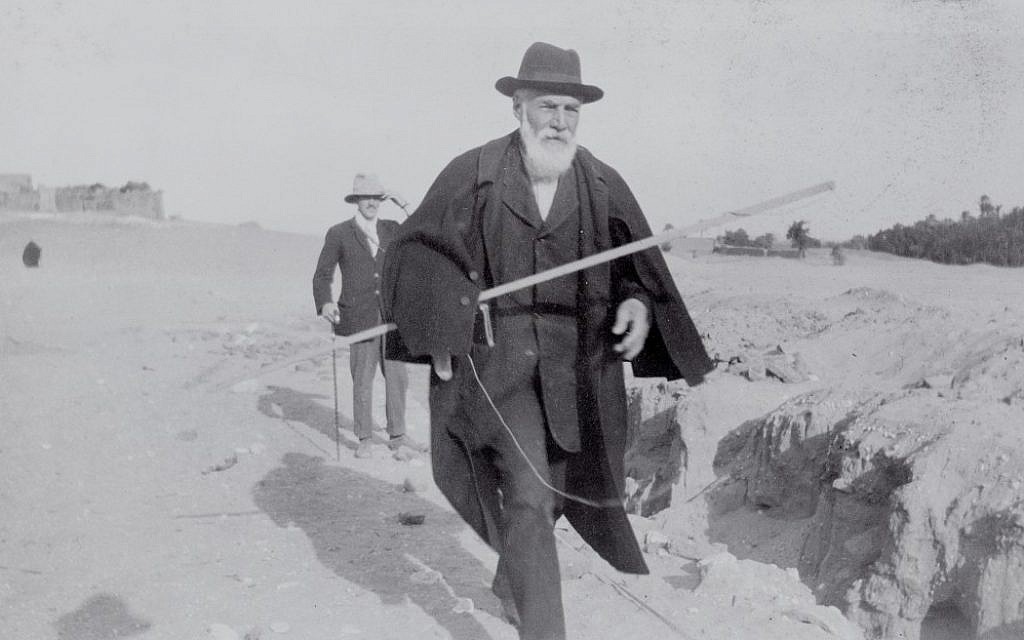
One of these guys was William Flinders Petrie, the Edwards Professor of Egyptian Archaeology and Philology at University College London.
William Flinders Petrie
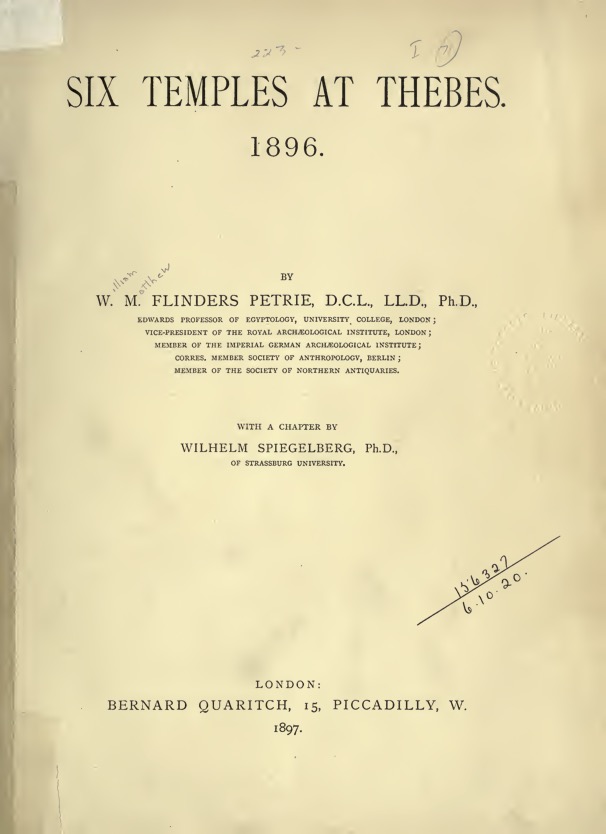
He’d made it his mission to excavate six temples on the west bank of the Nile at Thebes, opposite Luxor, on the other side of the hill from the famous Valley of the Kings.
Six Temples at Thebes
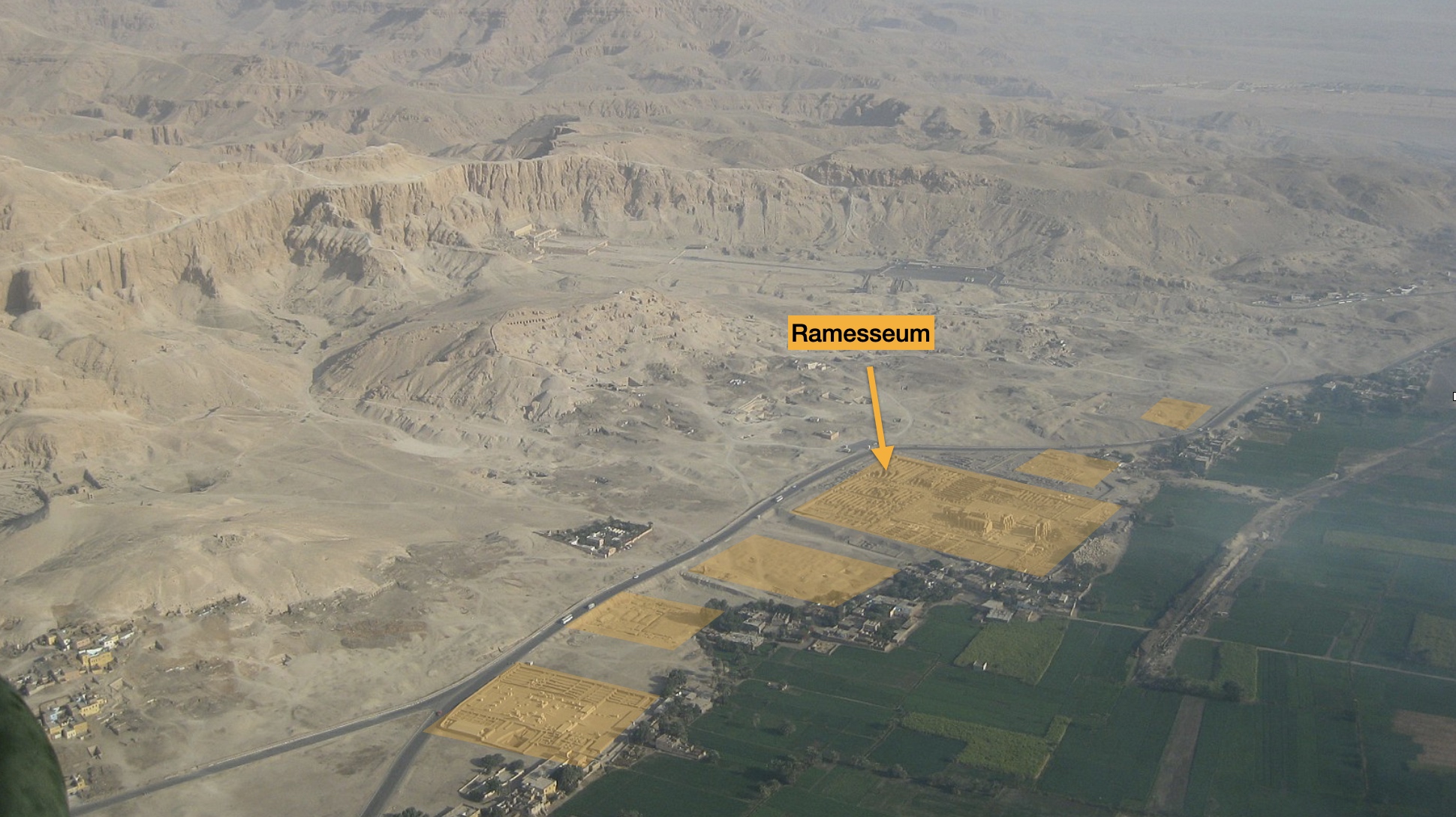
According to his journal, Petrie arrived in Luxor on the 10th of December 1895. After a few days staying with a friend, he set up base camp in one of the mud brick store tunnels of the 3200 year old Ramesseum; the mortuary temple of Pharaoh Rameses II. That may sound like a romantic setup, but in his journal he explains that it was so cold in the evenings that he would write his journal “between blankets” – the night December desert is cold.1
The six temples Petrie excavated, with the Ramessaeum highlighted
Only a few days after Petrie arrived, and maybe a little prematurely, his assistant James Quibell, wrote to James Henry Breasted, the Professor of Egyptology and Oriental History and founder of the Oriental Institute at the University of Chicago, giving him a status update on how the excavations were going. He wrote,
We hope for papyri, we hope for cuneiform tablets; as yet of course it is early days and we have [found] nothing important.3
That was soon to change – Petrie was about to make what he called his “great discovery”.4
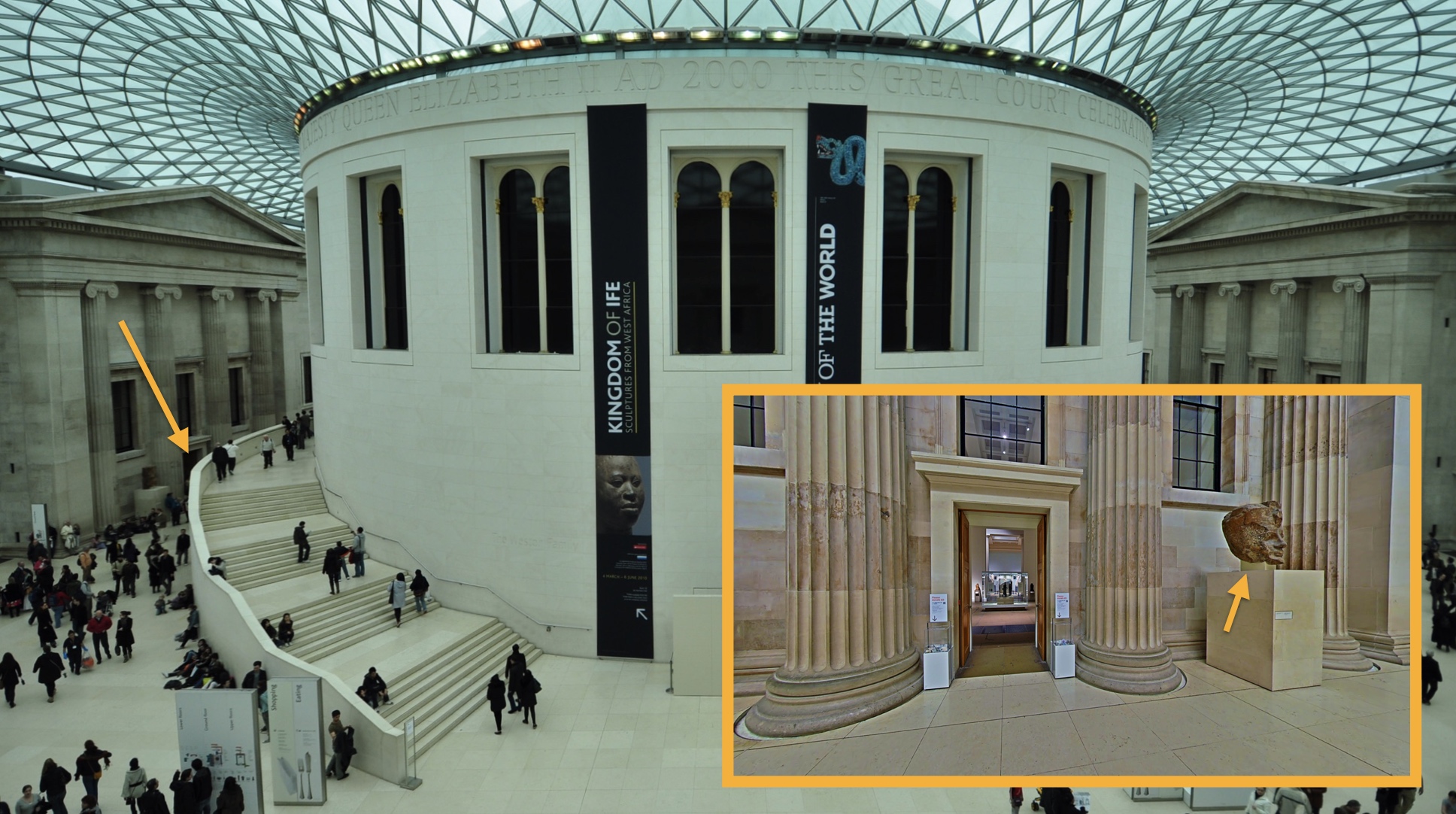
As we’ve said, Petrie was out there digging a series of temples. One of the mysteries he solved was that of the missing temple of Pharaoh Amenhotep III - he’s the Pharaoh you’ll have seen if you’ve been to the British Museum and gone to see the Rosetta Stone - you’ll probably have gone through the door in the image below to get to it. The statue on the right is of that Amenhotep III, found at the site Petrie was excavating.
Amenhotep III’s head in the British Museum
If you’ve been on a tour of Luxor you may have been to Amenhotep III’s mortuary temple - it’s common for tour buses to stop off at the Colossi of Memnon - they stand in front of what remains of that temple.
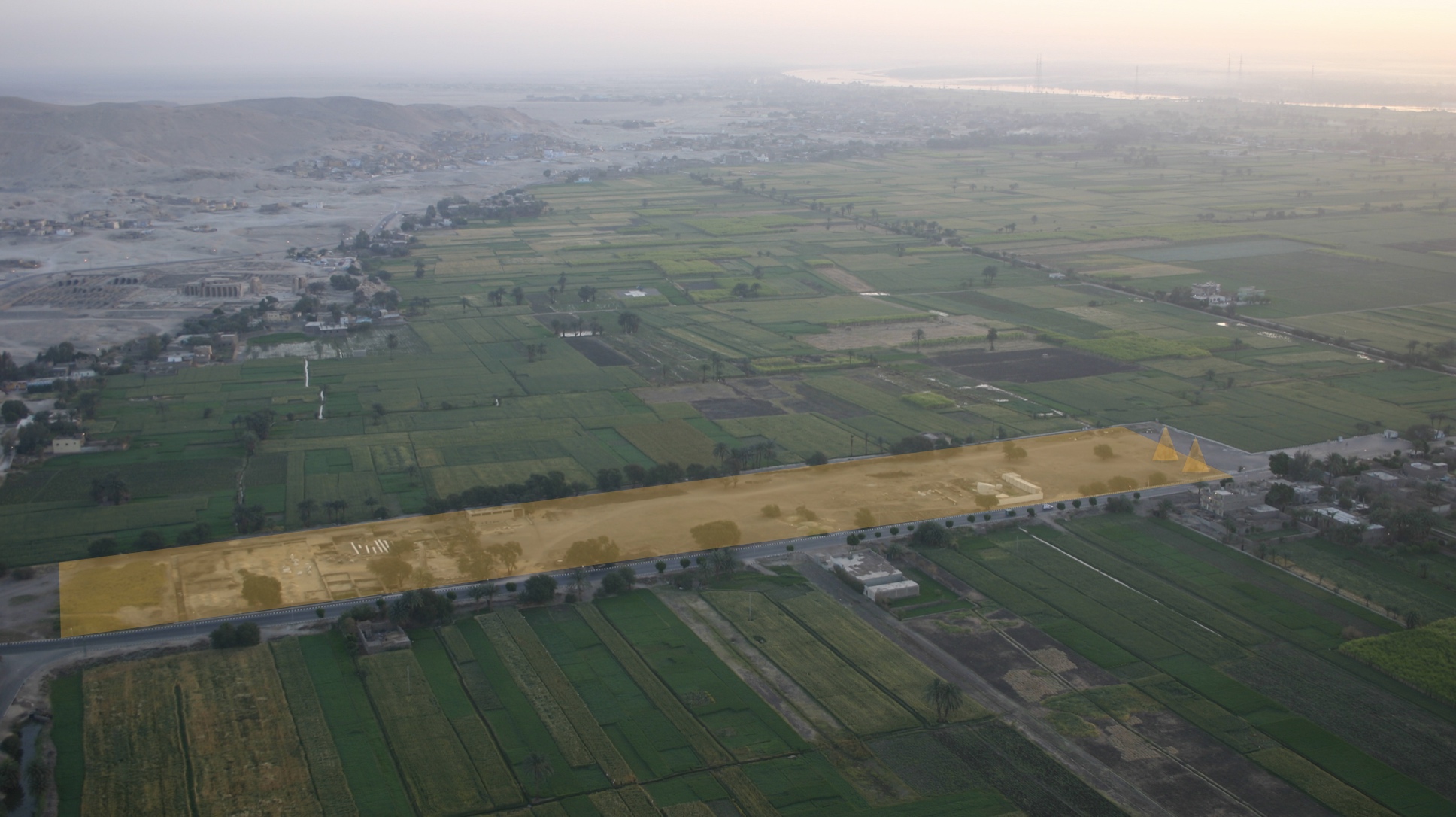
The temple of Amenhotep III. Note the two triangle highlights on the right indicating the location of the colossi of Memnon.
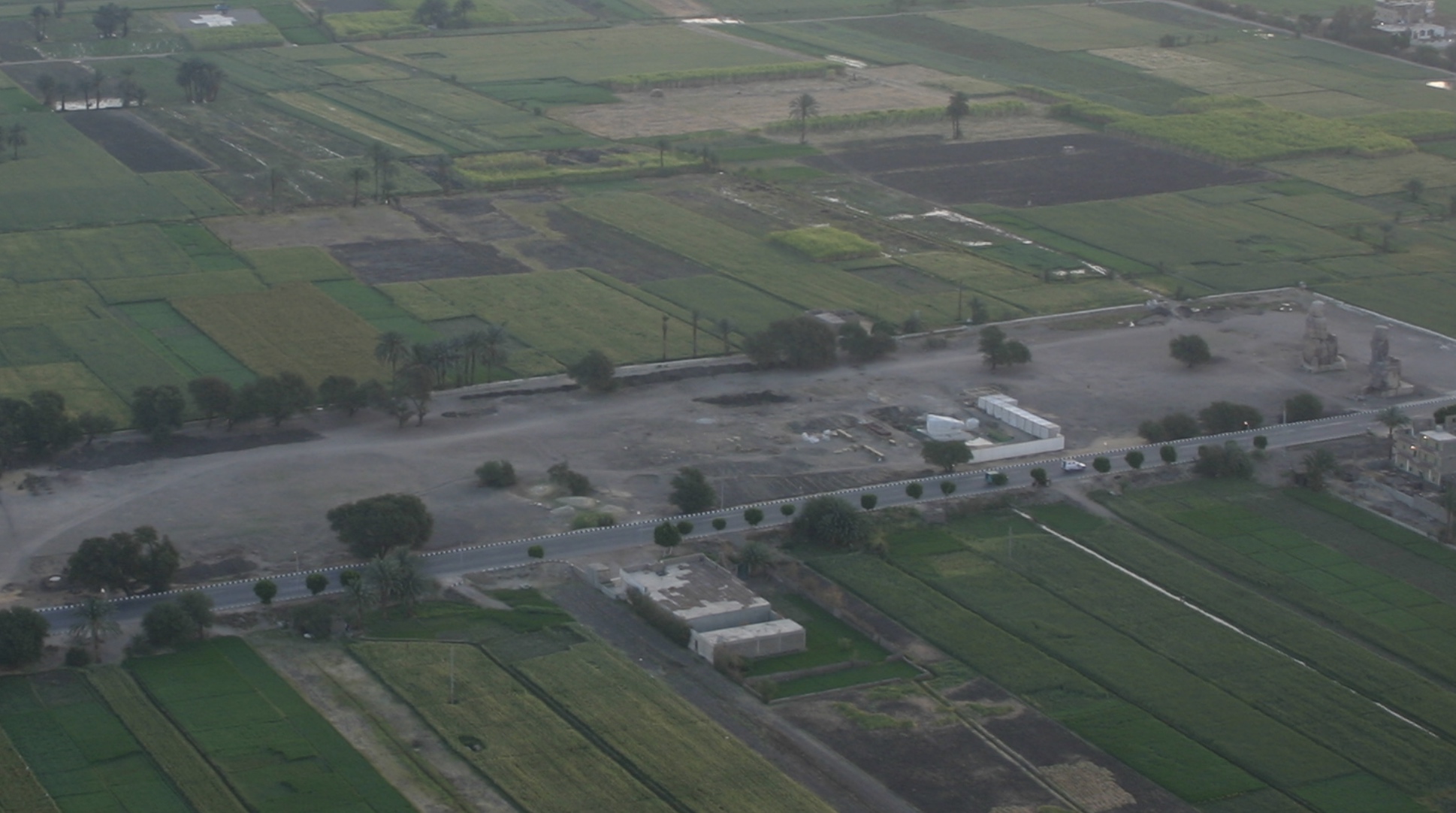
Anyway, if you look at a photo you’ll see that much of his mortuary temple is… gone:
The temple of Amenhotep III… empty.
Now, it’s gone for a number of reasons, like, earthquakes, and flooding, but the main culprit is our Pharaoh Merneptah.
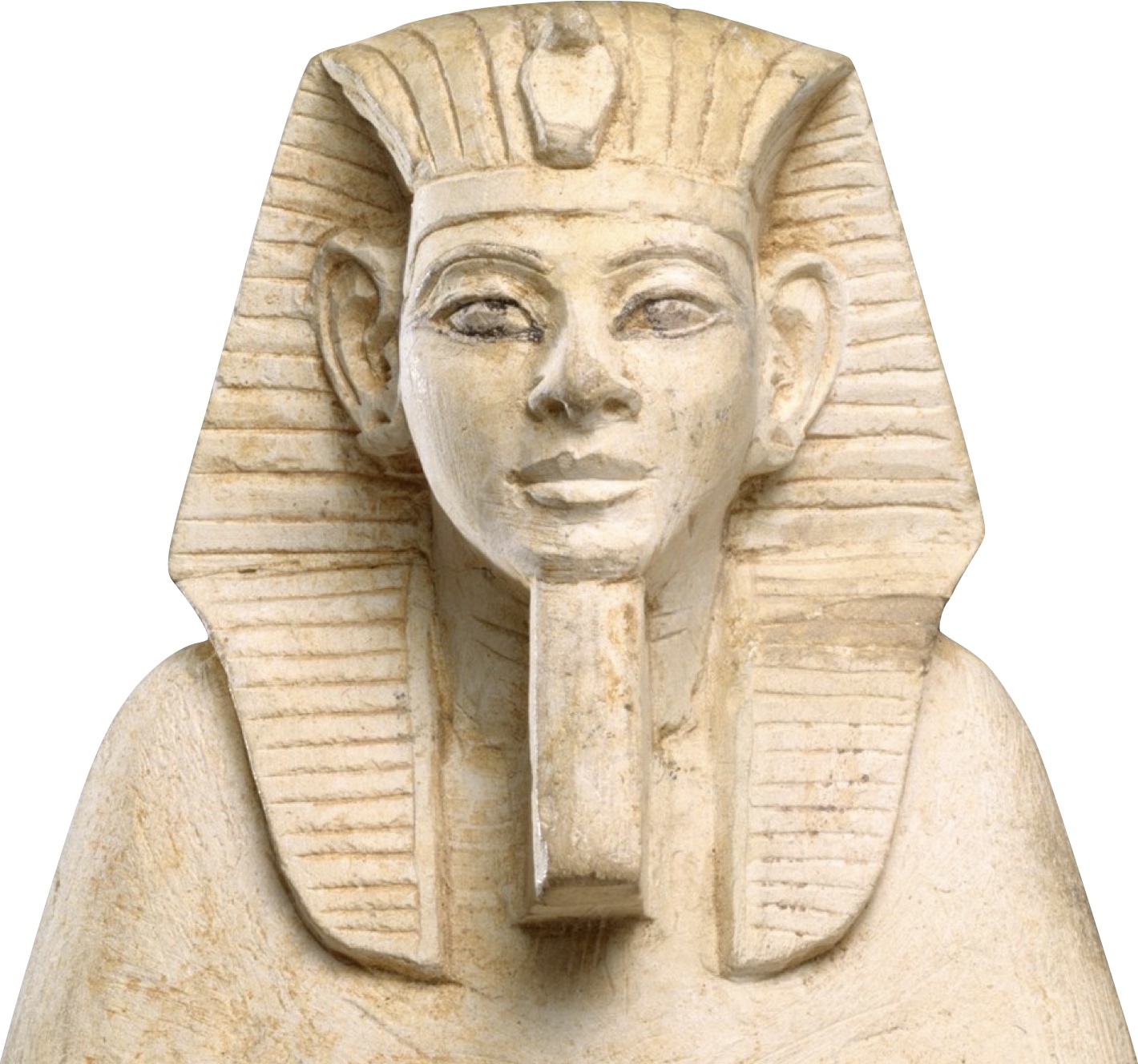
Pharaoh Merneptah
What Petrie discovered is that in building his own mortuary temple, Merneptah raided Amenhotep III’s mortuary temple for parts.
Because of this looting, Petrie was not a Merneptah fan, and he didn’t pull any punches when it came to describing his work. Referring to Merneptah Petrie wrote,
That beast smashed up all the statues and sculptures of Amenhotep II [sic] to put into his foundations, and wrecked the gorgeous temple behind the colossi for building materials.5
Elsewhere he explained that,
The site of Merenptah’s temple was disastrously dull; there were worn bits of soft sandstone, scraps looted from the temple of Amanhetep [sic] III, crumbling sandstone sphinxes, laid in pairs in holes to support columns.6
So, why did Merneptah do such a bad job? Well, as Reader in Egyptian Archaeology at the University of Liverpool, Professor Ian Shaw explains, the Late Bronze Age collapse began toward the end of Merneptah’s reign when he suffered the first waves of the invasions of the Sea People. He didn’t have the time or resources to replicate his father Ramses II’s grand building projects, and toward the end of his life,
[Merneptah] must have realized that he did not have many years left, however, for his mortuary temple on the Theban West Bank is constructed almost exclusively from blocks removed from earlier structures, particularly the nearby temples of Amenhotep III.7
That’s a decent enough explanation - Merneptah had more pressing things on his mind, like surviving invasion. That would have seemed to him like a good enough excuse to pick apart a mortuary temple belonging to one of his predecessors to throw one together for himself. Still, Petrie remained unmoved, describing the temple as being,
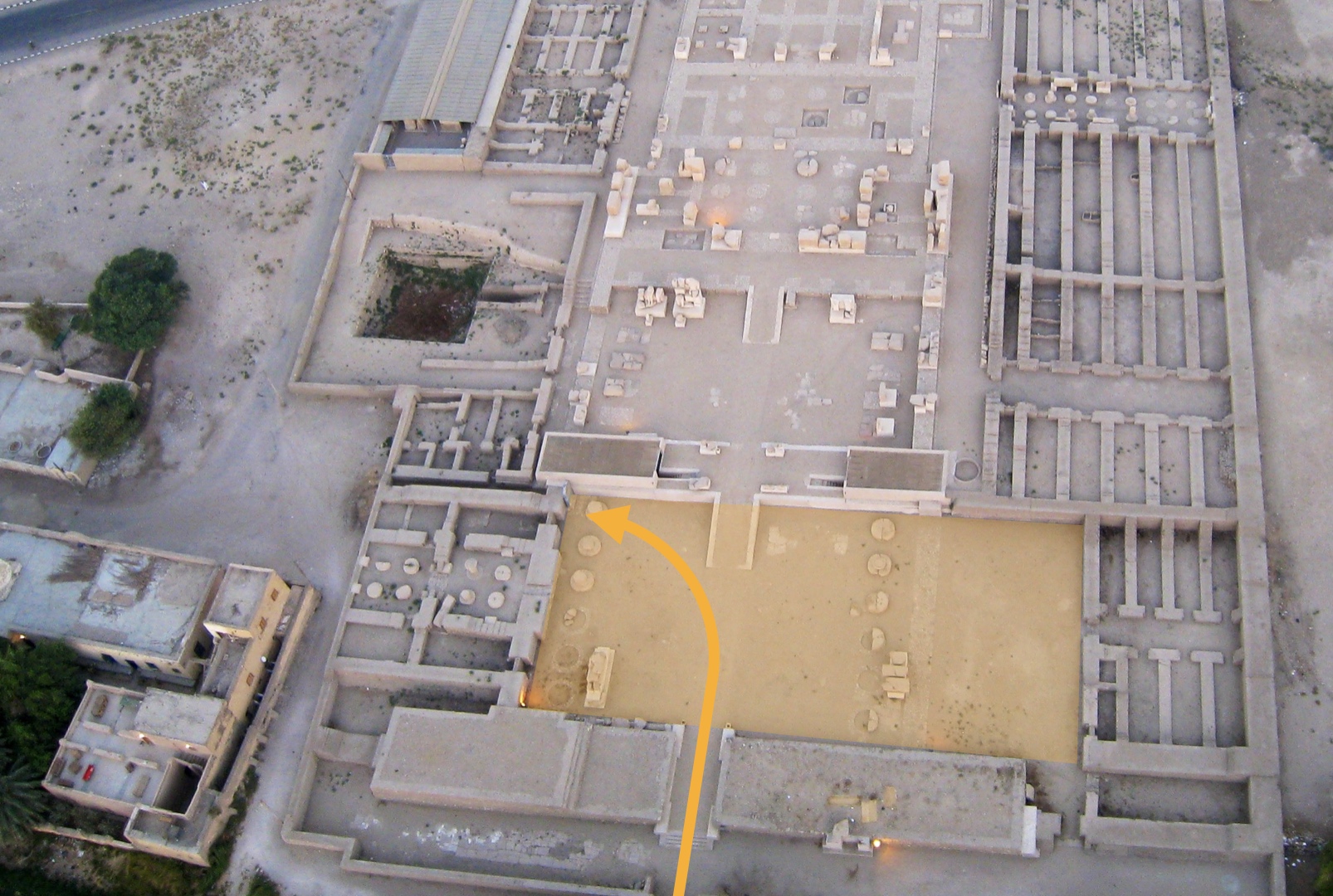
When you enter Merneptah’s Mortuary Temple, you’re standing in what’s called the First Court. When Petrie was excavating it he found at the back left corner of the court (that’s the south-west corner) a large, black, granite stele lying flat on the dirt floor.
The stele’s find-site in the first court of Merneptah’s mortuary temple
The stele was over 10 foot long, over 5 foot wide, and more than a foot thick. It clearly used to stand up straight, but had toppled over at some point during the 3,100 years between Merneptah building the Temple, and Petrie’s arrival. Petrie didn’t know it, but this stele was going to be the highlight of his expedition, and the highlight of his career.
On the upward facing side they found an inscription written by Amenhotep III describing his various building projects including his mortuary temple, the Luxor temple, and the third Pylon at Karnak.9
Clearly, the stele was one of the many items Merneptah had looted for his mortuary temple.
Petrie had the ground below the stele shovelled out, creating a small space to crawl into. On the underside he found another inscription, this time by Merneptah, but he couldn’t read much of it, because, as he wrote in his diary,
“…[the inscription] can only be seen a few inches from one’s nose as one lies under the stone…”10
Transcription and translation
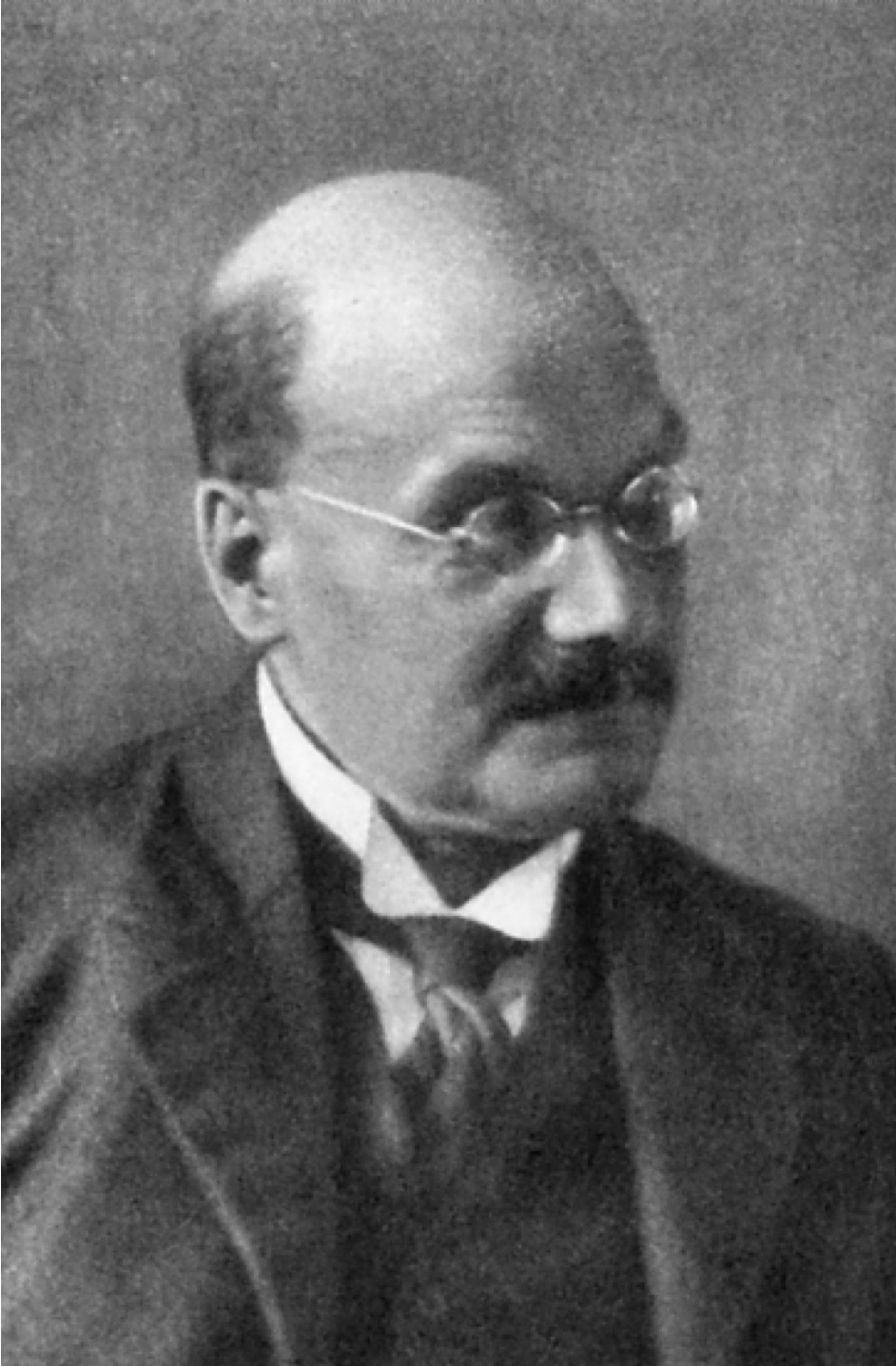
Working alongside Petrie was Dr Wilhelm Spiegelberg, who later became Professor of Egyptology at the University of Munich.
Dr Wilhelm Spiegelberg
From his notebooks it seems Petrie wasn’t a fan of the Germans, but he described Spiegelberg in relatively glowing terms:
He is the pleasantest German I know… for absence of their usual bumptiousness.11
Spiegelberg was out in Luxor taking copies of inscriptions and translating them, so he helped Petrie out doing the same thing during the excavations. About the day that he had Spiegelberg crawl under the stele to see what he could find, Petrie wrote in his memoirs that the german,
…lay there copying for an afternoon, and came out saying, “There are names of various Syrian towns, and one which I do not know, Isirar.” “Why, that is Israel,” said I. “So it is, and won’t the reverends be pleased,” was his reply.12
The significance of their discovery hit them immediately - it was the earliest mention of “Israel” outside the Bible.
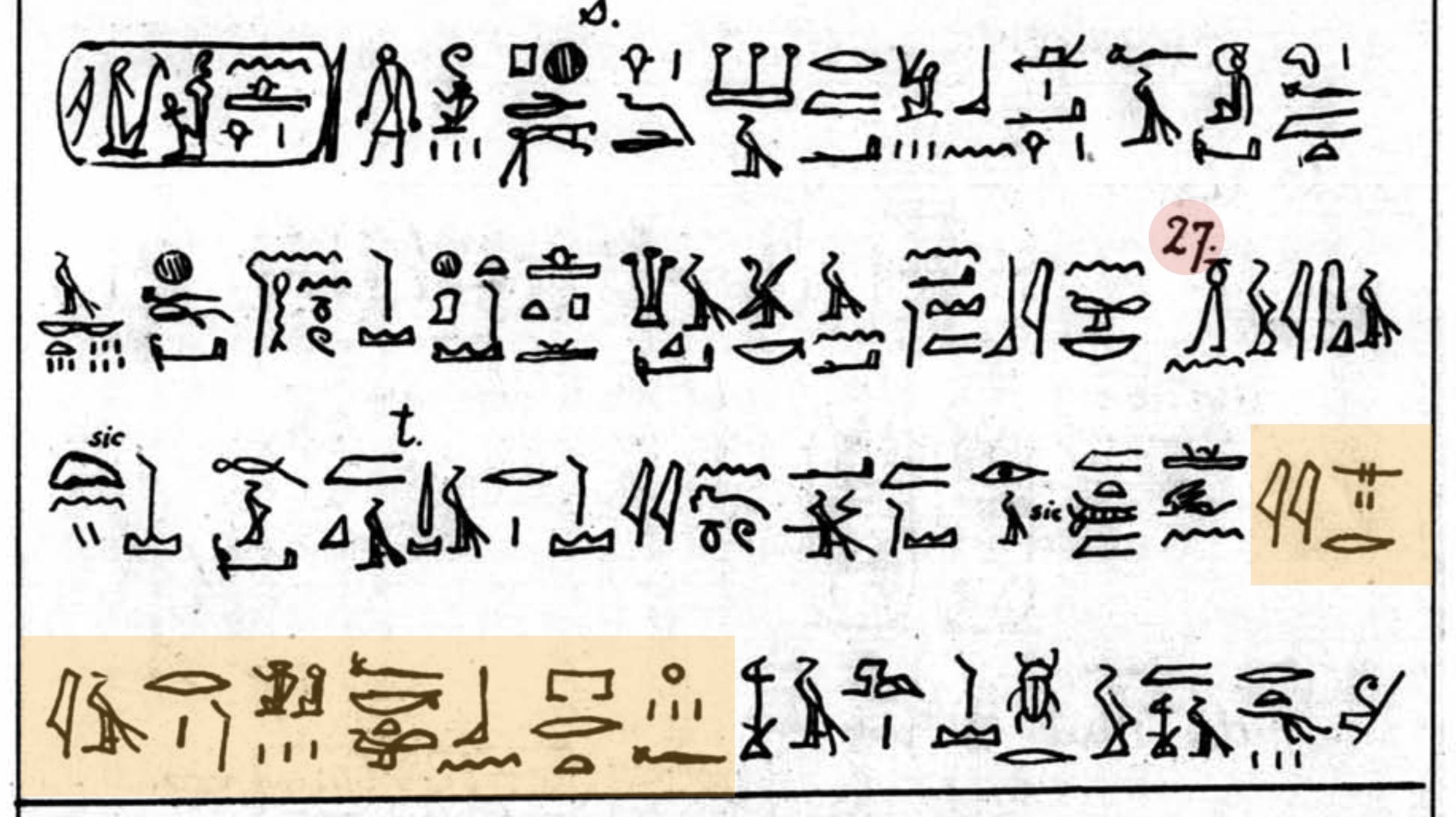
Spiegelberg wasted no time and published his transcription of Mernerpteh’s inscription the same year. Here are the highlighted hieroglyphs from line 27 of the inscription:13
Spiegelberg’s transcription
…which read, “Israel is wasted, its seed is not”. And there you go: Israel. On a stele dated around 1208 BCE.
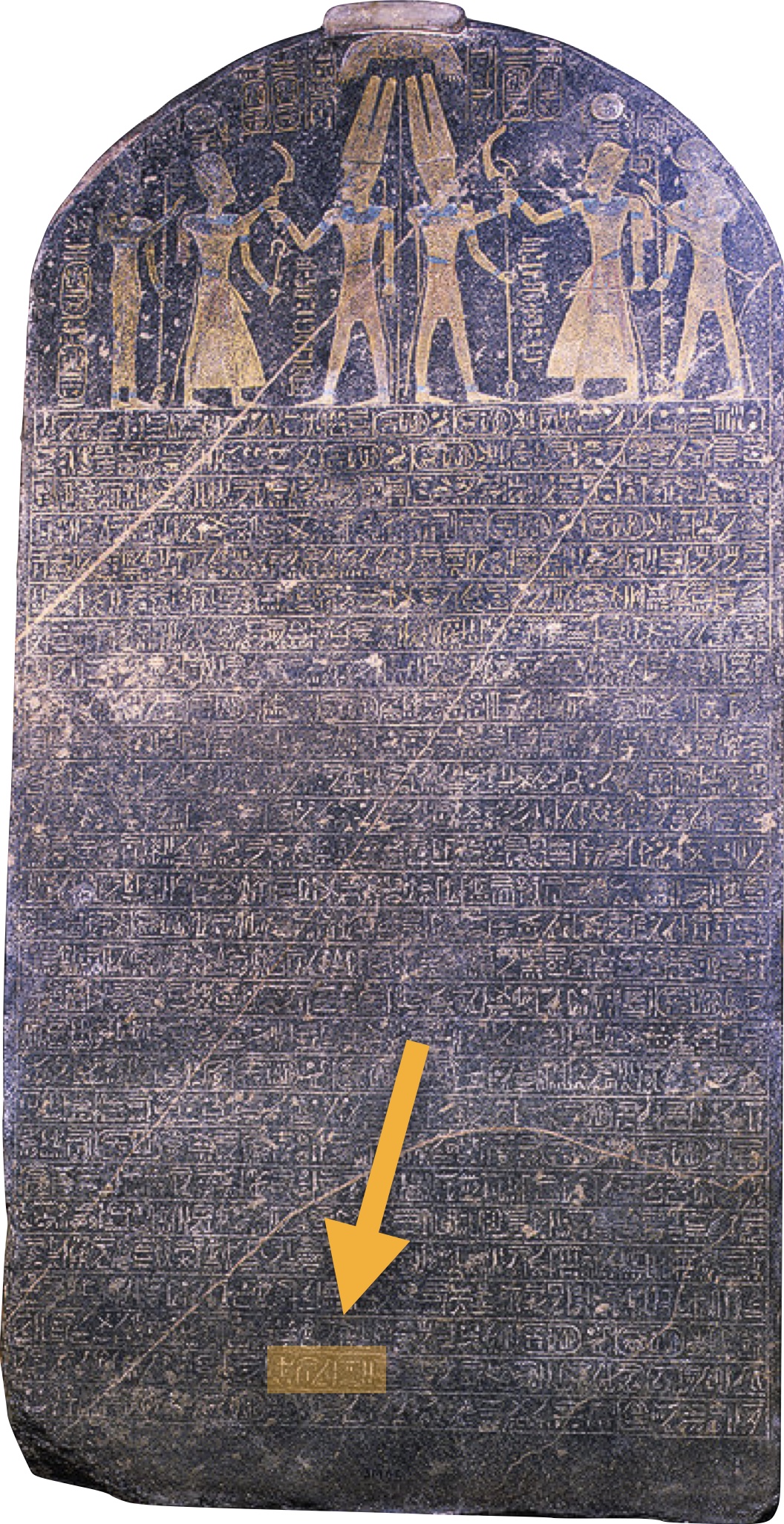
For context, the mention of Israel comes almost at the end of the stele in a list of places and towns that Merneptah had fought in the southern Levant. Here’s how the section reads:
The (foreign) chieftains lie prostrate, saying “Peace.” Not one lifts his head among the Nine Bows. Libya is captured, while Hatti is pacified. Canaan is plundered, Ashkelon is carried off, and Gezer is captured. Yenoam is made into non-existence; Israel is wasted, its seed is not; and Hurru is become a widow because of Egypt. All lands united themselves in peace. Those who went about are subdued by the king of Upper and Lower Egypt … Merneptah.14
The Merneptah Stele with ‘Israel’ highlighted.
The evening of the discovery, Petrie declared,
This stele will be better known in the world than anything else I have found.15
And he was right. He packed his bags on March 4th16 and headed home to England where news of the stele caused a sensation - for all the reasons it’s still promoted by Christian apologists today.
Now, I’m going to get into the apologetic value of the mention of “Israel” and its abuse by some apologists (Christian and otherwise) sometime in the future. For now, we’re going to stick to what Merneptah says about Israel. In the spirit of this series, we’re going beyond apologetics.
Beyond Apologetics
Language of Annihilation
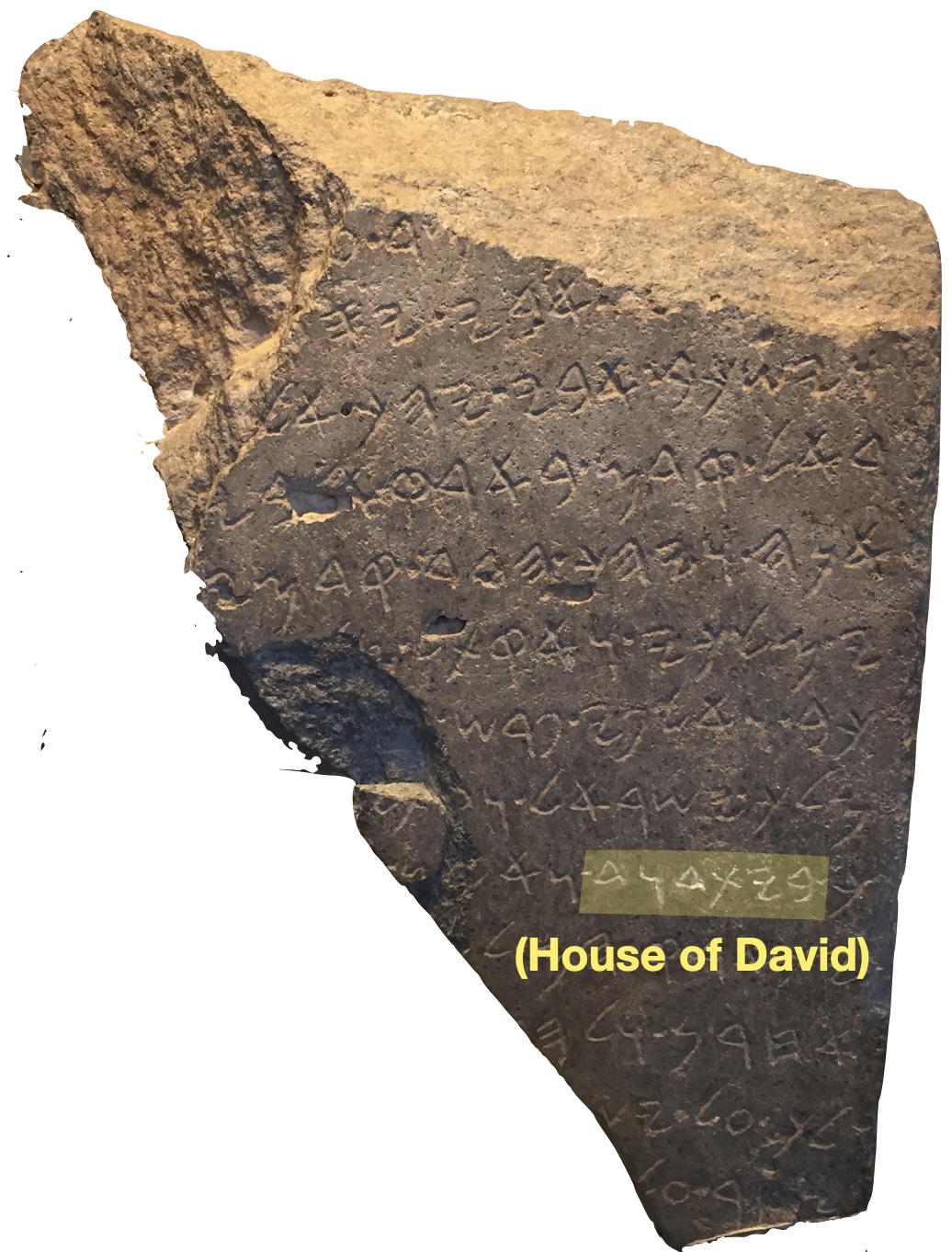
It’s a bit like the Tel Dan Stele’s mention of the “House of David” - the apologetics stuff is interesting enough, but it’s when you look at the rest of the sentence that the famous phrase is in that questions start to appear. So let’s get into it.
Merneptah
As we’ve seen, the Merneptah Stele’s mention of Israel is the phrase,
Now, there is plenty of discussion about what Merneptah meant by “its seed is not”,18 but we’re not going to get into that in any detail other than to say that what happened to the “seed” either means that “Israel” was completely wiped out down to the last man, woman and child, or, that their crops have been completely destroyed such that the few Israelites who survived the battle with Merneptah would die from starvation. The end result is the same: as Professor and Chair of the Religion department at Brandon University in Canada, Kurt Noll explains,
…Merneptah claims to have utterly annihilated these people.19
Now, we don’t need the Bible to know that Merneptah’s boast was nothing but wild exaggeration. Even with all the complication about working out precisely who Merneptah’s “Israel” refers to, we find Israel mentioned on the Tel Dan Stele (as we saw in the last video), we also find Israel mentioned on the Mesha Stele (which we’ll cover in a future video), and they’re mentioned on the Kurkh Stele of Shalmaneser III. Whoever “Israel” was… they seemed to have survived whatever Merneptah did to them just fine.
So, why did Merneptah claim to have annihilated “Israel”? Especially since anyone travelling from Egypt along the main trade route up the Levant would know that Israel was doing just fine? Well, as Professor of Hebrew Bible and Old Testament at Rhodes College, Steven McKenzie explains,
This statement is an exaggeration for propaganda purposes.20
If Merneptah’s claim is read as a statement of fact, it’s clearly false. It’s quite clearly exaggeration - Israel was not wiped out; as we’ve seen they lived to fight another day.
In fact, it’s more than just exaggeration. As Noll writes,
The rhetoric of this inscription is the usual boastfulness that one expects from a proud king of mighty Egypt. In fact, it is the language of cliché… the poem consists of sweeping generalizations quite typical of pharaonic bluster, the kind of text that makes it all but impossible to determine what events gave rise to the hyperbole.21
And that’s the point - Merneptah’s boast is not an isolated case, this is just how rulers wrote. It’s cliché.
Mesha
In fact, the next time we find mention of “Israel” in the historical record is in an inscription by a guy named Mesha, the ruler of the Moabites, claiming to have “wiped out” the Israelites. The inscription, dating from around 830 BCE, states,
And these aren’t the only instances of inscriptions claiming to have “wiped out” Israel - it’s kind of a theme, mainly because claims to have “wiped people out” is kind of a theme in ancient writing.
One more example…
Ramses III
A few pharaohs after Merneptah, Ramsesses III came along. By his time the invasion of the Sea People was in full swing. He was taking a beating on every front, particularly in his remaining territories along the coast of what is modern day Israel, or “Djahi” as the Egyptians referred to it.
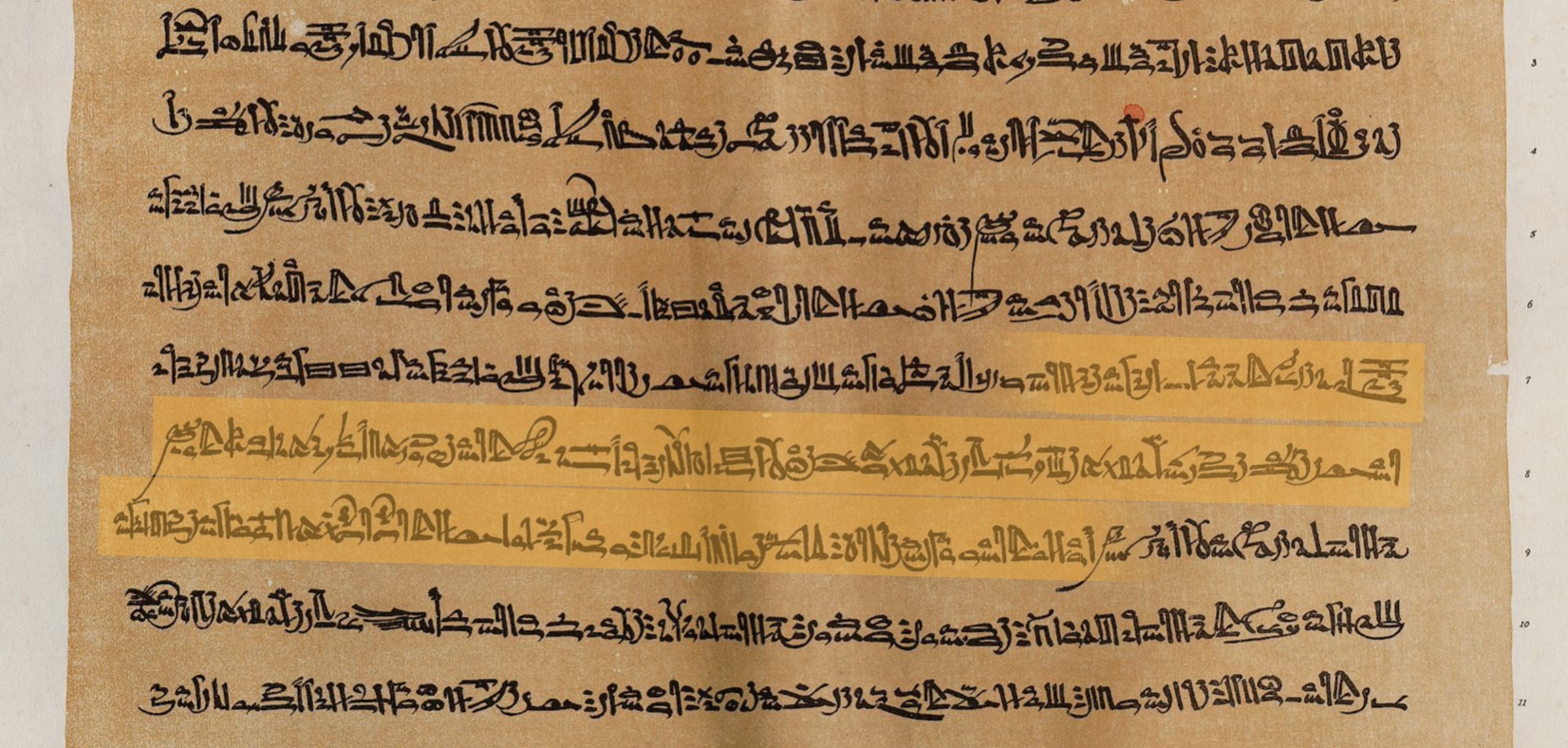
In a document known today as Papyrus Harris 1, stored in the British Museum but sadly not on display, we get a summary of the northern wars against the Peoples of the Sea. In it we read of events in his 8th year,
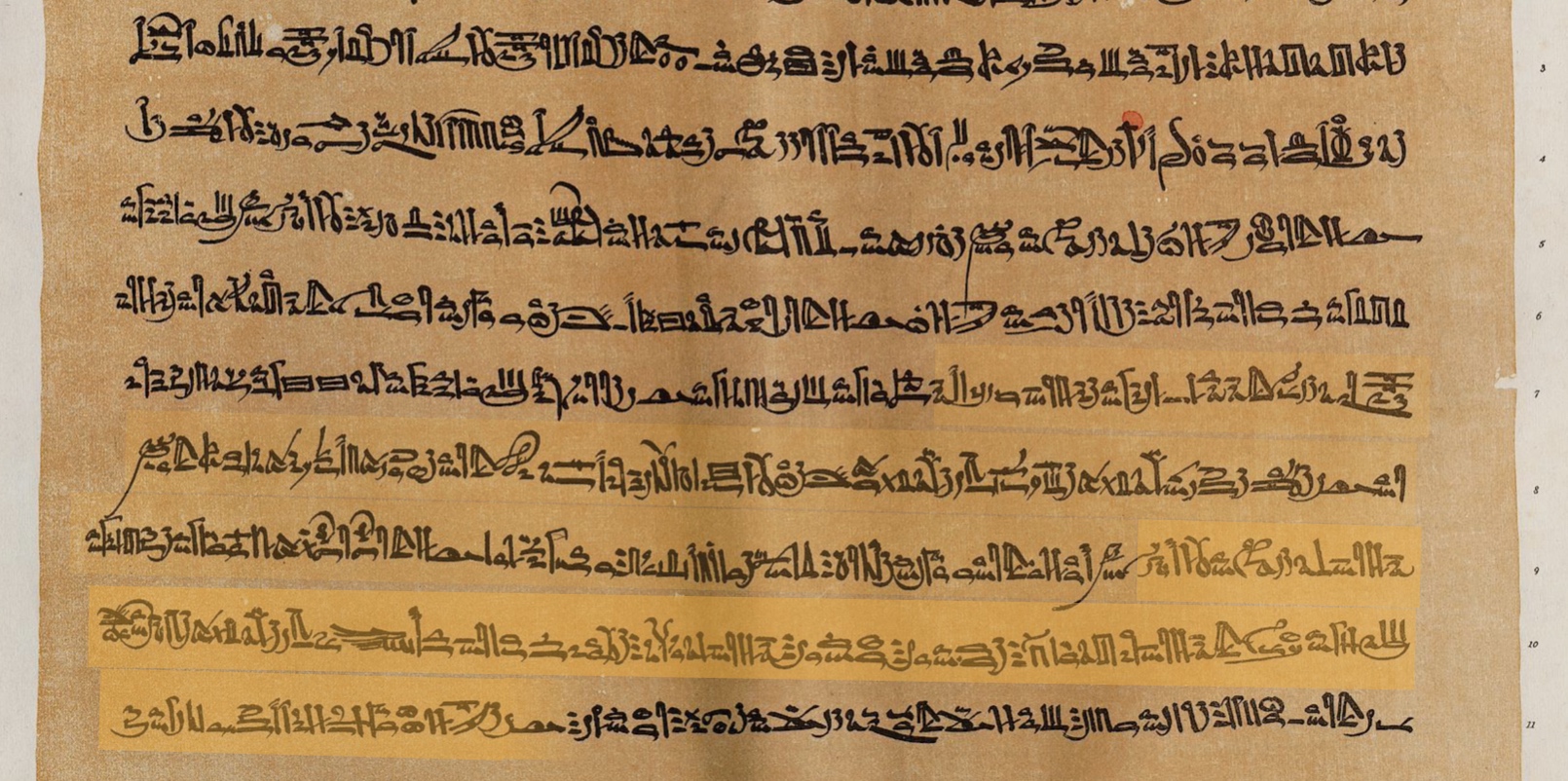
The Sherden and the Weshesh of the Sea were made nonexistent, captured all together and brought in captivity to Egypt like the sands of the shore. I settled them in strongholds, bound in my name.23
Papyrus Harris 1 with the above quote highlighted.
As Professor of History and Humanities at York University in Toronto, Carl Ehrlich explains what’s going on here:
According to Papyrus Harris I, Ramesses, after his victory, settled the Sea Peoples, whom he had “annihilated,” in fortresses24
So, these Sea People “tribes”, the Weshesh and Sherden, were annihilated. They were “made non-existent”. And… then they were settled? So… they weren’t annihilated?
Ramesses III continues,
I destroyed the people of Seir among the Bedouin tribes. I razed their tents: their people, their property, and their cattle as well, without number, pinioned and carried away in captivity, as the tribute of Egypt. I gave them to the Ennead of the gods, as slaves for their houses.25
Papyrus Harris 1 with the above quote highlighted.
These people of Seir seemed to have suffered a similar fate - after being completely annihilated and wiped off the face of the earth, they were enslaved and moved somewhere.
Clearly, annihilation isn’t all it’s cracked up to be. It seems being exterminated, wiped off the face of the earth, made non-existent, etc etc, was practically a guarantee that you were going to make a comeback, and probably in style.
SCRIPTURE IS NO DIFFERENT IN THE WAY IT TALKS ABOUT ANNIHILATION.
When it comes to the Bible, we often approach it with the expectation that we can read it at face value and understand it that way. A common approach is to just “read what it says” and accept what we think it’s claiming. We don’t have it in our minds that we’re reading a thoroughly ancient text written in thoroughly ancient ways - we read it like a book written in the past 50 years, something we can just take at face value.
Well, if we’re doing that, that’s a mistake, and the language of annihilation is one of many many examples of where the biblical text works exactly the same as other ancient texts. Let’s take a look.
Annihilation in the Bible
Joshua 10 & 11
We may as well dive in at the deep end - and turn to Joshua 10 & 11, a couple of the most controversial passages in scripture.
I’m hoping to do a series on these two chapters; for now we’re going to look at just one aspect of them: the way they describe the result of the two campaigns they document.
Chapter 10 is often referred to as the Southern Campaign and chapter 11 as the Northern Campaign. Let’s take a look.
Chapter 10 begins with the Israelites down in the Jordan Valley in their base camp at Gilgal. They marched up to Gibeon, defended it in battle against a coalition of Amorite Kings, chased those who retreated down the valley of Ayalon and chased those who survived the hailstones God threw down on them all the way into the southern hill country of Judah.
Toward the end of the chapter we’re presented with a list of cities the Israelites defeated, each one described in a pretty formulaic way including the phrase like “Joshua struck him and his people, leaving him no survivors” (10:33), or, “ he struck it with the edge of the sword, and every person in it; he left no one remaining in it…” (10:30)”.
After the list of towns we get the complete summary of the Southern Campaign:
Jos 10:40 “So Joshua defeated the whole land, the hill country and the Negeb and the lowland and the slopes, and all their kings; he left no one remaining, but utterly destroyed all that breathed, as the Lord God of Israel commanded.”
Now, some people try really hard to make this say something else, but what it’s saying is pretty clear. As Professor of Old Testament at United Theological Seminary, Thomas Dozeman writes,
“…the war is not for the purpose of conquest, but of extermination…”26
And, to emphasise the point that everyone was wiped out, the writer of this passage says that Joshua, “utterly destroyed all that breathed, as the Lord God of Israel commanded.”
Where’s that command? In another “text of terror”; Deuteronomy 20. Here’s what it says:
Dt 20:16–17 “But as for the towns of these peoples that the Lord your God is giving you as an inheritance, you must not let anything that breathes remain alive. You shall annihilate them—[…]—just as the Lord your God has commanded…”
There’s no getting around the way the text describes the result of the Southern Campaign: the southern half of Canaan’s population had been annihilated - exactly as commanded in Deuteronomy.
Let’s turn to the Northern Campaign.
In chapter 11, when the king of Hazor in the north heard about the Israelites’ southern campaign he organised for the kings of the various northern Canaanite tribes to gather together for war. The Israelites went up to fight them, and, of course, they won. Just like the one we find at the end of chapter 10, we get a summary of the northern campaign and what was achieved in it. Here’s how it reads:
Jos 11:19–20 “There was not a town that made peace with the Israelites, except the Hivites, the inhabitants of Gibeon; all were taken in battle. For it was the Lord’s doing to harden their hearts so that they would come against Israel in battle, in order that they might be utterly destroyed, and might receive no mercy, but be exterminated [and, like we saw about the southern campaign], just as the Lord had commanded Moses.”
Again, a complete annihilation. The Canaanites had been exterminated. Utterly destroyed. Who was left in the land? No one. As it says in the next verse,
Jos 11:23 “So Joshua took the whole land… And the land had rest from war.”
Everyone in Canaan was dead. Every last man, woman, child. There was no one left to breathe. Just as the Lord had commanded back in Deuteronomy.
But, it’s not that simple. What’s true for Merneptah’s claim about wiping out the Israelites is true for the biblical claim about the Israelites wiping out the Canaanites. As Noll writes,
Did [Merneptah] really wipe out Israel? In the ancient world, a king often claimed to have annihilated an enemy, yet the enemy in question curiously appears again in later inscriptions!27
K. L. Noll, Canaan and Israel in Antiquity: An Introduction, vol. 83 of The Biblical Seminar (New York: Sheffield Academic Press, 2001), 126.
And that’s what we find in Joshua. Let’s take a look at a couple of examples.
Debir
Back in 10:38-39 we read about what happened to Debir, a town at the southern end of the hills of Judah. Here’s what we’re told:
Jos 10:38–39 “Then Joshua, with all Israel, turned back to Debir and assaulted it, and he took it with its king and all its towns; they struck them with the edge of the sword, and utterly destroyed every person in it; he left no one remaining…”
Pretty conclusive - everyone in the town was completely annihilated. But, what do we read in Judges 1?
The tribes are taking their inheritance, and in verse 11 we find this:
Jdg 1:11–12 From there they went against the inhabitants of Debir (the name of Debir was formerly Kiriath-sepher). Then Caleb said, “Whoever attacks Kiriath-sepher and takes it, I will give him my daughter Achsah as wife.”
Well, if Debir had been annihilated as Joshua 10 claims, there were no inhabitants to go against. Maybe Caleb just wanted rid of his daughter? I mean, there was no one there to stand in the way of anyone who wanted to take Debir, right? Joshua had exterminated the town. So, why are we reading about the “inhabitants of Debir”?
Like Noll said, “the enemy in question curiously appears again in later inscriptions”. And it’s not like Debir is an isolated example from these two chapters. Let’s take a look at Hebron.
Hebron
The passage in Joshua 10 is pretty uncompromising:
Jos 10:36–37 “Then Joshua went up with all Israel from Eglon to Hebron; they assaulted it, and took it, and struck it with the edge of the sword, and its king and its towns, and every person in it; he left no one remaining, just as he had done to Eglon, and utterly destroyed it with every person in it.”
The annihilation was so complete “every person in it” is mentioned twice! There’s no wiggle room here - the passage describes a complete extermination of every single person in Hebron. The. Town. Was. Empty.
What do we find, bizarrely enough, at the end of the Northern campaign?
Jos 11:21 “At that time Joshua came and wiped out the Anakim from the hill country, from Hebron…”
They’re back?! Oh well. Good job they were annihilated again at the end of chapter 11. Phew. But… what do we read in Judges 1?
“Judah went against the Canaanites who lived in Hebron…”
The people of Hebron made it back from annihilation twice, and in quick succession!?
We could go on with more examples, but we don’t need to comb through the text. There’s a passage which puts a spotlight on this whole thing, saving us the trouble.
The nations that God left
We find it in Judges 3:
Jdg 3:1–5 “Now these are the nations that the Lord left to test all those in Israel who had no experience of any war in Canaan… the five lords of the Philistines, and all the Canaanites, and the Sidonians, and the Hivites who lived on Mount Lebanon… So the Israelites lived among the Canaanites, the Hittites, the Amorites, the Perizzites, the Hivites, and the Jebusites…”
Now, if you go back over the list of Canaanite tribes that Joshua annihilated on the northern campaign you’ll find a similar list:
Jos 11:3 “…the Amorites, the Hittites, the Perizzites, and the Jebusites in the hill country, and the Hivites under Hermon…”
So, these nations that Joshua had annihilated are specifically stated as having been left there by God as battle training for the Israelites? And that instead of annihilating the Canaanites the Israelites lived among them?
This is all very reminiscent of Merneptah’s bold claims to have wiped out the Israelites. He claimed to have wiped them out, but he’d done no such thing. Turns out the same is true of the Canaanite tribes that the Israelites claimed to have wiped out.
Clearly, annihilation in Joshua 10 and 11 isn’t what it seems. The Canaanites weren’t annihilated; they survive in the text in great number. And, even though the Israelites were commanded to wipe them out, we found in Judges that it was God’s intention for Canaanites to remain in the land.
So, that’s “annihilation” in Joshua 10 and 11. Onto our next example…
Amalek
We now go forward in the Old Testament to 1 Samuel to the classic “text of terror” that is 1 Samuel 15. In it we read about how God, speaking through Samuel, instructed king Saul to annihilate the Amalekites. Here’s how that command reads:
1 Sa 15:3 Now go and attack Amalek, and utterly destroy all that they have; do not spare them, but kill both man and woman, child and infant, ox and sheep, camel and donkey.
That’s pretty clear. Kill them all, down to the last man, woman, and child. And their animals. Wipe them all out.
The impetus for this action was a directive found in Deuteronomy 25:19…
Dt 25:19 …when the Lord your God has given you rest from all your enemies on every hand, in the land that the Lord your God is giving you as an inheritance to possess, you shall blot out the remembrance of Amalek from under heaven; do not forget.
So, what did Saul do? Well, the whole point of the narrative is that Saul’s downfall was due to the fact that though he killed all the Amalekites, he hadn’t killed their king - Agag. Here’s what it says a few verses after Samuel’s command:
1 Sa 15:8 [Saul] took King Agag of the Amalekites alive, but utterly destroyed all the people with the edge of the sword.
Those preaching on this passage usually concentrate on Saul’s disobedience in not killing Agag - as is kinda the point of the passage, it’s where the narrator wants the focus to be. What’s often passed over though is the rest of verse eight:
[…Saul] utterly destroyed all the people with the edge of the sword.
With the exception of Agag, the text claims that Saul really had wiped out all the Amalekites. He’d annihilated them. His oversight -not killing Agag- was soon remedied by Samuel, who, as we read a few verses later,
1 Sa 15:33 …hewed Agag in pieces before the Lord in Gilgal.
It’s grim stuff, but when it comes to the Amalekite population, that was the end of them. With Agag’s body parts strewn across the floor, there were no longer any Amalekites. They had been annihilated - Saul had “utterly destroyed all the people” down to the last man, woman, and child.
But, just like Merneptah’s Israel, though Saul and Samuel had “utterly destroyed” the Amalekites down to the last man, woman, and child, we find them reappearing only a few chapters later… and in significant numbers.
Here’s how 1 Sa 30 opens:
1 Sa 30:1–2 Now when David and his men came to Ziklag on the third day, the Amalekites had made a raid on the Negeb and on Ziklag. They had attacked Ziklag, burned it down, and taken captive the women and all who were in it, both small and great; they killed none of them, but carried them off, and went their way.
We’re not going to get into the many questions that arise from the fact that the Amalekites didn’t kill a single Israelite (unlike the Israelites who were supposed to have killed every man, woman, and child) - we’re in the passage to note that not only did the Amalekites survive Saul’s genocide, they appear to have survived in great numbers. There were enough of them to take all the woman and children of Ziklag captive (the soldiers had left for battle with Saul), and, more to the point, take a look at verse 17:
1 Sa 30:17 David attacked them from twilight until the evening of the next day. Not one of them escaped, except four hundred young men, who mounted camels and fled.
There were enough Amalekite soldiers to keep David’s army occupied for 24 hours, and by the end of the battle there were enough survivors on the Amalekite side for the retreat to be made up of 400 men.
Clearly, when Saul “utterly destroyed” the Amalekites, “utterly destroyed” doesn’t mean what we think it means. It seems “utterly destroyed” can mean “definitely not utterly destroyed.”
So much for the annihilation of the Amalekites.
For our final biblical example of where annihilation clearly doesn’t mean annihilation, let’s take a look at my favourite example…
Joshua 10:20
Back in Joshua 10 we have the record of Joshua’s “Southern Campaign”. As we’ve already seen, it includes the battle of Gibeon, the “Long Day”, and the conquest of the cities in southern Canaan. It’s also got a section, from verse 16-27, about 5 Amorite kings being shut in a cave to be dealt with after the Israelites had finished battling the Amorites.
So, Joshua instructs his army to go fight. And, they do. In the next verse we find out how that went:
Jos 10:20–21 When Joshua and the Israelites had finished inflicting a very great slaughter on them, until they were wiped out, and when the survivors had entered into the fortified towns, 21all the people returned safe to Joshua in the camp at Makkedah…
So…
The enemy was “wiped out”…
…but in the very same verse, only one phrase on, we find that there were survivors who managed to retreat to their fortified towns.
Now, imagine writing this with the expectation that the reader would understand the phrase “wiped out” in the way we’d understand it, i.e. as annihilation - “utter destruction”. If that’s what you wanted your readers to think you wouldn’t follow “until they were wiped out” in the very same sentence with talk of what the survivors did.
Interestingly, some bible translations fall right into this trap - they try to tone down the “wiped out” bit into something a little less… emphatic.
The NRSV that we’ve been quoting doesn’t shy away from the difficulty. It has “wiped out” next to talk of “survivors”. The same goes for the ESV and NASB. The same can’t be said for the New Living Translation which has,
Jos 10:20 (NLT) They totally wiped out the five armies except for a tiny remnant…
Running “except for” in the same sentence feels like a watering down of the absolutist language of the underlying Hebrew. The New English Translation is worse with its rendering the passage,
Jos 10:20 (NET) Joshua and the Israelites almost totally wiped them out, but some survivors did escape to the fortified cities.
“Almost totally wiped them out”!? That’s just not what the Hebrew says. It doesn’t say “almost wiped out”. It says “wiped out”. I like the NET, but in places it tries too hard to iron out or massage away difficulties for my liking.
You can look at attempts to massage away the weirdness as a positive thing - the translators are trying to make it easy for us laypeople to understand the narrative. The thing about this though is that we’re not reading a translation of the biblical text; we’re reading what someone thinks the biblical text should say. I don’t know about you, but I’m not really interested in that. If the text is not in a genre I’m familiar with then I want to know that, and contradictory statements right next to each other are the kind of clue I want. If the text is weird then I want to know that. Don’t try to hide it from me; just give it to me straight and then explain in a footnote how it ought to be understood.
Ironing out the “difficulties” would be like taking a poem and replacing the rhyming words at the end of each line with words that mean the same thing but that don’t rhyme - the poem would read like prose, hiding the fact from you that the text is actually a poem. And that matters - we interpret poems in a different way to how we interpret prose. Confusing poetry for prose will make you look like a right idiot, so you don’t want a translator doing that to you. So, Joshua 10:20 with its “annihilated! but survivors…” language is too useful to be watered down by translators like the NLT and NET do. You want to know you’re dealing with hyperbole so you don’t start interpreting it literally - as many people do.
In fact, this verse is probably the single most useful one in scripture to show how reading language of annihilation in wooden, literalist ways is to miss something important in the text: hyperbole.
Hyperbole
And that’s really what this video is about - it’s about being mindful when reading the biblical text, watching out for hyperbole, especially when it comes to the language of annihilation. Because if you take those claims at face value, you’re going to end up very confused when supposedly exterminated people reappear in great numbers later in the text.
When Merneptah wrote that he’d annihilated “Israel”, it was, at best, hyperbole. When Rameses III claimed to have annihilated the various Sea Peoples, it was hyperbole. When Mesha writes that he wiped out the Israelites he also was employing hyperbole.
And, as we’ve seen, it turns out that the Bible is no different. It contains hyperbole, particularly around the language of annihilation. This isn’t to try to remove the difficulty of the various difficult passages that talk about annihilation, it’s only to recognise that in those passages we’re almost always dealing with examples of hyperbole, not the boring repetition of historical facts.
Even though Joshua was said to have wiped out the inhabitants of the promised land, it’s very clear that no such thing happened. It’s hyperbole.
Even though the Bible says they did, Saul and Samuel didn’t annihilate the Amalekites. Not even close. It’s hyperbole.
And finally, even though the Israelite army was said to have “wiped” out the Amorite armies, when the very next sentence says there were survivors, it’s clear that the Amorites weren’t wiped out. It’s hyperbole.
Why does this matter? Well, if you’re taking these biblical ancient conquest accounts at face value, you’re going to have certain expectations of the archaeological record. You’re going to expect archaeologists to be digging up remains of huge battles, you’re going to expect wholesale change in the material culture from Canaanite to Israelite… and you’re going to expect annihilated people to not reappear in the text.
None of these things are true. Instead,
Archaeologists have not found evidence of annihilation - quite the opposite. They’ve found that the people who settled in the Canaanite highlands whose descendants were the biblical Israelites settled pretty much peacefully in areas no one was living in.
At the relevant sites, archaeologists have found that there’s precious little change in material culture at the beginning of the Israelite period - they’ve found that in the main, the culture of those who took part in the settlement of the country continued the surrounding Canaanite material culture.
And, when it comes to the text, we find that people who were supposedly annihilated reappear all over the place - the people of Hebron, Debir, the Amalekites, etc.
None of this will be any surprise to people who recognise hyperbole when they see it. They won’t have unrealistic expectations of the archaeological record, so they won’t be bending over backwards to try to make the evidence say what it doesn’t. That’s why, especially when it comes to the several-thousand-year-old biblical text, it’s important to know the genre of what you’re reading. And to know the the genre you need to be reading a proper translation that doesn’t hide the clues from you. And you need a decent study bible or commentary set that’ll inform you about what you’re reading. It’s not enough to just “read the Bible” because the presuppositions you approach the text with almost blind you to what you’re reading. We’re too steeped in our own 21st century, western, legalistic, materialist, stupid culture to understand a text that’s thousands of years old.
So. There you go. The mention of “Israel” on the Merneptah is cool, but the fact that they’re mentioned as having been annihilated is what’s really interesting. Beyond apologetics.
Featured image
Merneptah Stele, by Onceinawhile (CC-BY-SA-4.0), superimposed on General Karte von Theben, from the Lepsius Projekt (public domain).
William Matthew Flinders Petrie, “Seventy Years in Archaeology (1932), 171. ↩
James E. Quibell (correspondence dated 18th December 1896) in James Henry Breasted, “The Latest from Petrie,” The Biblical World (Feb), Vol. 7, No.2 (1896): 139. ↩
William Matthew Flinders Petrie, “Seventy Years in Archaeology (1932), 171. ↩
William Matthew Flinders Petrie (correspondence dated 14th February 1896) in James Henry Breasted, “The Latest from Petrie,” The Biblical World (April), Vol. 7, No.4 (1896): 292. ↩
Flinders Petrie, Seventy Years in Archaeology (New York, 1932), 171. ↩
Ian Shaw, The Oxford History of Ancient Egypt (Oxford University Press, 2003), 295. ↩
Flinders Petrie, “Egypt and Israel,” The Contemporary Review, May 1896, 619. ↩
Miriam Lichtheim, Ancient Egyptian Literature: Volume II: The New Kingdom (Berkeley: University of California Press, 1973–), 43–47. ↩
Flinders Petrie, Seventy Years in Archaeology (New York, 1932), 172. ↩
Wilhelm Spiegelberg, “Der Siegeshymnus des Merneptah auf der Flinders Petrie-Stele,” Zeitschrift für Ägyptische Sprache und Altertumskunde, Volume 34, Issue 1 (1896): 1-25. ↩
William W. Hallo and K. Lawson Younger, Context of Scripture (Leiden; Boston: Brill, 2000), 41. ↩
William Flinders Petrie, Seventy Years in Archaeology (New York, 1932), 172. ↩
William Flinders Petrie, Seventy Years in Archaeology (New York, 1932), 173. ↩
William W. Hallo and K. Lawson Younger, Context of Scripture (Leiden; Boston: Brill, 2000), 41. ↩
Michael G. Hasel, “Israel in the Merneptah Stela,” Bulletin of the American Schools of Oriental Research (November).296 (1994): 45-61. ↩
K. L. Noll, Canaan and Israel in Antiquity: An Introduction, vol. 83 of The Biblical Seminar (New York: Sheffield Academic Press, 2001), 126. ↩
Steven L. McKenzie, Introduction to the Historical Books: Strategies for Reading (Grand Rapids, MI; Cambridge: William. B. Eerdmans Publishing Company, 2010), 50. ↩
K. L. Noll, Canaan and Israel in Antiquity: An Introduction, vol. 83 of The Biblical Seminar (New York: Sheffield Academic Press, 2001), 126. ↩
James Bennett Pritchard, ed., The Ancient Near Eastern Texts Relating to the Old Testament , 3rd ed. with Supplement. (Princeton: Princeton University Press, 1969), 320. ↩
James Bennett Pritchard, ed., The Ancient Near Eastern Texts Relating to the Old Testament , 3rd ed. with Supplement. (Princeton: Princeton University Press, 1969), 262. ↩
C. S. Ehrlich, “Philistines,” Dictionary of the Old Testament: Historical Books (Downers Grove, IL: InterVarsity Press, 2005), 786. ↩
James Bennett Pritchard, ed., The Ancient Near Eastern Texts Relating to the Old Testament , 3rd ed. with Supplement. (Princeton: Princeton University Press, 1969), 262. ↩
Thomas B. Dozeman, Joshua 1–12: A New Translation with Introduction and Commentary, ed. John J. Collins, vol. 6B of Anchor Yale Bible (New Haven; London: Yale University Press, 2015), 59. ↩
K. L. Noll, Canaan and Israel in Antiquity: An Introduction, vol. 83 of The Biblical Seminar (New York: Sheffield Academic Press, 2001), 126. ↩
]]>Biblical Historical ContextThe Tel Dan Stele: Beyond Apologetics2022-01-02T23:01:00+00:002022-01-02T23:01:00+00:00https://biblicalhistoricalcontext.com/beyond-apologetics/tel-dan-steleNB: This post is available as a two-part youtube video.
The Tel Dan stele is a great example of the sort of archaeological discovery that apologists use to “prove the Bible true”. Sure, it mentions the “House of David”, and from an apologetics point of view, that’s pretty cool, but staying at that level can feel pretty shallow. When we dig deeper, the inscription highlights aspects of the biblical text that we might otherwise miss; aspects that force us to engage with the biblical text in more sophisticated ways than we otherwise might. And that’s way more interesting and useful than apologetic chest beating.
In this post we’re going to…
…have a brief look at the way people were thinking about the Bible in the lead up to the stele’s discovery
…look at how the Tel Dan stele was found, dated, and read
…look at how the relevant scholars figured out who it mentions - and it’s more than just the House of David
…see how the events related in the inscription line up or not with the way they’re recorded in the biblical text
…think a little about what this means for the way we read and think about the historical books of the Bible
Minimalism
For most of the 20th century, archaeologists working in the Middle East dug with a spade in one hand and a bible in the other. These were the days of “Biblical Archaeology”, when “archaeology proved the Bible true”.
But, in the late 80’s things got considerably more complicated. Due to new discoveries and more modern methods, interpretations of previous discoveries were revised, old conclusions were shown to be incorrect, and confidence in a face-value, literal reading of the “historical” books of the Bible really dropped off.
At the extreme end of this development were a group of scholars who came to be labelled “minimalists”, for their shared view that there’s precious little in the “historical” books that’s historically accurate. In their eyes the historical value of the biblical texts was… minimal.
Here’s an example of the sort of thing that was being written about such central characters as Saul and David in the early 1990s:
…the narratives of Saul and David… serve no evident purpose at this point in the history of the kingdoms of Palestine. Who would need persuading of what by such fictions? 1
David, in the eyes of the minimalists, was a “fiction”. Elsewhere in the same book we come across this:
Whoever is living in the Palestinian highlands around 1000 BCE, they do not think, look or act like the people the biblical writers have put there. They are literary creations.2
Around 1000 BCE? He’s talking about the time of David.
So, David was thought of as a fiction; a literary creation.
There are similar quotes from other “minimalist” scholars we could have used, but the one we just looked at is important because of the timing. That book, by Professor of Biblical Studies at Sheffield, Philip Davies was published in 1992, just one year before the discovery of the Tel Dan stele. His timing was terrible…
Discovery of the 1st section
Site background
In the far north of the modern state of Israel, at the foot of Mt Hermon and only a few meters from the border with Lebanon, lie the remains of the ancient city of Dan - the site known today as Tel Dan.
Tel Dan at the foot of Mt Hermon
Being one of the sources of the river Jordan, it’s a beautiful, green site and a welcome relief from the summer heat for tourists visiting the Holy Land.
Excavations began at Tel Dan in 1963, and even before the stele was discovered the site was famous for the discovery of what’s known as “Abraham’s Gate” –a well preserved Middle Bronze mudbrick gate– and the “High Place”, said to be the altar built by Jeroboam.
Middle Bronze mud brick gate at Tel Dan, AKA Abraham’s Gate
But it was in 1993 that the site’s most significant discovery would take place.
How the 1st section was discovered
(Sequence of events reconstructed from various sources3)
In 1993, the site was being excavated by Director of the Nelson Glueck School of Biblical Archaeology at Hebrew Union College, Avraham Biran.
Outside of excavation season, Biran drove up to the site from Jerusalem to show a visitor around the site. His site surveyor, Gila Cook, hitched a ride as she had some surveying work she wanted to finish at the site.
After some time the tour of the site was over and Biran called over to Cook to pack up her stuff - it was time for the long drive home.
Cook’s surveying equipment was bulky so on the way back to the car she set some of it down to rearrange it, so she could carry it a little easier. As she bent down to pick it up again she noticed that the light had fallen on a particular stone sticking up out of a newly excavated wall and on it she could see what looked like an inscription.
She called Biran over, they freed the slab, and they could make out the letters of an inscription as clear as day.
The find site of Fragment A at Tel Dan
Initial publication
As many scholars have noted, Biran was quick to get the inscription published, something he did with Joseph Naveh, a Professor of West Semitic Epigraphy and Palaeography at the Institute of Archaeology at the Hebrew University of Jerusalem.
When their article entitled “An Aramaic Stele Fragment from Tel Dan” was published in the Israel Exploration Journal, it became front page news. Like, New York Times front page news (Aug 6th 1993).
The reason for the global interest was because of what was found on the 9th line of the inscription. According to Biran and Naveh it read:
And [I] slew [… the kin-]g of the House of David.4
Fragment A of the Tel Dan Stele; the phrase ‘House of David’ is highlighted
This was, to understate things, a massive deal. This was earth shaking stuff. The House of David.
The vast majority of scholars accepted the obvious. As Professor of Jewish Studies at the University of Georgia, Baruch Halpern wrote a couple of years later:
The Tel Dan inscription unmistakably indicates the existence of a dynasty in the ninth century B.C.E. that traced its origin to David.5
After many years of searching by Biblical Archaeologists, finally, David had been found.
Apologetics
As you can imagine, this is the stuff Christian apologists’ dreams are made of. In an age where archaeological “proof” of the biblical narratives is cited by many Christians as one of the foundations for their belief, tangible evidence of the existence of one of the great heroes of the bible is a big deal.
It’s worth stating at this point that apologists do tend to run way too far with discoveries like the Tel Dan stele. As Halpern pointed out, mention of the “House of David” actually isn’t evidence for anything other than “a dynasty in the ninth century B.C.E. that traced its origin to David”.
The stele isn’t evidence that David penned psalms, mourned Absalom, or killed Goliath. It isn’t evidence of any of the events in the life of the biblical David; it’s just evidence of a dynasty named after him. And it’s worth keeping a cool head about that – apologists shouldn’t overplay their hand.
If, one day, archaeologists working in Jerusalem find a huge skull with a hole in its forehead with “How’s about that, Goliath, you big hairy goon” scratched on the side of it, then we can say that we have evidence of the stories of David. Until then, we don’t have that.
Funnily enough, it’s to Professor Emeritus of Archaeology in the Department of Archaeology and Ancient Near Eastern Civilizations at Tel Aviv University, Israel Finkelstein that we can turn to see a whole heap being made out of the inscription. Here’s what he wrote with Neil Asher Silberman in their book, The Bible Unearthed:
This is dramatic evidence of the fame of the Davidic dynasty less than a hundred years after the reign of David’s son Solomon. The fact that Judah (or perhaps its capital, Jerusalem) is referred to with only a mention of its ruling house is clear evidence that the reputation of David was not a literary invention of a much later period… the house of David was known throughout the region; this clearly validates the biblical description of a figure named David becoming the founder of the dynasty of Judahite kings in Jerusalem.6
When Finkelstein writes “Not a literary invention”, he is responding directly to the minimalist argument that the Bible’s historical books were written far too late to contain any historically reliable information –like, the Persian or even the Hellenistic era– and that their contents are literary fictions, as we heard before.
In fact, in The Quest for the Historical Israel, Finkelstein went further, saying that:
The mention of the “House of David” in the Tel Dan inscription from the ninth century B.C.E. leaves no doubt that David and Solomon were historical figures. And there is good reason to accept that many of the David stories in the books of Samuel—mainly the heroic tales and the description of his life as a bandit on the fringe of the Judean highlands—contain genuine, early historical memories.7
They’re some pretty strong statements!
Forgery!
Unsurprisingly, the discovery of the inscription and mention of the “House of David” was seen as serious egg on the minimalists’ faces. After all, as we saw a few minutes ago, it was only one year earlier that Philip Davies claimed that David was a “fiction” and a “literary creation”. As Halpern predicted:
Publication of the Tel Dan inscription will likely not lay the issue to rest.8
He wasn’t wrong. Only a few months later the first journal article casting doubt on the stele’s authenticity was published.
Frederick Cryer, of the University of Copenhagen, published an article entitled “On the recently‐discovered ‘house of David’ inscription” in the Scandinavian Journal of the Old Testament. Here’s what he had to say:
Unhappily, there are grounds for scepticism in connexion with the present find. The first of these is, as mentioned before, that there are reasons for uncertainty as far as the find context of the fragment is concerned… A fourth feature to be considered is topicality. In ancient-historical research, as in the craft of the cloak-and-dagger spy, it is axiomatic that if one finds information just at the moment one needs it, it is very likely to be false… For the record, I doubt that the inscription is a forgery… But the matter will definitely bear further looking into.9
He gave a few reasons the inscription could be a fake, and then… said… it’s probably not. A couple of years later he was back at it:
Without putting too fine a point on it, the archaeological context of the find is uncertain…10
…but back-pedalled in the same article:
I took what should, properly considered, be the first step in dealing with any new epigraphic find of uncertain provenance, which is to say that I examined the question of the authenticity of the inscription,’ and arrived at a positive -if hesitant- evaluation.11
These nonsense claims of forgery petered out, with minimalist Niels Peter Lemche, Professor of Old Testament Studies at the University of Copenhagen, admitting that,
…the arguments in favour of seeing the Tel Dan fragments as fake need to be much more forceful—certainly stronger than I have been able to show in this survey—if they are to prove beyond doubt that the inscription is the work of a forger.12
The consensus is that the inscription is authentic - today it’s only on the extreme fringes that you’ll find anyone who thinks it’s a forgery.
As Professor of Ancient History and Archaeology at The George Washington University, Eric Cline writes,
…no serious scholar doubted the authenticity of the fragments.13
So, how did the minimalists try to discredit the significance of the find next? Backflips.
Minimalist backflips
Instead of accepting the plainly obvious meaning of the inscription, the minimalists wrote up a number of other ways to read “House of David”. Here’s what they came up with:
A place name
Frederick Cryer wrote that maybe “bethdawd” (i.e. ‘beit david’; the text ordinarily translated “House of David”) was the name used by the inscription’s author…
…for a geographical unit which may have been equivalent to all or some part of the region we regard as Judah.14
This is plain speculation. There’s no evidence for the idea that people from the time of the inscription referred to land of Judah as bethdawd. He’s pulled that straight out of the air.
Lemche and Thompson suggested that it,
may be a place somewhere in the vicinity of ancient Dan!15
Again, speculation. There’s nowhere in the area of Dan that’s called bethdawd.
In the same article they suggested that,
We would argue that it could also refer to the name of a holy place at Dan…16
More speculation. What other bright ideas did they have?
House of Uncle
Moving on from place names:
In the Bible DWD can mean “beloved” or “uncle,”…17
The house of Uncle!? Yeah, of a god called “Uncle”.
This option was addressed by the Professor of Egyptology at the University of Liverpool, Kenneth Kitchen, who wrote,
And what of this mysterious deity *Dod, trundled out again by some commentators on the Tel Dan stela? Surely the time has now come to celebrate *Dod’s funeral-permanently! There is not one scintilla of respectable, explicit evidence for his/her/its existence anywhere in the biblical and ancient Near Eastern world. No ancient king ever calls himself ’beloved of Dod’; no temple of Dod has ever been found, and clearly identified as such by first-hand inscriptions. We have no hymns to Dod, no offering-lists for Dod, no published rituals in any ancient language for Dod, no statues of Dod, no altars, vessels, nor any other ritual piece or votive object dedicated to Dod as a clear deity. Why? Because he/she/it never existed in antiquity, but is a modem invention by ingenious scholars from the last century…. Dod is a dud deity, as dead as the Dodo…18
“House of Uncle” is just jibber jabber.
What next? Probably my favourite…
House of Kettle
Davies wrote,
…one place [in the Bible] it means “kettle.” So a number of ways of understanding DWD present themselves, most of them more plausible than translating “David.”19
“House of Kettle”? More plausible than the obvious House of David?! Lol.
Davies wasn’t alone. Cryer wrote that there was an option,
…that has not as yet to my knowledge received attention is… “house of the cauldrons”…20
This stuff is just nonsense, and they admit as much. In 2003 Lemche wrote,
If a person is set on understand[ing] this term as a reference to the ‘House of David, extremely strong arguments are needed if a change of opinion is going to be brought about. And it is true to say that as yet we have not found such strong arguments. The arguments we possess may be good enough to convince a person who would like to be convinced, but hardly anybody else.21
As he says, their arguments aren’t strong, and the only people who accept them are those who would like to be convinced of them.
Mainstream scholars’ reactions to these weird interpretations
So, how did more mainstream scholars react to this? Well, it was quite funny for those looking on.
Halpern wrote,
The recent discovery… is causing extraordinary contortions among scholars who have maintained that the Bible’s history of the early Israelite monarchy is simply fiction.22
Professor of Near Eastern Archaeology and Anthropology at the University of Arizona, William Dever, described the minimalists’ interpretations in similar ways saying that,
Several of the other revisionists have turned amusing intellectual somersaults to avoid the obvious meaning of the Dan inscription.23
That’s all pretty funny, but there were a few low blows. One example: Professor Emeritus of Ancient Near Eastern Cultures and Semitic Linguistics at Tel Aviv University, Anson Rainey, wrote an article with the subheading, “Davies is an amateur who ‘can safely be ignored’” saying that,
Davies’s objections are those of an amateur standing on the sidelines of epigraphic scholarship.24
Brutal. Another example was with Halpern again, this time being so amazed at the nonsense the minimalists suggested that he could only conclude that they were driven by non-academic motives:
One may question the motives of the hysteria—they differ in different scholars. In one the motivation may be a hatred of the Catholic Church, in another of Christianity, in another of the Jews, in another of all religion, in another of authority.25
I mean, it’s fair enough. If they knew their arguments weren’t strong and would only be believed by people who want to believe them, that’s hardly what scholarship is meant to be about, right? Still it was all pretty brutal.
So, after all was said and done, Dever summarised the situation well:
…regarding the authenticity of the inscription, we now have published opinions by most of the world’s leading epigraphers (none of whom is a “biblicist” in Thompson’s sense): the inscription means exactly what it says.26
…the “House of David”.
So, for the rest of this blog post, we’re going to stick with the consensus of the relevant scholars and carry on, accepting that the stele is legit - because it is, and that it really does mention the House of David - because it does.
What really drove the last nails into the coffin of “it’s a forgery!”/“it says House of my uncle’s kettle!” was the discovery of two more pieces of the stele, 11 months after the first piece was found.
Discovery of the 2nd and 3rd portions of the Stele
The area just north of where the first piece of the stele was found was a whole load of debris. As it was being excavated they found what eventually turned out to be a “High Place”. 2 meters south of it, lying in the debris 80cm above the current ground level, the second piece of the stele was found by Area Supervisor Malka Hershkovitz. They called this new piece “B1”.27
The find sites of Fragments A, B1, and B2
Then, in the same excavation season, Gila Gook –who’d found the first piece of the stele– was excavating the pavement behind the “High Place”. As she stuck a measuring rod into the base of the wall she spotted a 3rd piece of the stele, which they called “B2”.28
Fragments A, B1, and B2 of the Tel Dan Stele
And, to this day, that’s as much of the stele has been found.
Putting the pieces together
So, how did these 3 pieces relate? Well, Biran and Naveh found that B1 and B2, even though they were found 8 meters apart, fitted together perfectly29; and in a fascinating paper by Professor of Biblical Studies and Northwest Semitic Languages at the University of California, William Schniedewind says that B1 and B2 “make an obvious join” calling it “fragment B” (like pretty much everyone else).30
Schniedewind also says that the join between fragment A and B is “less certain”, but that,
This join forms a readable text with relatively minor difficulties.31
He goes on to explain that the join between fragment A and B that Biran and Naveh suggested is supported by the way the text lines up, matching the sort of phraseology found in inscriptions of this sort of genre.32
André Lemaire, a french epigrapher, Director of Studies at the École Pratique des Hautes Études also wrote saying,
…I have checked myself, in the Hebrew Union College museum, the placement of fragments A and B and I agree with the presentation of the editio princeps which seems to me the most probable, even if not practically certain.33
Fitting fragments A, B1, and B2 together
So, apart from a couple of scholars who say that either fragment A and B should be arranged vertically rather than side to side, or that they just aren’t related at all –suggested, no surprise, by our minimalist friend Cryer (who naturally says that it’s “a foregone conclusion that Dan A has nothing to do with Dan B”34), pretty much everyone goes with the arrangement suggested by Biran and Naveh in the article they published fragment B in.
So, we’ll continue following the consensus.
Before we get to what the text says, we need to know when the inscription was written.
Dating the inscription
As we’ve seen, the inscription was found in pieces, scattered across a relatively wide area. Obviously, that’s not how the stele originally stood. It would have been standing somewhere prominent so that people could read it –or, if they were illiterate, at least be impressed by it– before it got smashed up.
And, that’s how it was found - smashed into pieces. Not only was the inscription smashed, the pieces were found inside walls - they’d been used as filler to build those walls.
Based on that, it’s fair to say that the inscription must be older than the walls the pieces were found in - if the pieces are in a wall, they must have existed before the wall was built. You can’t make a wall out of pieces that don’t exist.
Then, since the wall was found smashed, the wall must have been built before it was smashed - again, simple logic.
Also, about the wall, it can’t be any older than the floor it was built on - the floor has to exist in order to build a wall on it. Also, the wall can’t be any newer than the date it was destroyed - it has to exist before it can be destroyed.
Based on that pretty simple set of rules, we can say that… since the wall fragment A was found in was destroyed in the 730s BCE by Tiglath Pileser III… and since the wall sits on a pavement that had lying on it pottery from the very late 9th century…
The inscription can’t be any newer than the late 9th century.35
William Dever36, Israel Finkelstein37, Kenneth Kitchen38, and William Schniedewind39 all agree. The stele must have been written somewhere in the late 9th century - sometime in the 840s BCE.
So, what does the inscription say?
Reconstruction of the “full” text
Biran and Naveh published a complete reconstruction of the text in the article they wrote on fragments B1 and B2.40 Here it is:
[….] and cut [… ]
[…] my father went up [against him when] he fought at [… ]
And my father lay down, he went to his [ancestors] (viz. became sick and died).
And the king of I[s-]
rael entered previously in my father’s land. [And] Hadad made me king.
And Hadad went in front of me, [and] I departed from [the] seven […-]
s of my kingdom, and I slew [seve]nty kin[gs], who harnessed thou[sands of cha-]
riots and thousands of horsemen (or: horses). [I killed Jeho]ram son of [Ahab]
king of Israel, and [I] killed [Ahaz]iahu son of [Jehoram kin-]
g of the House of David. And I set [their towns into ruins and turned]
their land into [desolation … ]
other [… and Jehu ru-]
led over Is[rael … and I laid]
siege upon [ … ]
It’s written in a dialect of Old Aramaic41, and even without the “House of David” bit it’s a massively significant find for those who study the way Aramaic developed over time and in different areas.
There is a whole ton of fascinating stuff in the inscription, but what we’re going to concentrate on in this post are lines 7, 8, and 9. Because, though finding “House of David” was cool, it’s the what the rest of the sentence it was found in says that should make Christians sit up and pay attention.
Joram, Ahaziah, and the House of David on the Tel Dan Stele
Ahaziah and Joram named
So, those lines –7 though 9– though they’re fragmentary, they can be reliably reconstructed. And what we’ll see when we read the scholarship on it is that those lines contain mention of the names “Ahaziah” and “Joram”. Let’s take a look at how the relevant scholars come up with that.
Lines 7 & 8 say: “[somebody]…ram son of [somebody…] king of Israel”
The “King of Israel” bit is very clear - but which king is it talking about?
The only king, either of Israel or of Judah, whose name ends with resh and mem is Jehoram.42
Jehoram, AKA, Joram’s place in the biblical chronology fits the dating of the stele.
Moving on…
Lines 8-9: “I kill[ed] [somebody]…yahu son of … [kin]g of the House of David.”
The “king” reconstruction isn’t certain - it’s only the 3rd of the 3 letters that make up melech that have been preserved, and not all scholars accept the reconstruction, though most seem to.
“Yahu” is the ending of a Hebrew theophoric name.43 It’s a royal name (it’s followed by “of the house of David”, so the “king of” reconstruction doesn’t matter either way), so which royal in the 9th century had a name ending in “yahu”? There’s only one real candidate: Ahaziah (Hebrew pronunciation: “Achazyahu”):
The name Ahaziah was borne by both a king of Israel and a king of Judah, but only one can be taken into consideration: the son of Jehoram and grandson of Jehoshaphat…44
The reading of Joram and Ahaziah, though fragmentary, is solid enough that Professor of Northwest Semitic Languages and Literatures at George Washington University, Christopher Rollston writes of the inscription:
Some details, nevertheless, are preserved. Namely, Hazael states that he killed King Jehoram son of Ahab the king of Israel and that he killed King Ahaziah son of Jehoram king of the House of David (i.e., Judah).45
Those who remember their Sunday School lessons will remember that these two characters appear in 2 Kings 8:28:
“[Ahaziah] went with Joram son of Ahab to wage war against King Hazael of Aram at Ramoth-gilead…”
Based on this (and a couple of other clues in the rest of the inscription), scholars have concluded that the author of the stele was Hazael. As Biran and Naveh wrote,
The text … clearly indicates that the author of the stele was Hazael himself, although his name does not appear in the fragments found to date.46
Hazael is well known in historical records, for example there’s an inscription on a basalt statue written by Shalmaneser III. He clearly didn’t think much of Hazael…
Hazael, son of nobody, seized the throne, called up a numerous army and rose against me.47
It’s the consensus position that Hazael, this “son of nobody”, was the Tel Dan stele’s author.
So, that’s all cool. We’ve got a “House of David”, “Ahaziah”, and “Joram” in an inscription written by Hazael. That’s pretty awesome.
But this is where we need to go beyond apologetics.
What we’ve got in The Tel Dan inscription is, as we’ve already said, a claim. The claim is that Hazael killed Joram king of Israel, and Ahaziah king of the House of David.
Now, scripture records the death of these two characters, and here’s the fun bit: it wasn’t at the hand of Hazael.
The scriptural record of Joram and Ahaziah’s deaths is in 2 Kings 9. A happy Sunday School story :)
The biblical description of events in 2 Ki 8:25-9:28
We’re going to summarise chapter 8:25 to 9:28 - and follow the action on a map…
Also, since the family trees involved here are pretty hairy we’ll put them to one side and stick with the action.
At the age of 22, Ahaziah becomes king of Judah during the 12th year of the reign of the Israelite King Joram son of Ahab,
2 Ki 8:28 Joram and Ahaziah team up and go to the city of Ramoth Gilead (Tell er-Rumeith) to fight Hazael, the king of Aram (roughly in the area of modern Syria, with its capital at Damascus)
2 Ki 8:29 Joram takes a beating and goes to the city of Jezreel to recover, leaving the Israelite army still at Ramoth Gilead
2 Ki 8:29 and Ahaziah goes there to pay Joram a visit
2 Ki 9:1 Elisha, a prophet in Israel tells one of his prophetic band to go to Ramoth Gilead (where Joram had just received a beating), and anoint a guy called Jehu as king of Israel to take the place of Joram (Jehu seems to be some sort of high-ranking military guy)
2 Ki 9:4-10 The prophet goes to Ramoth Gilead, asks for Jehu, anoints him, and tells him to wipe out Joram and the rest of the descendants of Ahab (Joram’s father)
2 Ki 9:7-10 He explains that the reason for this is to get revenge on Jezebel - Joram’s mother, Ahab’s wife - who’d wiped out Israelite prophets.
2 Ki 9:15-16 To prevent word getting out Jehu gets the army officers to make sure that no one leaves Ramoth Gilead, and he heads off in his chariot with some of his men to pay Joram a visit in Jezreel
2 Ki 9:17 Meanwhile, a lookout in Jezreel tells Joram that he sees a troop heading towards the city. Joram sends a messenger on horseback to the oncoming troop to ask if everything is OK.
2 Ki 9:18 Jehu tells the messenger that it’s none of his concern and to fall in behind him, which he does.
2 Ki 9:19-20 Joram sends out another messenger, but the same thing happens. The lookout reports that he recognises Jehu’s chariot driving style - “like a maniac”.
2 Ki 9:21-22 Joram and Ahaziah both jump into their chariots and ride out to meet Jehu. When they meet, Joram asks Jehu if he’s coming in peace. Jehu responds that there will not be peace while Joram’s mother Jezebel continues to practice witchcraft and idolatry.
2 Ki 9:24 Jehu then shoots Joram in the heart, killing him.
2 Ki 9:27 When Ahaziah sees this he flees almost due south, probably heading back to his southern kingdom of Judah, but Jehu chases him (around ~13km!), catches up with him next to a place called Ibleam, and shoots him. The arrow doesn’t kill Ahaziah immediately. Instead Ahaziah turns around and heads north-west for Megiddo. He reaches the city, but dies there shortly thereafter.
The sequence of events in 2 Kings 9
A contradiction
Clearly, this doesn’t line up with the inscription on the Tel Dan stele.
Scripture says that Joram and Ahaziah were killed by Jehu, but the inscription says they were killed by Hazael. This seems plainly contradictory - they were either killed by one or the other (or neither!).
This, at least as far as I can tell, was one of only a few useful thing the minimalists pointed out. Here’s what Davies had to say:
…it’s a bit mischievous even to raise the possibility of a parallel between the Dan inscription and the Bible without conceding that such a parallel must show the Biblical account to be in error!48
More mainstream scholars pointed out the same thing - here’s Halpern:
…the text can be best deployed both against the revisionists and against the conservatives as a strong argument that our texts are neither entirely unreliable nor complete or reliable in detail.49
So, how do we deal with the fact that scripture says one thing about who killed Joram and Ahaziah, and the inscription another? As Professor of History and Humanities at York University in Toronto Carl Ehrlich pointedly states,
…maximalists are faced with having to attempt to harmonize seemingly conflicting pieces of evidence in this case.50
Dealt with?
The articles we’ve been quoting from haven’t missed this contradiction - most of them have addressed it directly:
Biran and Naveh asked,
Is it possible that Hazael saw Jehu as his agent?51
Professor Emeritus of Old Testament at the Lutheran School of Theology at Chicago, Ralph Klein writes in his Hermeneia commentary,
If Jehu were acting as an agent of Hazael or was his vassal, Hazael could claim responsibility for these assassinations even though Jehu or his men did the actual killing.52
I mean, this sort of explanation would fit nicely with what some Christians think of as a “high” view of scripture and inerrancy, where historical information in the Bible must be accurate and reliable. The explanation that both Jehu and Hazael could legitimately claim to have killed the two kings because one worked for the other allows for both sources being “right”, or “correct”, or “true”.
Sticking with the inerrancy discussion, you could also say that the Bible is “right” and Hazael’s inscription is “wrong”, and go on your merry way – Hazael being a liar doesn’t have any effect on biblical inerrancy.
And, if that’s what you need, fine. Read it that way. But, stop reading this post now, because things are about to get complicated…
Why? Because 2 Kings 9 has a parallel account in 2 Chronicles 22…
The parallel account in 2 Chronicles 22
Like we did for 2 Kings 9, here’s a summary of the action in 2 Chronicles 22 (and thankfully, it’s a lot shorter):
2 Chr 22:7 Ahaziah goes out with Joram to meet Jehu
2 Chr 22:8 While wiping out Joram’s extended family, Jehu comes across Ahaziah’s nephews and officials, and kills them too
2 Chr 22:9 Jehu then goes looking for Ahaziah, who’d been captured hiding in Samaria. He was brought to Jehu who executed him.
The sequence of events in 2 Chronicles 22
That is quite… “different”. Putting aside the inscription on the Tel Dan stele for a moment, what we’ve got here is a contradiction between two Biblical narratives from parts of the Bible we commonly think of primarily as history writing:
In 2 Kings Ahaziah dies from his wounds in Megiddo after fleeing there from Ibleam
In 2 Chronicles Ahaziah is executed by Jehu after hiding in Samaria
It can’t be both!
If you read the two passages carefully you’ll find other details that can’t be made to fit either but we won’t get into that here.
See? Beyond apologetics. We’re out of the comfortable world of archaeology “proving the Bible” with the “House of David” inscription, and we’re now in considerably more murky waters dealing with a flat contradiction between two biblical texts.
This stuff is way more interesting than apologetics, at least to me :)
On Biblical contradictions
So, a quick word on Biblical contradictions (and i’m going to write something on contradictions another time and get into some detail then) so I’ll keep it brief for now…
First of all, I’m not talking about “contradictions” which can just be explained away as “differences”. I’m talking about flat contradictions, where only one of two statements can be true.
So. From the first time a biblical text was written down until the printing press was invented, biblical texts were copied out by hand. This means literally thousands of people have had a chance to notice and iron out contradictions - thousands of people over hundreds and hundreds of years. That these contradictions have survived down to this day tells us something: until only relatively recently, with a couple of humorous exceptions, no one cared about Biblical contradictions.
As Professor of Old Testament Criticism and Interpretation at Yale Divinity School, John J. Collins wrote in his Introduction to the Hebrew Bible:
It is typical of biblical literature that these tensions in the text were not smoothed out by a final editor, but were allowed to stand, allowing us to see some of the diverse perspectives that shaped these books.53
Caring about contradictions is a new thing. Reading the Bible in ways that depend on it being free of contradictions is just not what people did.
If you’re reading the Bible that way, being worried about “contradictions” says more about your approach to the text than the text itself.
Why? Because the important realisation we need to have is this:
Back in the day, no one wrote dispassionate, objective histories. No one wrote history just for the fun of it. No one wrote history just to keep accurate historical records of events. It just wasn’t their concern. And everyone knew that. So no one expected it.
Writers wrote for a specific purpose, with a specific audience in mind. They used sources, but they used them in ways that suited their purposes. So, when we figure out what those purposes were, we can see why they narrated events in the ways they did.
Worrying about “contradictions” kinda misses the point.
OK, back on topic…
Authorial intent
What’s with the contradictions in the two passages we’re looking at? Well, as we’ve said, it’s down to the fact that they weren’t writing history as we think of it. They weren’t trying to make their records line up. Our three writers –Hazael, the author of Kings, and the author of Chronicles– were each writing with very specific intents and purposes.
Hazael’s purpose for writing
Let’s start with Hazael’s inscription on the Tel Dan stele.
Scholars are in agreement that the Tel Dan stele is a “Memorial stele”.5455
Associate Professor at the Centre for Jewish Studies at the University of Maryland, Matthew Suriano, wrote a paper that goes into this stuff in a ton of detail. In it he lists off the elements that make up the Memorial Stele genre.56 They are:
Historical reference to predecessors and their failures (lines 2–4)
Validation through succession (line 3)
Validation through “divine election” (lines 4 and 5)
Elimination of all claimants to power (line 6)
Justification through military prowess (lines 7–13)
(We’ve been looking at lines in that final 5th point.)
It turns out that the Tel Dan stele is a great example of this genre. So, what were texts written in this genre all about? Schniedewind explains that the stele,
…was intended as propaganda boasting of Hazael’s victories on the northern border of Israel.57
It’s straight up self-promotion. It’s all about cementing the legitimacy of your rule in the minds of your subjects by appealing to your achievements. Rulers would exaggerate, spin, and tell all sorts of tall tales in these Memorial Steles. If you’re looking for unbiased history, Memorial steles aren’t what you want.
So, based purely on the Tel Dan stele, there’s no reason to think that it was definitely Hazael who defeated Joram and Ahaziah instead of Jehu, and there’s no reason to think that it couldn’t have been Jehu who killed them while working for Hazael, and there’s no reason to think that it couldn’t have been Jehu killing them because one of Elisha’s prophets told him to. The Tel Dan stele just isn’t the sort of historically reliable source you need to make that sort of judgement - it doesn’t rule out anything.
So, that’s Hazael’s purpose. What about the author of Kings?
The Deuteronomist’s purpose for writing
We’re going to deal with it in another post, but just quickly, the book of Kings is part of a collection of biblical books known as the Deuteronomistic History, made up of Joshua, Judges, Samuel, and Kings.
Along with the book of Deuteronomy, it was written in two editions - the first was written in the time of King Josiah by scribes of the “Deuteronomistic school” in Jerusalem, and the second edition was edited during the exile - the final chapter of the book mentions events that happened several decades into the exile.
Of course, the scribes of the Deuteronomistic school used older traditions and sources that went back, in some cases, hundreds of years, but the writings are essentially from the end of the 1st temple period and into the exile.58
That being the case, there’s a time gap of somewhere between 200 and 250 years between the death of Joram and Ahaziah, and the time the Deuteronomistic History was put together. That doesn’t mean that the text is necessarily historically unreliable, it’s just to say that it wasn’t written by an eye witness to the events it records.
For us, the important bit to realise is that though the historical accuracy of some of the writers’ reports are incredibly accurate over long stretches of time, that wasn’t what they were aiming for. It wasn’t their purpose. It wasn’t their interest.
The writers of the Deuteronomistic school had a specific purpose in writing – to provide a reconstruction of Israel’s history as seen through the lens of their book of the Law - Deuteronomy. Collins explains that,
…the reconstruction of the history of Israel in these books has a clear ideological character. It is heavily influenced by Deuteronomic theology, and sees a pattern of reward and punishment in history…59
Anyone reading Joshua, Judges, Samuel, or Kings will have noticed that theme. Those books are infused with the idea that God was rewarding or punishing the Israelites’ good or bad behaviour.
But on how historically accurate those reports were, at least by the standards we expect today, Collins goes on to explain that,
We should not doubt that these writers tried to give an accurate account of the past, as they understood it. But they also clearly wanted to convey a theological understanding of history, the belief that the course of events is shaped by God in response to human actions. This theological aspect of these books is as important for the modern reader as any historical information they contain.60
History was secondary to their primary interest of theology.
When it comes to our passage in 2 Kings, this theme is very clear indeed. The prophet sent by Elisha to Ramoth Gilead told Jehu that the reason he was being made king was so that he should,
2 Ki 9:7 …strike down the house of your master Ahab, so that I may avenge on Jezebel the blood of my servants the prophets, and the blood of all the servants of the Lord.
This was all in response to what Ahab and Jezebel had done. Back in 1 Kings 21 we find Elijah prophesying the end of Jezebel, and the entire house of Ahab.
1 Ki 21:21–24 I will bring disaster on you; I will consume you, and will cut off from Ahab every male, bond or free, in Israel; and I will make your house like the house of Jeroboam son of Nebat, and like the house of Baasha son of Ahijah, because you have provoked me to anger and have caused Israel to sin. Also concerning Jezebel the Lord said, ‘The dogs shall eat Jezebel within the bounds of Jezreel.’ Anyone belonging to Ahab who dies in the city the dogs shall eat; and anyone of his who dies in the open country the birds of the air shall eat.”
And what we have in 2 Kings 9 (and 10) is the fulfilment of that prophecy. Jehu may have been Hazael’s instrument, but this passage very much has him as God’s instrument for bringing about vengeance on Ahab and Jezebel.
Jehu kills Joram, the son of Ahab, he kills Jezebel, and and he kills all of Ahab’s descendants. The note about Ahaziah’s limping to his death in Megiddo is almost incidental. The Deuteronomistic writer here is interested in how God arranged for the end of Ahab and Jezebel’s influence on the people of Israel.
So, theological considerations aside, is the record in 2 Kings 9 historically accurate? Again, it’s hard to say. The writer seems very keen to either interpret events in light of his Deuteronomic theology, or to embellish events that same way.
Ok, so that’s the Deuteronomist. What about our final version of events? Let’s take a look at the passage in Chronicles.
The Chronicler’s purpose for writing
First, it’s worth mentioning that Chronicles was written way later than the Deuteronomistic history. In 1 Chronicles 3 we get a genealogy that runs for 6 generations after the return from exile, so Chronicles must have been completed, at the earliest, in around 400 BCE, about the time of that 6th generation. That’s around 150-200 years after the completion of the Deuteronomistic History.61
Though superficially we’re dealing with the same event, we’ve seen there are irreconcilable differences between what we find in Chronicles and what we find in Kings.
Undoubtedly, the writer of Chronicles, known as the “Chronicler”, had a copy of the book of Kings to refer to - he quotes from it often enough. So when he wrote what he did, he knew he was going off script. As Collins explains,
…the great bulk of the cases where [the Chronicler] departs from the Deuteronomistic History can be explained by his theological and ideological preferences.62
Senior Lecturer in Ariel University’s Israel Heritage Department David Rothstein explains one of these preferences in the Jewish Study Bible:
Chronicles discusses the fortunes of the northern monarchy only to the extent that they impact on Judah.63
Our passage in 2 Chronicles 22 is a great example: Joram the king of Israel only appears because the circumstance surrounding his death is the context in which Ahaziah’s death was brought about. There’s no mention of Elisha’s prophet anointing Jehu, there’s nothing about Ahab and Jezebel’s terrible influence on Israel. Joram and co are just background noise.
And, that’s because Ahaziah’s death is what the Chronicler is interested in.
That’s why he changes the order of events. As Ralph Klein wrote in his commentary on Chronicles,
…the Chronicler reversed the order because he wanted to make the death of Ahaziah the climax of his account.64
He doesn’t leave Ahaziah’s death to chance - in his narrative the Chronicler doesn’t allow him to limp off to Megiddo. He has him cut down by Jehu on the spot. An altogether different spot. And as the climax of that narrative, not some footnote.
The Chronicler was interested above all other things in the centrality and primacy of the Jerusalem Temple and the system of worship that took place there. He measured the kings of Judah by how well they maintained that system. David was awesome because he prepared for the building of the Temple. Solomon was awesome because he built the temple. All the kings that followed were measured against how closely they were aligned to that interest.
We’ll look at just one example: Ahaziah’s father. In 2 Chronicles 21, the previous chapter, we read that,
2 Ch 21:11 …he made high places in the hill country of Judah, and led the inhabitants of Jerusalem into unfaithfulness…
He went directly against the centralisation of worship at Jerusalem. So, what happened to him? The Chronicler describes his end like this - one of my favourite passages in the whole Bible:
2 Ch 21:18–20 After all this the Lord struck him in his bowels with an incurable disease. In course of time, at the end of two years, his bowels came out because of the disease, and he died in great agony. His people made no fire in his honor, like the fires made for his ancestors… He departed with no one’s regret. They buried him in the city of David, but not in the tombs of the kings.
That’s about as brutal a summary of anyone in the whole Bible. In the eyes of the Chronicler, this guy was a nobody, and everyone had to know it.
So how did that guys son, Ahaziah, measure up? In verse 4 we read,
2 Ch 22:4 He did what was evil in the sight of the Lord, as the house of Ahab had done…
What had Ahab done? We’ve got to turn back to 1 Kings to hear about Ahab:
1 Ki 16:30–33 Ahab son of Omri did evil in the sight of the Lord more than all who were before him… [he] went and served Baal, and worshiped him. He erected an altar for Baal in the house of Baal, which he built in Samaria. Ahab also made a sacred pole. Ahab did more to provoke the anger of the Lord, the God of Israel, than had all the kings of Israel who were before him.
Ahab was basically the anti-Chronicler. And the Chronicler saw Ahaziah as being as bad as Ahab. Clearly, Ahaziah had to die, and his death had to be a judgement from God. Moping off to Megiddo to die quietly in a corner wouldn’t cut it. So, the Chronicler arranges his Ahaziah narrative such that there’s a crescendo that ends with Ahaziah’s execution. That it was Jehu that performed it didn’t really matter. That it happened at the same time as Joram’s death didn’t really matter. For the Chronicler, it was all about God judging an unfaithful Judahite king who should have known better than to sink to Ahab’s level. An example needed to be made of him.
But for whose benefit? For the benefit of those the Chronicler was writing: people living in the early Second Temple period who the Chronicler also wanted to show fidelity to the Jerusalem Temple and its system of worship - only this time, the 2nd temple, not the 1st.
Summary of the measure of Historicity
So, we’ve looked at Hazael’s account on the Tel Dan stele. We’ve looked at the Deuteronomist’s account in 2 Kings. And we’ve looked at the Chronicler’s account in 2 Chronicles. Where does all this leave us? Everyone agrees that Joram and Ahaziah were killed, but we’ve got conflicting claims about who killed them, where, and how. With our three sources, can we get any clarity on what actually happened?
No. We just can’t with 100% confidence know who killed Joram and Ahaziah, though we can be pretty confident that Joram and Ahaziah died in a way they probably weren’t all that keen on. We can’t know for sure how Jehu fits into all this - did he work for Hazael? Did he mortally wound Ahaziah at Ibleam, or did he execute him in Samaria?
We just don’t know. The facts of the events are beyond our reach. They’re pretty much lost to history. We’ve got three different writers, each writing accounts of an event that was too important to them to leave uninterpreted, unspun, or unused to further their agenda.
And that for me is the takeaway from all this.
Writers had agendas. They do today and they did back then. Facts are secondary, message is everything. And when three different writers have one set of facts but three different purposes for writing, historical accuracy is going to struggle to survive through the process of writing those texts. We can’t assume that everything we read in the “Historical Books” of the Bible is plain history - the authors weren’t all that interested in historical accuracy. They were interested primarily in theology.
And this is where things can really make a difference to the way we engage with the Bible.
Reading the Bible Better
If it’s important to you that there are no contradictions in the Bible, then you’re concerned about something the biblical writers weren’t concerned about. If we read the Bible with that expectation,
We’re going to be disappointed, and,
We’re going to completely miss the message the authors were aiming to get across.
Instead of worrying about contradictions –that almost no one cared about until only relatively recently, because people back then knew better than to worry about contradictions– let’s use contradictions as a reminder to engage with the biblical texts as their authors intended us to engage with them. They were writing theology, so let’s concentrate on the theology. 100% historical accuracy was not a priority for the writers of the historical books, so let it also be a low priority in our reading. Let’s pay more attention to the primary interest of the biblical writers, which was theology.
When we read the book of Kings, let’s focus on reading it through the lens of the Deuteronomistic writers living at the end of the 1st Temple period and in the exile. Follow the Deuteronomist’s plot of how God rewarded or punished the activity of the kings of his people, not the plot our modern culture has programmed us to think is there. Don’t worry about things the writers didn’t concern themselves with.
When we read the book of Chronicles, let’s focus on reading it from the point of view of the Chronicler, who lived several generations into the return from exile. He wasn’t writing at the same time as the Deuteronomist, and he was interested in very different things, writing for a very different audience. His overriding interest was in Temple worship, and in his writings measured people against the standard of fidelity to Temple worship.
Zooming out a little from Kings and Chronicles, to properly understand any biblical passage we’ve got to work out who wrote the passage, why they wrote it, when they wrote it, and for who. Without that information, we’re going to struggle to get the message the author was trying to convey. But when we do have that information, we’ll do a much better job at interpreting the Bible.
Conclusion
So, the Tel Dan Stele. Apologists are right that the House of David bit is cool, but when we go beyond apologetics we’ll find so much more that’s useful if we’ll let our assumptions be challenged by it and what it points to.
Featured image
The Tel Dan Stele superimposed on the Survey of Israel map of the relevant area.
Footnotes
Philip R. Davies, In Search of Ancient Israel, 2nd edition (Bloomsbury, 2015), 57. (Originally published in 1992, a year before the first fragment was discovered) ↩
Philip R. Davies, In Search of Ancient Israel, 2nd edition (Bloomsbury, 2015), 18. (Originally published in 1992, a year before the first fragment was discovered) ↩
Events reconstructed from various sources: Hershel Shanks, “Happy Accident: David Inscription,” Biblical Archaeology Review (September/October), Vol. 31, No. 5 (2005): 46. Avraham Biran, “‘David’ Found at Dan,” Biblical Archaeology Review (March/April), Vol. 20, No. 2 (1994): 33. Avraham Biran & Joseph Naveh, “An Aramaic Stele Fragment from Tel Dan,” Israel Exploration Journal, Vol. 43, No. 2/3 (1993): 84. ↩
Avraham Biran & Joseph Naveh, “An Aramaic Stele Fragment from Tel Dan,” Israel Exploration Journal, Vol. 43, No. 2/3 (1993): 90. ↩
Israel Finkelstein and Neil Asher Silberman, The Bible Unearthed (Free Press, 2002), 129. ↩
Israel Finkelstein, “King Solomon’s Golden Age: History or Myth?,” in The Quest for the Historical Israel, ed. Brian B. Schmidt (Brill, 2007), 114-115. ↩
Baruch Halpern, “The Stela from Dan: Epigraphic and Historical Considerations,” Bulletin of the American Schools of Oriental Research (November), no. 296 (1994): 63. ↩
Frederick H. Cryer, “On the recently‐discovered “house of David” inscription,” Scandinavian Journal of the Old Testament (February), Vol. 8, No. 1 (1994): 14-15. ↩
Frederick H. Cryer, “Of Epistemology, Northwest-Semitic Epigraphy and Irony: the ‘Bytdwd/House of David’ Inscription Revisited,” Journal for the Study of the Old Testament (March), Vol. 21, No. 69 (1996): 4-5. ↩
Frederick H. Cryer, “Of Epistemology, Northwest-Semitic Epigraphy and Irony: the ‘Bytdwd/House of David’ Inscription Revisited,” Journal for the Study of the Old Testament (March), Vol. 21, No. 69 (1996): 6. ↩
Niels Peter Lemche, “‘House of David’: The Tel Dan Inscription(s),” in Jerusalem in Ancient History and Tradition, ed. Thomas L. Thompson (T&T Clark, 2003), 66. ↩
Eric H. Cline, Biblical Archaeology: A Very Short Introduction (Oxford University Press, 2009), 61. ↩
Frederick H. Cryer, “On the recently‐discovered “house of David” inscription,” Scandinavian Journal of the Old Testament (February), Vol. 8, No. 1 (1994): 16-17. ↩
Niels Peter Lemche & Thomas L. Thompson, “Did Biran Kill David?,” Journal for the Study of the Old Testament, Vol. 64 (1994): 10. ↩
Niels Peter Lemche & Thomas L. Thompson, “Did Biran Kill David?,” Journal for the Study of the Old Testament, Vol. 64 (1994): 13. ↩
Philip R. Davies, “‘House of David’ Built on Sand: The Sins of the Biblical Maximizers,” Biblical Archaeology Review (July/August), Vol. 20, No.4 (1994): 55. ↩
Kenneth A. Kitchen, “A Possible Mention of David in the Late Tenth Century BCE, and Deity Dod as Dead as the Dodo?,” Journal for the Study of the Old Testament, Vol. 76 (1997): 41-42. ↩
Philip R. Davies, “‘House of David’ Built on Sand: The Sins of the Biblical Maximizers,” Biblical Archaeology Review (July/August), Vol. 20, No.4 (1994): 55. ↩
Frederick H. Cryer, “A ‘Betdawd miscellany: DWD, DWD’ or DWDH?,” Scandinavian Journal of the Old Testament (February), Vol. 9, No. 1 (1995): 54. ↩
Niels Peter Lemche, “‘House of David’: The Tel Dan Inscription(s),” in Jerusalem in Ancient History and Tradition, ed. Thomas L. Thompson (T&T Clark, 2003), 66. ↩
William G. Dever, What Did the Biblical Writers Know and When Did They Know It?: What Archaeology Can Tell Us about the Reality of Ancient Israel (Grand Rapids, MI; Cambridge, U.K.: William B. Eerdmans Publishing Company, 2002), 30. ↩
Anson F. Rainey, “The ‘House of David’ and the House of the Deconstructionists,” Biblical Archaeology Review (March/April), Vol. 20, No. 6 (1994): 47. ↩
William G. Dever, What Did the Biblical Writers Know and When Did They Know It?: What Archaeology Can Tell Us about the Reality of Ancient Israel (Grand Rapids, MI; Cambridge, U.K.: William B. Eerdmans Publishing Company, 2002), 128–129. ↩
Avraham Biran and Joseph Naveh, “The Tel Dan Inscription: A New Fragment,” Israel Exploration Journal, Vol. 45, No. 1 (1995): 2. ↩
Avraham Biran and Joseph Naveh, “The Tel Dan Inscription: A New Fragment,” Israel Exploration Journal, Vol. 45, No. 1 (1995): 5. ↩
Avraham Biran and Joseph Naveh, “The Tel Dan Inscription: A New Fragment,” Israel Exploration Journal, Vol. 45, No. 1 (1995): 9. ↩
William M. Schniedewind, “Tel Dan Stela: New Light on Aramaic and Jehu’s Revolt,” Bulletin of the American Schools of Oriental Research (May), no. 302 (1996): 78. ↩
William M. Schniedewind, “Tel Dan Stela: New Light on Aramaic and Jehu’s Revolt,” Bulletin of the American Schools of Oriental Research (May), no. 302 (1996): 78. ↩
William M. Schniedewind, “Tel Dan Stela: New Light on Aramaic and Jehu’s Revolt,” Bulletin of the American Schools of Oriental Research (May), no. 302 (1996): 78. ↩
André Lemaire, “The Tel Dan Stela as a Piece of Royal Historiography,” Journal for the Study of the Old Testament, Vol. 81 (1998): 3. ↩
Frederick H. Cryer, “A ‘Betdawd miscellany: DWD, DWD’ or DWDH?,” Scandinavian Journal of the Old Testament (February), Vol. 9, No. 1 (1995): 54.) ↩
Baruch Halpern, “The Stela from Dan: Epigraphic and Historical Considerations,” Bulletin of the American Schools of Oriental Research (November), no. 296 (1994): 68. ↩
William G. Dever, What Did the Biblical Writers Know and When Did They Know It?: What Archaeology Can Tell Us about the Reality of Ancient Israel (Grand Rapids, MI; Cambridge, U.K.: William B. Eerdmans Publishing Company, 2002), 128. ↩
Israel Finkelstein and Neil Asher Silberman, The Bible Unearthed (Free Press, 2002), 129. ↩
K. A. Kitchen, On the Reliability of the Old Testament (Grand Rapids, MI; Cambridge, U.K.: William B. Eerdmans Publishing Company, 2006), 37. ↩
William M. Schniedewind, “Tel Dan Stela: New Light on Aramaic and Jehu’s Revolt,” Bulletin of the American Schools of Oriental Research (May), no. 302 (1996): 75. ↩
Avraham Biran and Joseph Naveh, “The Tel Dan Inscription: A New Fragment,” Israel Exploration Journal, Vol. 45, No. 1 (1995): 13. ↩
William M. Schniedewind, “Tel Dan Stela: New Light on Aramaic and Jehu’s Revolt,” Bulletin of the American Schools of Oriental Research (May), no. 302 (1996): 81. ↩
Avraham Biran and Joseph Naveh, “The Tel Dan Inscription: A New Fragment,” Israel Exploration Journal, Vol. 45, No. 1 (1995): 9. ↩
Avraham Biran and Joseph Naveh, “The Tel Dan Inscription: A New Fragment,” Israel Exploration Journal, Vol. 45, No. 1 (1995): 9. ↩
Avraham Biran and Joseph Naveh, “The Tel Dan Inscription: A New Fragment,” Israel Exploration Journal, Vol. 45, No. 1 (1995): 9. ↩
Christopher A. Rollston, “Epigraphy: Writing Culture in the Iron Age Levant”, in The Wiley Blackwell Companion to Ancient Israel, ed. Susan Niditch (2016) , 135. ↩
Avraham Biran and Joseph Naveh, “The Tel Dan Inscription: A New Fragment,” Israel Exploration Journal, Vol. 45, No. 1 (1995): 17. ↩
James Bennett Pritchard, ed., The Ancient Near Eastern Texts Relating to the Old Testament , 3rd ed. with Supplement. (Princeton: Princeton University Press, 1969), 280. ↩
Philip R. Davies, “‘House of David’ Built on Sand: The Sins of the Biblical Maximizers,” Biblical Archaeology Review (July/August), Vol. 20, No.4 (1994): 55. ↩
Baruch Halpern, “The Stela from Dan: Epigraphic and Historical Considerations,” Bulletin of the American Schools of Oriental Research (November), no. 296 (1994): 63. ↩
Carl S. Ehrlich, “The Bytdwd-Inscription and Israelite Historiography: Taking Stock after Half a Decade of Research,” in The World of the Aramaeans II: Studies in History and Archaeology in Honour of Paul-Eugène Dion, ed. P. M. Michèle Daviau, John W. Wevers, and Michael Weigl, vol. 325, Journal for the Study of the Old Testament Supplement Series (Sheffield: Sheffield Academic Press, 2001), 65. ↩
Avraham Biran and Joseph Naveh, “The Tel Dan Inscription: A New Fragment,” Israel Exploration Journal, Vol. 45, No. 1 (1995): 18. ↩
Ralph W. Klein, 2 Chronicles: A Commentary, ed. Paul D. Hanson, Hermeneia—A Critical and Historical Commentary on the Bible (Minneapolis, MN: Fortress Press, 2012), 316. ↩
John J. Collins, Introduction to the Hebrew Bible and Deutero-Canonical Books, Third Edition. (Minneapolis, MN: Fortress Press, 2018), 188. ↩
William M. Schniedewind, “Tel Dan Stela: New Light on Aramaic and Jehu’s Revolt,” Bulletin of the American Schools of Oriental Research (May), no. 302 (1996): 85. ↩
Matthew Suriano, “The Apology of Hazael: A Literary and Historical Analysis of the Tel Dan Inscription,” Journal of Near Eastern Studies (July), Vol. 66, No. 3 (2007): 171. ↩
Matthew Suriano, “The Apology of Hazael: A Literary and Historical Analysis of the Tel Dan Inscription,” Journal of Near Eastern Studies (July), Vol. 66, No. 3 (2007): 172. ↩
William M. Schniedewind, “Tel Dan Stela: New Light on Aramaic and Jehu’s Revolt,” Bulletin of the American Schools of Oriental Research (May), no. 302 (1996): 85. ↩
John J. Collins, Introduction to the Hebrew Bible and Deutero-Canonical Books, Third Edition. (Minneapolis, MN: Fortress Press, 2018), 174–175. ↩
John J. Collins, Introduction to the Hebrew Bible and Deutero-Canonical Books, Third Edition. (Minneapolis, MN: Fortress Press, 2018), 188. ↩
John J. Collins, Introduction to the Hebrew Bible and Deutero-Canonical Books, Third Edition. (Minneapolis, MN: Fortress Press, 2018), 188. ↩
John J. Collins, Introduction to the Hebrew Bible and Deutero-Canonical Books, Third Edition. (Minneapolis, MN: Fortress Press, 2018), 491. ↩
John J. Collins, Introduction to the Hebrew Bible and Deutero-Canonical Books, Third Edition. (Minneapolis, MN: Fortress Press, 2018), 491. ↩
David Rothstein, “1 Chronicles: Introduction and Annotations (דברי הימים א),” in The Jewish Study Bible, ed. Adele Berlin and Marc Zvi Brettler (New York: Oxford University Press, 2004), 1716. ↩
Ralph W. Klein, 2 Chronicles: A Commentary, ed. Paul D. Hanson, Hermeneia—A Critical and Historical Commentary on the Bible (Minneapolis, MN: Fortress Press, 2012), 315. ↩
]]>Biblical Historical ContextA critical assessment of the scientific explanation for the Ten Plagues in “The Exodus Decoded” – Plague 7: Hail2021-04-04T23:01:00+00:002021-04-04T23:01:00+00:00https://biblicalhistoricalcontext.com/exodus/exodus-decoded-plagues-part-03-hail
We’re up to the seventh plague. What has Jacobovici got in store for us now?
Plague 7 – Hail
God told Moses to visit Pharaoh “early in the morning” and told him that because he refused to let the Israelites go, God would send the heaviest hail that Egypt had ever seen. Everything that wasn’t brought to a shelter – humans or animals – would die.
Still in the presence of Pharaoh, Moses stretched out his staff, and God responded with “thunder and hail, and fire came down on the earth.” Apart from in the land of Goshen which was spared it, an extremely heavy hail came down too.
The result was destruction on a massive scale – the hail killed any humans or animals out in the fields, it shattered every tree, and flattened the barley that was soon to have been harvested.
Jacobovici leads with the oddest feature of the text:
Egypt was now struck by plague number seven: hail. And it was a very unusual hail, involving ice and fire mixed together.
It’s not hard to come to the conclusion that the hail was unusual; a plain reading of the text leaves us with a few questions:
Ex 9:24 …there was hail with fire flashing continually in the midst of it…
Is this describing lightning falling in a hail storm? FWIW that’s how I read it. But, taking the translation at face value you could also imagine it describing balls of hail with fire flashing inside them. Naturally, Jacobovici goes with the more exciting interpretation.
After explaining that “rabbis teach that the biblical description is no metaphor,” the viewer is then given a clip of an interview with Rabbi Chaim Sacknovitz who explains that,
Seventh plague was the plague of hail, but the Bible describes hail in a very unique manner. the hail was together with esh [Hebrew for ‘fire’], with fire; the idea being that the fire and the ice commingled together, they coexisted together. the Bible then describes God as making a miracle within a miracle, taking opposites in nature, and having them coexist together.
To provide historical evidence for this Jacobovici then briefly mentions the Ipuwer Papyrus, which, in his words,
specifically states that Egypt was struck by a strange hail made up of ice and fire mingled together.
That is enough for Jacobovici to conclude that the “comprehensive scientific explanation” for this seventh plague is,
what scientists call “accretionary lapilli”; volcanic hail that could only have come from the earthquake-induced Santorini volcano.
To explain what accretionary lapilli are another expert is trotted out; this time Dr Catherine Hickson of the Geological Survey of Canada who explains,
“when the ash cloud goes up to great distances in the stratosphere essentially what happens is you have moisture in the atmosphere, you also have a lot of water vapour in the cloud itself. so the small fragments of ash and crystals actually form a nucleus, something very similar to a hailstorm.”
And there we go. That’s it. Jacobovici concludes this plague saying,
In other words, Egypt experienced fire and ice raining from above, just as the Bible describes.
I hope you’re convinced.
Before we get to our usual biblical and scientific objections, let’s start with Jacobovici’s reference to the Ipuwer Papyrus.
The Ipuwer Papyrus
The Ipuwer papyrus contains a text known as “The Admonitions of Ipuwer”, an Egyptian sage. Jacobovici claims that,
Incredibly, there is an Egyptian papyrus that tells the exact same story. It’s called the Ipuwer papyrus, and it’s dated by many scholars to the Hyksos period. The Ipuwer papyrus specifically states that Egypt was struck by a strange hail made up of ice and fire mingled together.
First, the dating. Was it written during the Hyksos period (1650-1550 BCE1)? That’s a pretty fringe view. The consensus is,
The “Admonitions” was composed during the First Intermediate period (c.a. 2000 BCE) or the late Middle Kingdom.2
So, it wasn’t written when Jacobovici needs it to have been written. It was written hundreds and hundreds of years before any date for the Exodus:
Although our manuscript was written in the Nineteenth or Twentieth Dynasty (1350–1100 B.C.), the original belonged to an earlier time, perhaps to the period between the Old and Middle Kingdoms (2300–2050 B.C.). The language and orthography are “Middle Egyptian.” The situation described conforms to that which followed the breakdown of the central government at the end of the Old Kingdom. The pharaoh who is denounced is not named, but may have been one of the last rulers of the Sixth Dynasty or one of the kings of the weak dynasties following.3
It therefore has nothing to do with the Exodus narratives.
Let’s pretend it was written when Jacobovici think it was… does it mention hail with fire in it? No. So, does it mention ordinary hail? No, it doesn’t mention that either. Read it for yourself here.456
The only possible similarity is in the outcome of the seventh plague – the Admonitions contains the following line,
When ripped out of its context that line looks like it’s describing the same thing we read here:
Ex 9:25 …the hail also struck down all the plants of the field, and shattered every tree in the field.
There’s no other link that could be made to the biblical text – the Ipuwer Papyrus just doesn’t mention hail at all.
Perhaps tellingly, Jacobovici doesn’t repeat the claim about the hail in this blog post where he expands on the papyrus’ relevance to the seventh plague.
So, I’ve no idea where he gets the idea that “the Ipuwer papyrus specifically states that Egypt was struck by a strange hail made up of ice and fire mingled together.” Because it doesn’t. It doesn’t say anything remotely like that.
Scientific objections
According to Jacobovici, the “comprehensive scientific explanation” for the seventh plague is that Egypt suffered,
“a very unusual hail, involving ice and fire mixed together”
“accretionary lapilli; volcanic hail that could only have come from the earthquake-induced Santorini volcano”
“fire and ice raining from above”
Sandwiched between the 2nd and 3rd statement is the quote from Dr Catherine Hickson which Jacobovici uses to explain “accretionary lapilli”.
Let’s start there. Dr Hickson says,
“When the ash cloud goes up to great distances in the stratosphere essentially what happens is you have moisture in the atmosphere, you also have a lot of water vapour in the cloud itself. so the small fragments of ash and crystals actually form a nucleus, something very similar to a hailstorm.”
That’s how accretionary lapilli are formed. If we take a look at an excerpt from the glossary found in Fundamentals of Physical Volcanology we get a little more detail:
Accretionary Lapilli – “Small (between 4 and 32 mm in diameter) rounded particles formed by the accretion of large numbers of smaller particles in a volcanic eruption plume. The small particles may be held together by water, ice, or electrostatic forces.”8
And in a slightly more concise form,
The term accretionary lapilli is used to refer to lapilli-sized aggregates composed entirely of ash.9
So, accretionary lapilli are basically little blobs of volcanic ash, and they’re created when volcanic ash meets moisture in the air.
Is it accurate then to say that accretionary lapilli are “ice and fire mixed together”? No. They don’t contain ice, and they don’t contain fire.
Let’s give Jacobovici some credit though; the Thera eruption did produce accretionary lapilli.10 But, just how rare is it for a volcanic eruption to produce accretionary lapilli?
Accretionary lapilli are the most widely preserved aggregate in volcanic facies.11
Oh. So, not rare at all then.
No matter the eruption, volcanic ash will eventually make its way back down to earth, and some of it will be in the form of accretionary lapilli. Does this mean that any accretionary lapilli that’s fallen at any time from any volcano is a plague from God? That would be the logical conclusion based on Jacobovici’s logic. As usual, just asking the question is enough to see how dumb the claim is.
So much for the science. Will Jacobovici have any more luck with the text?
Biblical objections
Having seen that accretionary lapilli can’t reasonably be described as “ice and fire mixed together”, how does the biblical text describe the 7th plague? Does it describe hailstones made of ice and fire?
That’s certainly the way Rabbi Chaim Sacknovitz describes it in his short clip. He seems to be citing the views of the 10th century Rashi who explained that the hail was,
a miracle within a miracle! Fire and hail mingled, although hail is water! But in order to perform the will of their Creator they made peace one with the other12
Rashi wasn’t the first to take this view. The 4th century Doctor of the Church, St Cyril of Jerusalem, referred to the fire & ice combo hail in his 9th catechetical lecture in which he defended the notion that the sun –made of fire– can exist in the heavens –made of water. He explained that,
…if any one disputes this because of the opposite natures of fire and water, let him remember the fire which in the time of Moses in Egypt flamed amid the hail, and observe the all-wise workmanship of God.13
Similar phenomena are described in 3 Enoch, in a context not dissimilar to St Cyril’s. In the pseudepigraphal book the character Rabbi Ishmael described how the angel Metatron took him up to the heavens to see the water suspended in the firmament and “where fire burns in the midst of hail”. The Rabbi describes that,
3 Enoch 42:3 I saw fire, snow, and hailstones enclosed one within the other, without one destroying the other, through the power of the name A Consuming Fire, as it is written, “For YHWH your God is a consuming fire.”14
So, if nothing else. the clip with Rabbi Sacknovitz is useful for showing that Jacobovici’s explanation of the biblical text at least isn’t original. He’s going with some pretty ancient interpretations of the plagues narrative – at least for this plague.
But, what does the text actually say? Does it really talk about “ice and fire mingled together”?
The description of the hail given in Exodus isn’t all that clear – it’s described in a pretty odd way:
Ex 9:24 …there was hail with fire flashing continually in the midst of it…
At least that’s how the NRSV renders it. It’s clearly a difficult phrase to translate – take a look at the pretty wide range of ways it’s been rendered:
ESV15: there was hail with fire flashing continually in the midst of it
NIV16: hail fell and lightning flashed back and forth
The translation note gives a more literal reading: “and fire taking hold of itself in the midst of the hail”
CEB18: lightning flashing in the middle of the hail
NLT19: Never in all the history of Egypt had there been a storm like that, with such devastating hail and continuous lightning
Modern scholars aren’t the only ones to have struggled with it. Predating Rashi, Cyril, and the author of 3 Enoch we find that the translators of the LXX “paraphrased the entire awkward sentence”20:
So yeah, it’s not 100% clear; the text is a little ambiguous.
The UBS Handbook on Exodus states that,
The word for fire is the same as verse 23, but here it is described as flashing continually. This is a participle meaning literally “seizing itself.” So various translations have “lightning flashing back and forth,” “fiery flashes” (NEB), “flashes of forked lightning” (TOT), and “lightning cracking back and forth” (Durham). In the midst of the hail may be understood as “through the hail” (NEB, NAB), or even “as the hail was falling.”22
So, literally, the fire was “seizing itself”.
Quite how you go from “fire seizing itself” to “accretionary lapilli made of ice and fire raining from above” is beyond me. But, you know, being a documentary maker Jacobovici is well qualified to make such judgements.
Conclusion
Hopefully it’s clear enough that Jacobovici’s “comprehensive scientific explanation” for the seventh plague of hail fails at the science, the bible, and the historical evidence. It’s complete nonsense.
In the next post we’ll take a look at the 8th and 9th plagues. If you can’t stomach any more of this gibberish, I understand. Feel free to drop out any time you like.
Further reading
Sorry. I can’t keep doing this.
Featured image
Paul M. Adams, David K. Lynch and David C. Buesch, “Accretionary lapilli: what’s holding them together?”, Desert Symposium 2016: 257.
Footnotes
Ian Shaw, The Oxford History of Ancient Egypt (Oxford University Press, 2000), 484. ↩
William W. Hallo and K. Lawson Younger, The Context of Scripture (Leiden; New York: Brill, 1997–), 93. ↩
“Although our manuscript was written in the Nineteenth or Twentieth Dynasty (1350–1100 B.C.), the original belonged to an earlier time, perhaps to the period between the Old and Middle Kingdoms (2300–2050 B.C.). The language and orthography are “Middle Egyptian.” The situation described conforms to that which followed the breakdown of the central government at the end of the Old Kingdom. The pharaoh who is denounced is not named, but may have been one of the last rulers of the Sixth Dynasty or one of the kings of the weak dynasties following.” James Bennett Pritchard, ed., The Ancient Near Eastern Texts Relating to the Old Testament, 3rd ed. with Supplement. (Princeton: Princeton University Press, 1969), 441. ↩
Or here: R. O. Faulkner, “The Admonitions of an Egyptian Sage,” The Journal of Egyptian Archaeology (December), Vol. 51, No. 1 (1965): 53–62. DOI: 10.1177/030751336505100107. ↩
Or here: Miriam Lichtheim, Ancient Egyptian Literature: Volume I: The Old and Middle Kingdoms (Berkeley: University of California Press, 1973–), 149-161. ↩
Or here: William W. Hallo and K. Lawson Younger, The Context of Scripture (Leiden; New York: Brill, 1997–), 93–98. ↩
Elizabeth A. Parfitt and Lionel Wilson, “Fundamentals of Physical Volcanology” (Blackwell, 2008), iii. ↩
Rolf Schumacher & Hans-Ulrich Schmincke, “Internal structure and occurrence of accretionary lapilli – a case study at Laacher See Volcano,” Bulletin of Volcanology (November), Vol. 53, No. 8 (1991): 614. DOI: 10.1007/BF00493689 ↩
M. Vespa & Ralf Gertisser, “Interplinian explosive activity of Santorini volcano (Greece) during the past 150,000 years,” Journal of Volcanology and Geothermal Research (May), Vol. 153, No. 3-4 (2006): 262-286. DOI: 10.1016/j.jvolgeores.2005.12.009 ↩
J. S. Gilbert & S. J. Lane, “The origin of accretionary lapilli,” Bulletin of Volcanology (November) Vol. 56, No. 5 (1994): 398. DOI: 10.1007/BF00326465 ↩
Cyril of Jerusalem, “The Catechetical Lectures of S. Cyril, Archbishop of Jerusalem,” in S. Cyril of Jerusalem, S. Gregory Nazianzen, ed. Philip Schaff and Henry Wace, trans. R. W. Church and Edwin Hamilton Gifford, vol. 7, A Select Library of the Nicene and Post-Nicene Fathers of the Christian Church, Second Series (New York: Christian Literature Company, 1894), 52. ↩
James H. Charlesworth, The Old Testament Pseudepigrapha, vol. 1 (New York; London: Yale University Press, 1983), 293. ↩
The Holy Bible: English Standard Version (Wheaton, IL: Crossway Bibles, 2016) ↩
The New International Version (Grand Rapids, MI: Zondervan, 2011) ↩
Common English Bible (Nashville, TN: Common English Bible, 2011) ↩
Tyndale House Publishers, Holy Bible: New Living Translation (Carol Stream, IL: Tyndale House Publishers, 2015) ↩
William H. C. Propp, Exodus 1–18: A New Translation with Introduction and Commentary, vol. 2, Anchor Yale Bible (New Haven; London: Yale University Press, 2008), 302. ↩
Rick Brannan et al., eds., The Lexham English Septuagint (Bellingham, WA: Lexham Press, 2012) ↩
Noel D. Osborn and Howard A. Hatton, A Handbook on Exodus, UBS Handbook Series (New York: United Bible Societies, 1999), 225. ↩
]]>Biblical Historical ContextContinuing our critical assessment of the scientific explanation for the ten plagues in “The Exodus Decoded” – Plagues 2 to 62021-02-19T23:01:00+00:002021-02-19T23:01:00+00:00https://biblicalhistoricalcontext.com/exodus/exodus-decoded-plagues-part-02-plagues-2-to-6
In the previous post we began our critical look at Simcha Jacobovici’s “comprehensive scientific explanation” for the 10 plagues in his 2006 Exodus Decoded documentary. We only got as far as covering his ideas on the first plague before giving up in disgust. In this post we’ll continue; starting with the 2nd plague we’ll work our way through to the 6th.
This post is going to be a little different to the last one. Previously we had to go through reports of what happened at the 1986 Lake Nyos disaster in Cameroon, studies of iron levels in the Nile, and fault-line maps of north-eastern Africa. This time we need nothing but to use our brains.
Let’s get started.
Plague 2 – Frogs
In the Exodus narrative, seven days after the waters of Egypt waere turned to blood (Ex 7:25), God sent Moses to speak to Pharaoh with the warning that if the Israelites were not freed, “I will plague your whole country with frogs.” Pharaoh was told to expect the frogs to come out of the river and spread everywhere, from Pharaoh’s own bed to the ovens and kneading bowls of the people of Egypt.
The text doesn’t mention a response from Pharaoh; Aaron just got on with it. He stretched out his hand over the waters of Egypt and the frogs came out of the water and “covered the land of Egypt”.
The Egyptian magicians managed to pull off the same trick, bringing their own plague of frogs on the land of Egypt. Pharaoh then summoned Moses and asked that he’d pray to God the next day for the removal of the frogs.
The next day God answered Moses’ prayer and the frogs died where they were – in houses, courtyards, and fields. The Egyptians gathered the dead frogs into great big piles, “and the land stank.”
Bearing in mind the explanation for the water turning to blood that we covered in the previous post, how does Jacobovici’s “comprehensive scientific explanation” for the ten plagues answer the plague of frogs? He explains,
The first thing that happens in such circumstances is that the water becomes devoid of oxygen, and all living things in it die… The only things that do not die are frogs. Unlike fish they can hop out, and as it turns out biblical plague number two is a frog infestation.
Well, if that counts as “scientific” then my pointing out Mars and Jupiter in the night sky to my two young boys makes me an astrophysicist.
Scientific objections
If we don’t think about it too much, the explanation that everything-died-in-the-river-apart-from-the-frogs-because-frogs-can-jump-out-of-the-river seems plausible. I mean, frogs can jump out of rivers but fish can’t.
If we think about it for around 0.75 seconds… if the Nile turned reddish-brown because of CO2 bubbling up from (non-existent) fault lines beneath the river disturbing a (non-existent) hypolimnion containing dissolved iron (which doesn’t happen in the Nile), then that same CO2 would have killed a large proportion of the frogs that hopped out of the water. After all, the CO2 released during the Lake Nyos disaster caused the death of almost 4,000 cows – frogs aren’t going to have an easier time of a massive wall of CO2. They’d probably have been more likely to survive by staying in the water.
Biblical objections
Though Jacobovici stands in a long tradition of seeing the first plague as the cause of the second,1 that idea certainly isn’t found in the text. In fact, the opposite is true; this is best demonstrated by taking a look at the timeline:
Ex 7:25–8:2 Seven days passed after the LORD had struck the Nile. Then the LORD said to Moses, “Go to Pharaoh and say to him, ‘…I will plague your whole country with frogs…’”
This clearly doesn’t line up with Jacobovici’s explanation. He has the frogs jumping out of the water as soon as it turned reddish-brown, but the biblical text has the frogs hopping out a whole week after the water turned to blood (and, in the biblical narrative they don’t hop out of the river in response to a change in the river).
The next objection revolves around where the frogs came from. Here’s what Moses told Aaron to do:
Ex 8:5 Stretch out your hand with your staff over the rivers, the canals, and the pools, and make frogs come up on the land of Egypt.
Rather like the difficulty for Jacobovici’s explanation of the water in the water pots turning reddish-brown in the first plague, for this second plague we’ve got frogs hopping out of pools. These pools of water unconnected to the Nile would presumably not have turned reddish-brown from the iron-hydroxide thing. So why would the frogs hop out of pools of perfectly good water in plague proportions?
It’s also clear from the Exodus record that the river was not emptied of frogs – plenty stayed behind. The frogs came up out of the rivers, canals, and pools, but they did not return to them. Instead, the plague was brought to an end when,
Ex 8:13–14 …the frogs died in the houses, the courtyards, and the fields. And they gathered them together in heaps, and the land stank.
By the end of it, the only frogs that remained were those that had remained in the Nile the whole time:
Ex 8:10–11 So that you may know that there is no one like the LORD our God, the frogs shall leave you and your houses and your officials and your people; they shall be left only in the Nile.
So, were the frogs the only survivors of the CO2/iron-hydroxide thing because they hopped out? Or, as the biblical record indicates, did a whole load of them remain in the Nile the whole time? If, as scripture indicates, they had remained in the Nile, how did they survive the CO2 poisoning and iron hydroxide thing? That’s the whole point of this comprehensive scientific explanation, right?
Finally, let’s not forget that,
Ex 8:7 …the magicians did the same by their secret arts, and brought frogs up on the land of Egypt.
Either the frogs immediately hopped out of the Nile as a result of its turning reddish-brown, as Jacobovici claims, or the magicians, using secret art, caused them to come out of the rivers, canals, and pools several days after the water was turned to blood, as the Exodus record states.
Once again, Jacobovici’s proposed explanation doesn’t match the details in the biblical text. It’s not event close.
Plague 3 – Gnats
The biblical record of the third plague is considerably shorter than the first two.
Pharaoh was given no warning. There was no demand to “let my people go.” God simply instructed Moses to tell Aaron to hit the “the dust of the earth.” When he did, “all the dust of the earth turned into gnats throughout the whole land of Egypt.” The gnats then plagued both humans and animals alike.
For the first time, the Egyptian magicians weren’t able to replicate the plague, declaring it to be “the finger of God.”
Jacobovici explains,
The lack of clean water then leads to lice, flies, and bacterial epidemics among humans and domestic animals. Not surprisingly, biblical plague number three is lice.
Scientific objections
So… unclean water causes plagues-levels of gnats!? Just on the face of it this claim is ridiculous and deserves no more time than its already had.
It should be noted that there isn’t a single mention of gnats (or mosquitoes, or flies, or anything else like that) in any of the reports on the Lake Nyos disaster.
Biblical objections
Compared to Jacobovici’s explanation that the gnats were a natural result of the presence of unclean water, the biblical picture is completely different. In Exodus we read that the gnats were caused by Aaron hitting the ground with his staff; the Egyptian magicians recognised the event as “the finger of God”, not a natural event.
Once again, the “comprehensive scientific explanation” doesn’t explain what’s described in the text.
Plague 4 – Flies
Quick aside: I’ve experienced a plague of flies while camping along Australia’s southern coast, and let me tell you, it’s no fun. We had to abandon our tent and go find a hotel to sleep in. We locked ourselves behind the fly screen and survived on beer –the only thing we could think to grab from our tent before driving off– until the next morning. Anyway…
The record in Exodus doesn’t explain how the previous plague of gnats ended; it just rolls straight into the fourth plague.
In Ex 8:20 Moses was told to go to Pharaoh the next day and speak to him as he went into the river – just like the first plague. Moses warned Pharaoh that if he didn’t let the Israelites go that there’d be a plague of flies that would affect the whole land of Egypt.
The next day, “great swarms of flies” “ruined” “all of Egypt” (8:24). Pharaoh summoned Moses who agreed to request of God that the flies would leave the next day. And so they did.
Jacobovici’s explanation for this plague is the same as that for the gnats:
The lack of clean water then leads to lice, flies, and bacterial epidemics among humans and domestic animals. Not surprisingly, biblical plague number three is lice. Plague number four is flies.
That’s it. “Comprehensive”, huh. Just like the gnats, a fly infestation of plague proportions occurred because… the water had some rust in it.
Scientific objections
The Exodus record states that this plague would not affect the land of Goshen where the Israelites lived. Yet, if the flies were caused by unclean water, and all the water in Egypt (including the water jars!) had turned to blood/contained some rust, then all the water including that in Goshen would have been affected and there would be no reasonable “scientific” explanation for Goshen to be spared a fly infestation. Yet the record clearly states that Goshen was spared the flies, “that you may know that I Yahweh am in this land.” Jacobovici’s explanation just doesn’t match reality.
Biblical objections
If rotting fish were floating on the river, and the water beneath them was reddish brown, would anyone think the Nile would be suitable for bathing in? Probably not. Yet, God told Moses to speak to Pharaoh just as he was doing exactly that: “…present yourself before Pharaoh, as he goes out to the water…” (Ex 8:20). What’s clear here is that the picture painted in the biblical record is incompatible with the assumptions baked into Jacobovici’s explanation for the plague. Far from the water bring unclean, we find Pharaoh bathing in it, just as he had been when Moses warned him of the first plague (Ex 7:14). And if the water is clean, there isn’t a triggered-by-unclean-water plague of flies.
“Comprehensive scientific explanation” indeed…
Plague 5 – Livestock diseased
Moses was sent to tell Pharaoh that the following day a “deadly pestilence” would fall on the livestock that were outdoors. Victims of the plague were to include horses, donkeys, camels, cows, sheep, and goats, but only those that belonged to Egyptians. Livestock owned by Israelites would be spared. The next day, “all the livestock of the Egyptians died, but of the livestock of the Israelites not one died” (Ex 9:6).
Jacobovici’s explanation?
The lack of clean water then leads to lice, flies, and bacterial epidemics among humans and domestic animals. Not surprisingly, biblical plague number three is lice. Plague number four is flies. Plague number five is an epidemic.
That’s right, “an epidemic.”
Scientific objections
Interestingly, Jacobovici doesn’t mention the thousands of animals that died from the Lake Nyos disaster. As we saw in the previous post,
3952 cows, 552 goats, 337 sheep and 3404 fowl also died.2
Why doesn’t Jacobovici link these deaths with the plague suffered by the livestock? Probably because the animals that died at Lake Nyos did so as a result of CO2 poisoning, and that within hours of the CO2 release – but this 5th plague happened at least weeks after the 1st plague purportedly caused by a CO2 release.
Cattle that died of CO2 poisoning at Lake Nyos. Public domain - source.
Another reason he may not have linked the animal death caused by the Lake Nyos disaster with the 5th plague can be found in a plain reading of the biblical text…
Biblical objections
Biblically speaking, the ‘deadly pestilence’ did not affect all livestock. Which horses, cows, and sheep were affected was based not on their location as was the previous plague of flies, but on their ownership:
Ex 9:6 …all the livestock of the Egyptians died, but of the livestock of the Israelites not one died.
Though “it is not possible to identify the precise disease on the basis of information given in the Bible”,3 whatever disease it was meant to have been, the natural world is not aware of an ownership-based disease. So for Jacobovici to suggest that the 6th plague was the natural result of unclean water is just bonkers. It doesn’t fit with the biblical description.
Plague 6 – Boils
The biblical description is short: with Pharaoh looking on, Moses and Aaron took handfuls of soot from a kiln and threw it in the air. The airborne soot spread across all Egypt and caused humans and animals to develop “festering boils”.
Just like plagues 2-5, Jacobovici states that this 6th plague too was caused by unclean water:
The lack of clean water then leads to lice, flies, and bacterial epidemics among humans and domestic animals. Not surprisingly, biblical plague number three is lice. Plague number four is flies. Plague number five is an epidemic. Plague six is boils and blisters – man and beast.
Unlike plagues 2-5, Jacobovici links back to the Lake Nyos disaster covered in the first post. He continues,
Can an earthquake induced gas leak explain this kind of outbreak? Let’s go back to the 1986 disaster at Lake Nyos, Cameroon. At the time, people living along the lake develop strange boils and burns. It turns out that carbon dioxide mixed with air put people into a kind of coma, reducing circulation to the skin, and causing the kind of boils described in the Bible as plague number 6.
So, at least there’s something to work with here.
Scientific objections
OK, Jacobovici has a point – there is evidence that humans who survived the Lake Nyos disaster suffered from blisters. But, how many? Everyone? Most of them? Half of them? No. As Baxter and Kapila explain,
Unequivocal evidence of blistering or ulceration of the skin was present in 36 (7%) of 548 in-patients4
7% hardly explains “all the Egyptians” suffering from boils (Ex 9:11).
Let’s expand it out a bit – let’s pretend that we can count burns as boils. How many burns were recorded amongst the Lake Nyos survivors?
Skin lesions resembling burns were recorded in 19% of the survivors overall and these were mostly redness of the skin… Virtually all of the victims with skin lesions had reported a period of unconsciousness… Most of the lesions were superficial…5
Again, 19% is hardly “all the Egyptians”. Also, it sounds like the majority of the burns that were suffered could hardly be described as being similar to what we’d expect from a plague sent by God.
Jacobovici also claims the following:
It turns out that carbon dioxide mixed with air put people into a kind of coma, reducing circulation to the skin, and causing the kind of boils described in the Bible as plague number 6.
But when you read the literature you find something else:
Prolonged states of unconsciousness and skin blisters have not been recorded with CO2.6
Quite simply, CO2 poisoning does not cause the boils suffered by the Egyptians in the sixth plague. Those that did suffer from blisters at Lake Nyos did so on specific parts of the body:
A common site for the skin lesions was over the cheekbone of the face or other likely pressure points or skin sites with poor circulation (e.g. shins and feet).7
This isn’t a plague; it’s people’s skin being damaged in places that hit the ground as they fell unconscious.
Biblical objections
The most obvious biblical objection to Jacobovici’s explanation comes from the timeline. In the Exodus narrative the sixth plague happens many days after the onset of the first plague. If a “comprehensive scientific explanation” is to be given, it needs to take that into account.
Jacobovici appeals to the evidence of the blisters and burns suffered by victims and survivors of the Lake Nyos disaster. But, what isn’t mentioned is that those symptoms developed within minutes or hours of the CO2 poisoning suffered by the Cameroonians – not days or weeks as the biblical timeline demands. Had the cause of the 6th plague been the same cause of the 1st plague – CO2 bubbling up beneath the Nile – the 6th plague would have affected the Egyptians only moments after the 1st plague, not days or weeks.
Next, as we saw above, the unfortunate people caught up in the Lake Nyos disaster did suffer from blisters. But,
Virtually all of the victims with skin lesions had reported a period of unconsciousness…8
There’s no mention of unconsciousness in the biblical record – only boils.
What about the animals? Scripture states that the soot thrown by Moses and Aaron “caused festering boils on humans and animals” (Ex 9:10), yet the animals caught up in the disaster at Lake Nyos weren’t affected by blisters or burns. As Baxter and Kapila explain,
Human skin readily blisters in response to environmental damage from agents such as heat or chemicals which is not the case for the skin of many animals, including cattle; thus the absence of blisters or other skin lesions on the cattle corpses is not surprising.9
A final objection (that any viewer of Exodus Decoded should have immediately spotted): the explanation falsely equates boils with blisters and burns. Scripture talks about one, Jacobovici talks about the others. Of the various symptoms suffered by those caught up in the Lake Nyos disaster (burns, paralysis, cough, vomiting, diarrhoea, weakness, headache, fever, etc), boils is not one of them.
As explanations for the sixth plague go, Jacobovici’s is woefully inadequate.
Conclusion
As we’ve seen, it takes very little mental effort to realise that the “explanations” for the biblical plagues are just plain nonsense.
Are we done? No; there’s life in this dead horse yet…
In the next instalment we’ll take a look at Jacobovici’s “comprehensive scientific explanation” of the 7th and 8th plagues. Bring valium.
Further reading
If you want to read a “comprehensive scientific explanation” for something, maybe try the following:
Fiona Watt, “That’s not my dinosaur, its body is too squashy” (Usborne, 2020)
Dead cattle and surrounding compounds in Nyos village. Public domain - source.
Footnotes
“Rationalist commentators often connect the plagues of blood and frogs causally. If the fish died (7:21), presumably the frogs came up on the land to escape the pollution. It is not impossible that the biblical authors, too, made some such connection, but the text is silent.” William H. C. Propp, Exodus 1–18: A New Translation with Introduction and Commentary, vol. 2, Anchor Yale Bible (New Haven; London: Yale University Press, 2008), 350. ↩
Samuel J. Freeth, “The Lake Nyos Disaster,” in Natural Hazards In West and Central Africa, eds. Samuel J. Freeth, Charles O. Ofoegbu K. Mosto Onuoha (Vieweg, 1992), 66. ↩
Günter Mayer, “דֶּבֶר,” ed. G. Johannes Botterweck and Helmer Ringgren, trans. John T. Willis and Geoffrey W. Bromiley, Theological Dictionary of the Old Testament (Grand Rapids, MI; Cambridge, U.K.: William B. Eerdmans Publishing Company, 1978), 126. ↩
Peter J. Baxter and Mukesh Kapila, “Acute health impact of the gas release at Lake Nyos, Cameroon, 1986,” Journal of Volcanology and Geothermal Research (Nov), Vol. 39, No. 2-3 (1989): 270. DOI: 10.1016/0377-0273(89)90064-4 ↩
]]>Biblical Historical ContextA critical assessment of the scientific explanation for the Ten Plagues in “The Exodus Decoded” – Lake Nyos and the First Plague2021-01-22T23:01:00+00:002021-01-22T23:01:00+00:00https://biblicalhistoricalcontext.com/exodus/exodus-decoded-plagues-part-01-blood-lake-nyos
In some corners of the Christian world the need to read Exodus literally has created a market for books and documentaries that explain how the events recorded in its pages happened. While they’re usually visually stunning and persuasive to the uninformed, these resources package up fringe theories, out-of-context quotes from scholars, and fabricated connections between archaeological artefacts and ancient texts that quite plainly don’t exist.
The documentaries are invariably sloppy with their chronologies. They claim that long studied texts and oft visited sites are “unknown until now”. They treat the bible like it’s some sort of clue book for a grand puzzle.
In the space of an hour and thirty minutes the documentary maker takes the audience on an Indiana Jones-style adventure from “no one knows anything” to “we’ve solved everything, what do you think?”
It’s worth spelling out the unspoken schema these Exodus documentaries follow:
For centuries, godless scholars who want to destroy the Bible’s credibility have misinterpreted archaeological evidence and ancient texts. But now, I, a documentary maker, have for the first time correctly interpreted the relevant data, and produced a coherent big picture that both overturns everything that’s been written on the Exodus and proves that the event happened as written. This whole time the answers were staring us in the face.
Reading proper scholarship is infinitely preferable to watching these nonsense documentaries, but since naive-but-well-intentioned Christian friends keep asking me about the claims they’ve encountered in these videos, I’ve had to watch some of them.
I could spend the rest of my life eviscerating these books and documentaries, but my mental health matters. So I’ve decided to write a series on one section of one documentary in the hope that the exercise shows just how little critical thinking is required to debunk them.
The example we’re going to look at is the “scientific explanation” of the ten plagues found in Simcha Jacobovici’s 2006 The Exodus Decoded (‘ED’ from here on in). It ticks all the boxes.
Introducing the Ten Plagues
To get to the point in the documentary where the “comprehensive scientific explanation for all ten plagues” begins to be explained (around 32 mins 14 seconds) the audience has already been on quite a journey.
Though it makes me twitch, we’re going to accept the identification of the ultimate cause of the plague sequence with the Thera (Santorini) eruption.
We’re going to put aside the ongoing heated discussion around the dating of that event, and brush aside its implications for the validity of the documentary’s claims. We’re going to accept as fact the patently false chronology the documentary is based on1 and deal purely with what it has to say about the plagues. We’re also going to be ignoring all the fine work that’s been done over the years on source and redaction criticism of the plague narratives. Finally, we’ll proceed with the fundamentalist assumption that Moses wrote these narratives in a single document.
Jacobovici begins his section on the plagues as follows:
Until now, no one has come up with a comprehensive scientific explanation for all ten plagues.
OK. Let’s start by making careful note of the precise claim: we’re apparently going to be presented with scientific explanations for the events described in scripture. If we’re at all familiar with the relevant scholarship we’ll recognise that Jacobovici is in deep, deep trouble. As William Propp explains,
Any rigorous attempt to explain the whole Plagues narrative as a naive but basically accurate report of a chain of natural calamities is doomed from the start.2
Regardless, let’s wade right in.
We’re going to look at Jacobovici’s claims from a few angles:
Is the “scientific explanation” he presents scientifically sound?
Do the “scientifically explained” phenomena match scripture’s description of the relevant plague?
Does the “scientific explanation” marry up with the biblical timeline of the plagues sequence?
For that last one, we’re going to need to know how long scripture says the ten plagues took to unfold…
A biblical timeline of the plagues
Though the Exodus record doesn’t spell out how long the duration of all ten plagues was, we are given the period of a few of the intervals between some of the plagues:
Exodus 7:25 tells us that between the start of plague 1 & 2 were seven days.
Ex 8:10 indicates that the plague of frogs lasted at least a couple of days (“tomorrow”)
Ex 8:20 says that on day 1 of the fourth plague Pharaoh was threatened with a plague of flies, 8:24 says that God was true to his word and sent the flies, 8:29&31 says that God removed the flies the next day. So, 3 days all up.
Ex 9:31 says that the hail ruined the flax and barley that were “in the ear”. In Egypt barley is harvested in February/early March.3
Ex 10:1-13 has Moses conversing with Pharaoh, and the east wind beginning that would bring the locusts. Ex 10:13 says the locusts arrived the next morning. Ex 10:16 has Pharaoh “hurriedly” call Moses, who in Ex 10:18 prays to God who in Ex 10:19 arranges for a westerly wind that blows the locusts into the Red Sea – so, at least a couple of days.
Ex 10:22 has the plague of darkness lasting 3 days.
Ex 12:17-18 says that the Israelites left Egypt on the 14th day of the first month. Ex 13:4 says that the month was Abib. Passover happens in late March-April.4
When all of that is added up we have a plague sequence lasting at least two months. It’s probably unwise to extrapolate out the 6 week gap between the 7th plague of hail and the 10th plague of the death of the first born to a period of 6 months or so.
We can safely proceed on the basis that the Exodus record has the 10 plagues taking a minimum of 2 months to unfold. With that, let’s take a look at the plagues themselves.
Plague 1 – Water to blood
God instructed Moses to visit Pharaoh and speak to him “as he is going out to the water” (Ex 7:15). In the sight of Pharaoh and his officials (Ex 7:20), Moses, standing on the river bank (Ex 7:15) with Aaron, lifted up his staff. The water in the river then turned to blood, Pharaoh seemingly still standing in it. But it wasn’t just the river that turned to blood; it was the water in Egypt’s “rivers, its canals, and its ponds, and all its pools of water… even in vessels of wood and in vessels of stone” (Ex 7:19). Pharaoh remained undeterred however as his magicians were able to demonstrate the same feat (Ex 7:22).
What is Jacobovici’s explanation for this first plague? He claims that the water turning to blood is the first in a series of knock-on effects from an “earthquake storm” that accompanied the Thera eruption:
Earthquakes can’t possibly explain how Moses turned the Nile’s waters into blood, can they? In fact they can, when they trigger gas leaks; and we don’t have to go back 3,500 years to prove the point. In 1984, at Lake Monoun, and in 1986 at Lake Nyos, both in Cameroon, the sweet clear lake waters suddenly turned blood-red. The mystery was solved when Professor George Kling explained the phenomenon in terms of an underground gas leak.
With this, the documentary turns its attention to the 1986 Lake Nyos disaster. This tragic event is employed to explain the first plague as well as the nine that followed, so it’s worth spending a bit of time getting familiar with it.
The Lake Nyos disaster
The ‘gas leak’ Jacobovici mentions is West Africa’s worst natural disaster on record.5 It resulted in the deaths of 1700 people, and the displacement and resettlement in seven camps of 4424 more.6 The loss to animal life was also enormous: by one estimate 3952 cows, 552 goats, 337 sheep and 3404 fowl also died.7
Here’s how the Cameroonian catastrophe was described by Professor George Kling in one of the first published accounts of the events of the day, in the journal Science the following year:
On 21 August at about 2130 a series of rumbling sounds lasting perhaps 15 to 20 seconds caused people in the immediate area of the lake to come out of their homes. One observer reported hearing a bubbling sound, and after walking to a vantage point he saw a white cloud rise from the lake and a large water surge. Many people smelled the odor of rotten eggs or gunpowder, experienced a warm sensation, and rapidly lost consciousness. Survivors of the incident, who awakened from 6 to 36 hours later, felt weak and confused. Many found that their oil lamps had gone out, although they still contained oil, and that their animals and family members were dead. The bird, insect, and small mammal populations in the area were not seen for at least 48 hours after the event. The plant life was essentially unaffected.8
It turns out that Lake Nyos sits in a volcanic crater formed around 400 years ago.9 Beneath its 208m depth10 lies a diatreme – a volcanic pipe, formed by a gas explosion, that runs down to the magma.11
Carbon Dioxide and its effects
Along with other volcanic gases, Carbon Dioxide (CO2) slowly makes its way up the diatreme beneath the lake. When it reaches the lake it doesn’t bubble up to the surface as you might expect; instead, it dissolves into the water. The dissolved gas isn’t distributed evenly throughout the lake; it remains at the bottom in a layer called the hypolimnion.12 There it sits, building up and up and up until the water is saturated with CO2. To give an idea of just how much CO2 can be dissolved in lake water, in measurements taken after the event there were still 5 litres of CO2 in every 1 litre of water.13
It should be noted that this situation can only occur in crater lakes:
Only large deep lakes can contain potentially hazardous quantities of dissolved gas… any lake which is less than about 30 metres deep is likely to be well oxygenated and therefore contain very little dissolved carbon dioxide.”14
The circumstances under which this scenario can occur are clearly limited.
The Lake Nyos disaster was caused by the release of CO2 from the lake. The CO2 degassed and effervesced from the bottom of the lake over the course of a few hours15 taking 200,000 tonnes of water16 out of the lake with it. It created an invisible cloud of CO2 that was, at least initially, 100 metres high over the crater rim.17 As the gas cloud spilled over the rim and headed toward the village of Nyos at a speed of 19m/s18 it thinned out to 50 metres high, and then, over the course of the next few hours, dissipated without a trace.19
Baxter and Kapila wrote up a summary of the health impacts of the gas on both the 1700+ who died in the disaster, and the 845 survivors who were treated in nearby hospitals.20
From Catholic missionaries who were in the area at the time they received reports of the discovery of human and animal corpses over an area 20 km long and 15 km wide. All the deaths occurred in the valley bottoms. The evidence suggests the vast majority of those who died lost consciousness very quickly: they lay dead on their beds or had managed to make it only a short way from their houses.21
Most of the corpses looked normal. A few had skin lesions that looked like burns, and blisters 5-15 cm wide.22 Of the survivors, 19% had skin lesions23, these were mostly on the cheekbone area of the face and other pressure points along with areas of poor circulation, like the shins, suggesting their wounds were sustained on falling over as they lost consciousness.24
Those who lost consciousness but eventually woke up did so after a very long time spent unconscious – up to 36 hours in some cases. They reported that before blacking out they felt fatigue, light-headedness, warmth, and confusion.25
Dissolved iron and its effects
As well as containing large amounts of dissolved CO2, Lake Nyos’ hypolimnion also contained a large amount of dissolved iron. When the dissolved iron, drawn upward by the CO2, reached a depth of 10 metres from the surface, it mixed with the oxygenated waters it encountered. The mix of dissolved iron and oxygen caused a chemical reaction to take place producing iron hydroxide, i.e. rust.26 This rust gave the surface layer27 of the lake a colour variously described as “reddish”,28 “dull red”29, “reddish-brown”,30 and “brown”31. Photographs of the lake show it to be far from the colour of blood.
The 14 seismograph stations installed between 1984 and 1985 to monitor the seismic activity of Mt Cameroon detected plenty of earthquakes so minor they could not be felt32, however they didn’t detect any significant seismic activity during or preceding the disaster.33 Though ultimately “what disturbed the lake’s stable stratification in 1986 can never be known for certain”,34 and there’s plenty of discussion about what triggered the release of CO2 from the lake, it’s widely agreed that the disaster was not caused by an earthquake.
We could go into significantly more detail, but that’s more than enough to decide just how useful the Lake Nyos disaster is as an explanation for the first plague described in Exodus 7.
The first plague in light of the Lake Nyos disaster
As it turns out, an interview with Professor George Kling whose work we’ve been citing makes up a significant portion of the documentary’s explanation for the first plague. Here’s what he has to say:
When it comes to the biblical plagues along the Nile Delta there, there are many elements that are present that could suggest a buildup of gas. So we could have a situation where gas beneath the earth is trapped in pockets, and earthquakes along the fault line then release that gas; and depending on the kind of water that that gas goes through, it could even turn that water red.
The interview is overlaid with a fair bit of B-Roll of bubbling water and shots of Lake Nyos, so it’s hard to be sure that Kling has been fairly represented. We’ll proceed on the assumption that the interview was played as recorded, not chopped and spliced together.
Does Kling’s suggested possible explanation for the 1st plague work?
In a word, no.
Scientific objections
For the example of Lake Nyos to be relevant we’d need the Nile to be stratified into at least two layers – an oxygenated surface layer and a lower layer containing no oxygen but loads of dissolved iron. Does the Nile resemble this? Not at all.
A 2009 study sampled various locations along a 60 km long stretch of the Nile, south and north of Cairo, including just outside an iron and steel factory.35 They did find that the amount of iron in the river was higher than it should be36, but that iron “exists as crystalline iron oxides (goethite, limonite, and magnetite)”37; not the kind of iron that turns to rust when it encounters oxygenated water.
So much for the iron content. Even if there was enough dissolved iron, is the Nile deep enough for the Nyos scenario? An investigation of the river’s last 150 km before it meets the sea found that its average depth was around 8 metres; its deepest point being 18 metres below the surface.38 That’s nowhere near the minimum 30 metres of depth required to have a non-oxygenated lake, never mind flowing river.
How about a fault line that crosses the river that a pocket of CO2 could come bubbling up through? Do any of those exist? As Jacobovici explains,
The Nile Delta where the Bible says the exodus took place is criss-crossed by fault lines. To the east the Great Rift Fault separating the Asian and African plates runs through the Sea of Galilee, the Dead Sea, and the Red Sea, all the way to Africa. In addition there is a fault line that runs along the modern Suez Canal and another fault line that runs along the Nile Delta under ancient Avaris. Meanwhile, some 700 kilometres to the west, the rift between the African plate and the European plate runs practically under Santorini.
The area certainly is seismically active, but the criteria for the scenario suggested in the documentary are a little more stringent. It requires not just an earthquake – we also need the Nile to be crossed by a fault line; somewhere for the released CO2 to meet the river water (and disturb the non-existent dissolved iron in the river’s non-existent non-oxygenated bottom layer).
Does such a fault line exist? Yes. There are a few Cretaceous–Early Tertiary faults that cross the Nile in the Cairo area.39
But, things aren’t that easy. An oft-overlooked aspect of this plague is that, as Ex 7:21 explains, the water turning to blood happened not just in the area around Goshen in northern Egypt but “throughout the whole land of Egypt”.
All the water in all of Egypt turned reddish-brown.
Clearly, CO2 bubbling up through fault lines near Cairo isn’t going to disturb supposedly iron-rich waters around 1,000 kilometres upstream at ancient Egypt’s southern border at the first cataract at Aswan. But if Jacobovici’s “comprehensive scientific explanation” is to explain what we read in the Exodus record, it needs to explain how water at Egypt’s southern border turned reddish-brown. For that we would need a fault line that runs beneath the Nile just south of modern Aswan.
Though there are seismically active faults in the area40 –quite a number of them in fact41– none of the fault lines run beneath the river. The fault lines stop a few kilometres short at the edge of Lake Nasser. That being the case, there’s nowhere for CO2 to bubble up from under the river and cause the non-existent dissolved iron to leave the non-existent non-oxygenated bottom layer of the Nile and meet the topmost oxygenated later, thus forming iron oxide to give the river a reddish-brown appearance. Bearing in mind that all of Egypt’s water was said to have turned to blood, the bubbling CO2’s disturbance of the non-oxygenated layer of water at Aswan would need to stir up the non-existent iron-rich water layer the entire 1,000 km length of the Nile from this point.
Jacobovici’s explanation has another difficulty: the implications of what we find in the biblical time period. As we’ve seen above, in Exodus 7:25 there were seven days between the 1st plague and Moses’ visit to Pharaoh to warn him of the 2nd plague. If, as is commonly assumed, the river was no longer reddish-brown by the time of the second plague, then the reddish-brown water at Egypt’s southern border would need to flow down the Nile and out into the Mediterranean in a maximum of seven days. And because the Egyptian magicians were said to replicate the miracle, this would actually need to happen twice in the same seven day period. This raises the obvious question: how long does it take water in the Nile at Aswan to reach the Mediterranean?
Since the Aswan High Dam was built, the stretch of the Nile from Aswan to the sea no longer behaves quite as it used to, so we can’t pretend to know exactly how fast it used to flow. Also, far more water is drawn out of the Nile for thirsty mouths and irrigation than used to be the case. As a result, we can’t be all that precise about the Nile’s flow velocity in antiquity.
We do have the modern figures to work with though. A recent study that took readings at different points along the Nile explains that,
“The mean flow velocity varied from 0.32 to 0.75 m/s”42
Based on that we can work out that it takes between ~15.5 and ~36 days for water to flow between Egypt’s southern border at Aswan and the Mediterranean sea.43
Working on the assumption that the Nile’s current average mean flow velocity isn’t totally incomparable with how it used to be in antiquity, it’s pretty clear that there’s no way that reddish-brown water at Egypt’s southern border at Aswan would have flowed down the Nile and out to sea – twice – in the space of a week. Even at the top average speed it would have taken more than 2 weeks for the river to clear before the magicians could repeat the trick in any convincing way (it’s hard to convince anyone you’ve changed water from clear to reddish-brown if the water is already reddish-brown from a previous instance of the same phenomenon – they would need to turn clear water reddish-brown to be taken seriously).
To put it politely, it seems unlikely that the scenario painted in the documentary could produce a reddish-brown Nile that matches the biblical description.
Putting together all of the above, we would need a non-oxygenated layer of an 8 metre deep river to contain a very large amount of dissolved iron magically standing still against the river current, precisely over one of the two or three fault lines that cross the Nile in the Cairo area and the fault lines that we’re going to pretend exist at Aswan, and everywhere in between these two points. The CO2 bubbling up through these fault lines would then unfreeze the still-standing dissolved iron, causing the river to give it a rusty colour. Since there are 7 days between the 1st and 2nd plague and the Egyptian magicians replicated the plague, the Nile would need to flow more than 4 times faster than its top average speed in order to flush all the reddish-brown water out to sea with enough time for the magicians to replicate the plague and cause all the water in Egypt to turn reddish-brown, and be flushed out in time for the 2nd plague.
Seems legit.
Biblical objections
Let’s pretend the scientific impossibilities inherent in Jacobovici’s scientific explanation aren’t insurmountable. There is a bigger problem his suggested solution has to face: it doesn’t explain all the phenomena described in the bible – far from it. Let’s remind ourselves of how he sets up the plague sequence:
Earthquakes can’t possibly explain how Moses turned the Nile’s waters into blood, can they? … If the Nile turned blood-red as a result of a gas leak, then the chain of events described in the Bible would have been set into motion.
Hopefully the goal post shifting is clear – the above quote contains two instances of the logical fallacy.
Jacobovici asks “Earthquakes can’t possibly explain how Moses turned the Nile’s waters into blood, can they?” He’s preparing the audience for an explanation of how the Nile could have turned to blood. But contrast this with what we read in scripture:
Ex 7:19 The LORD said to Moses, “Say to Aaron, ‘Take your staff and stretch out your hand over the waters of Egypt—over its rivers, its canals, and its ponds, and all its pools of water—so that they may become blood; and there shall be blood throughout the whole land of Egypt, even in vessels of wood and in vessels of stone.’”
The biblical record states that the plague didn’t affect only the Nile and the canals connected to it; the ponds and water jars were affected too. It should be pretty obvious that CO2-bubble-induced disturbances of the Nile won’t have any affect on pond water, never mind the contents of water jars.
Let’s have the same quote again so we can call out the second instance of goal-post-shifting:
Earthquakes can’t possibly explain how Moses turned the Nile’s waters into blood, can they? … If the Nile turned blood-red as a result of a gas leak, then the chain of events described in the Bible would have been set into motion.
He starts by wondering if an earthquake could somehow cause the Nile to turn into blood. In the next sentence he changes that to the Nile turning blood-red.
Notice that? He’s gone from looking for an explanation for a change in substance, i.e. water to blood, to now looking for an explanation for a change in the Nile water’s appearance, i.e. “the sweet clear lake waters suddenly turning blood-red”.
The biblical text is abundantly clear: its claim is that the water actually turned into actual blood. Not “blood-red”. Scripture describes a change of substance, not just appearance. The goal posts have been more than just shifted; they’ve been picked up and taken on a hike.
In conclusion, Jacobovici’s explanation of the first plague is nonsense, from both a scientific and biblical point of view – it’s not physically possible, and even it if was, it doesn’t explain what’s written in the text.
Awkward segue
Having seen that the “comprehensive scientific explanation” for the first plague is anything but comprehensive or scientific, we turn to the implications of what Jacobovici says straight after George Kling’s clip:
If the Nile turned blood-red as a result of a gas leak, then the chain of events described in the Bible would have been set into motion.
With that opening “if”, Jacobovici’s explanation for the 10 plagues fails its own test. The “explanation” is self-debunking.
However, for the purposes of this series, we’re going to pretend that that the first plague happened exactly as he says it did, and that it really did cause the nine plagues that followed in the biblical account.
Yes, that’s impossible. Yes, it doesn’t make any sense. Yes, we could justifiably stop flogging this dead horse… but where’s the fun in that?
In the next post we’ll continue with the new few plagues.
Further reading
Dr Seuss, Green Eggs and Ham - it would be a more profitable use of your time than watching The Exodus Decoded.
Those who know me will inform you that chronological jiggery pokery [Hulk voice:] makes me angry. Accepting a nonsense chronology even for the purposes of ripping another argument limb from limb makes me twitch. E.g. Jacobovici claims that the ten plagues were the result of the Thera eruption dated to 1628 BCE, but that the Exodus was the expulsion of the Hyksos that took place under Pharaoh Ahmose I who only began to rule in 1550 BCE at the beginning of the New Kingdom. For an introduction to the chronological difficulties surrounding these events see Janine Bourriau, “The Second Intermediate Period (c.1650-1550 BC),” in The Oxford Dictionary of Ancient Egypt, ed. Ian Shaw (Oxford University Press, 2000), 205. ↩
William H. C. Propp, Exodus 1–18: A New Translation with Introduction and Commentary, vol. 2, Anchor Yale Bible (New Haven; London: Yale University Press, 2008), 347. ↩
“The Elohist has not lost track of the calendar. He is thinking in terms of the Egyptian agricultural year, where crops ripen earlier than in Canaan. Egyptian flax blooms and barley is harvested in February or early March, while Palestine begins to reap its barley in April, the month of ʾābîb. Similarly, the locusts destroy Egypt’s wheat crop shortly before the harvest in March–April, roughly the time of the Exodus and the season in which locusts are common. Canaan’s wheat is reaped in May.” William H. C. Propp, Exodus 1–18: A New Translation with Introduction and Commentary, vol. 2, Anchor Yale Bible (New Haven; London: Yale University Press, 2008), 335. ↩
“The Elohist has not lost track of the calendar. He is thinking in terms of the Egyptian agricultural year, where crops ripen earlier than in Canaan. Egyptian flax blooms and barley is harvested in February or early March, while Palestine begins to reap its barley in April, the month of ʾābîb. Similarly, the locusts destroy Egypt’s wheat crop shortly before the harvest in March–April, roughly the time of the Exodus and the season in which locusts are common. Canaan’s wheat is reaped in May.” William H. C. Propp, Exodus 1–18: A New Translation with Introduction and Commentary, vol. 2, Anchor Yale Bible (New Haven; London: Yale University Press, 2008), 335. ↩
“The worst natural disaster ever to be inflicted on West Africa by a single catastrophic event was caused by a cloud of toxic gas, released from the waters of Lake Nyos on the 21 st August 1986” Samuel J. Freeth, “An introduction to the natural hazards of West and Central Africa,” in Natural Hazards In West and Central Africa, eds. Samuel J. Freeth, Charles O. Ofoegbu K. Mosto Onuoha (Vieweg, 1992), 4. ↩
Mesmin Tchindjang, “Lake Nyos, a Multirisk and Vulnerability Appraisal,” Geosciences (August), Vol. 8, No 312. (2018), 10. DOI: 10.3390/geosciences8090312 ↩
Samuel J. Freeth, “The Lake Nyos Disaster,” in Natural Hazards In West and Central Africa, eds. Samuel J. Freeth, Charles O. Ofoegbu K. Mosto Onuoha (Vieweg, 1992), 66. ↩
George W. Kling et al, “The 1986 Lake Nyos Gas Disaster in Cameroon, West Africa,” Science (April) Vol. 236, No. 4798 (1987), 169. DOI: 10.1126/science.236.4798.169 ↩
John P. Lockwood and Meyer Rubin, “Origin and age of the Lake Nyos maar, Cameroon,” Journal of Volcanology and Geothermal Research (Nov), Vol. 39, No. 2-3 (1989), 123. DOI: 10.1016/0377-0273(89)90052-8 ↩
Samuel J. Freeth, “Potentially hazardous lakes in West Africa,” in Natural Hazards In West and Central Africa, eds. Samuel J. Freeth, Charles O. Ofoegbu K. Mosto Onuoha (Vieweg, 1992), 47. ↩
Sei-Ichi Kanari, “An inference on the process of gas outburst from Lake Nyos, Cameroon,” Journal of Volcanology and Geothermal Research (Nov), Vol. 39, No. 2-3 (1989), 147-149. DOI: 10.1016/0377-0273(89)90054-1 ↩
Peter J. Baxter and Mukesh Kapila, “Acute health impact of the gas release at Lake Nyos, Cameroon, 1986,” Journal of Volcanology and Geothermal Research (Nov), Vol. 39, No. 2-3 (1989). DOI: 10.1016/0377-0273(89)90064-4 ↩
George W. Kling, Michele L. Tuttle, and William C. Evans, “The evolution of thermal structure and water chemistry in Lake Nyos,” Journal of Volcanology and Geothermal Research (Nov), Vol. 39, No. 2-3 (1989), 159. DOI: 10.1016/0377-0273(89)90055-3 ↩
A.B. Walker, D.W. Redmayne and C.W.A. Browitt, “Seismic monitoring of Lake Nyos, Cameroon,” in Natural Hazards In West and Central Africa, eds. Samuel J. Freeth, Charles O. Ofoegbu K. Mosto Onuoha (Vieweg, 1992), 110. ↩
Kling 1987, op. cit., 173; Kling et al 1989, op. Cit., 159. ↩
W. B. Ambeh, J. D. Fairhead, and D. J. Francis, “Seismicity of the Mount Cameroon Region, West Africa,” Journal of African Earth Sciences, Vol. 9, No. 1 (1989), 1. DOI: 10.1016/0899-5362(89)90002-X ↩
“Significant seismic activity during or preceding the event was not observed at the Kumba recording station 220 km south west of Lake Nyos. Several large boulders perched on topographic highpoints around the lake and the neatly stacked household goods in many homes imply that the magnitude of any local shock was negligible. Anecdotal evidence from survivors also does not support the hypothesis of aseismic shock.” Kling 1987, op. cit., 173. ↩
M. R. Lasheen and N. S. Ammar, “Speciation of some heavy metals in River Nile sediments, Cairo, Egypt,” Environmentalist (March), Vol. 29, No. 1 (2009), 8-9. DOI: 10.1007/s10669-008-9175-3 ↩
See also Mona Sayed and W. M. Salem, “Hydrochemical assessments of surface Nile water and ground water in an industry area – South West Cairo,” Egyptian Journal of Petroleum (Sept), Vol. 24, No. 3 (2015), 8. ↩
Ali El Sagheer, Maher Amin, Mervat Refaat, Omayma Obada, “Building Automated Navigation System for River Nile in Egypt Using Remote Sensing and GIS Techniques,” American Journal of Geographic Information System (), Vol. 7, No. 2 (2018), 61. See also Abdelazim Negm, Saleh Mesbah, Tarek Abdelaziz, and Omar Makboul, “Nile River Bathymetry by Satellite Remote Sensing Case Study: Rosetta Branch,” in The River Nile: The Handbook of Environmental Chemistry, ed. Abdelazim Negm (Springer, 2017), 262. ↩
I. M. Hussein and A. M. A. Abd-Allah “Tectonic evolution of the northeastern part of the African continental margin, Egypt,” Journal of African Earth Sciences (July), Vol. 33, No. 1 (2001), 63. ↩
E.g. the Kalabsha fault. See Z. Hamimi, W. Hagag, R. Osman, M. El-Bialy, I. Abu El-Nadr, and M. Fadel, “The active Kalabsha Fault Zone in Southern Egypt: detecting faulting activity using field-structural data and EMR-technique, and implications for seismic hazard assessment,” Arabian Journal of Geosciences (August), Vol 11, No. 15, Article 421 (2018), 1-20. DOI: 10.1007/s12517-018-3774-1. See also M. Awad and M. Mizoue, “Earthquake activity in the Aswan region, Egypt,” Pure and Applied Geophysics (October), Vol. 145, No. 1 (1995), 69-86. DOI: 10.1007/bf00879484 ↩
A. Deif, H. Hamed, H. A. Ibrahim, K. Abou Elenean, and E. El-Amin, “Seismic hazard assessment in Aswan, Egypt,” Journal of Geophysics and Engineering (December), Vol. 8, No. 4 (2011), 531-548. DOI: 10.1088/1742-2132/8/4/006 ↩
Fahmy S. Abdelhaleem , Ahmed M. Amin & Esam Y. Helal, “Mean flow velocity in the Nile River, Egypt: an overview of empirical equations and modification for low-flow regimes,” Hydrological Sciences Journal (December, 2020), 5. DOI: 10.1080/02626667.2020.1853732 ↩
Here’s how to work that out. It’s almost exactly 1,000 km between Aswan and the Med. Given there are 1,000 metres in 1 km, we’re talking about a distance of 1,000 x 1,000 = 1 million metres. So, at the mean flow velocity’s upper bound of 0.75 m/s we can work out that it would take 1,000,000 / 0.75 = 1,333,333 seconds for water to make that journey. When we convert seconds to days we get 1,333,333 / 60 (seconds in a minute) / 60 (minutes in an hour) / 24 (hours in a day) = 15.43 days. At mean flow velocity’s lower bound of 0.32 m/s we can work out that it would take 1,000,000 / 0.32 = 3,125,000 seconds. Converting that to days we get 3,125,000 / 60 / 60 / 24 = 36.17 days. ↩
]]>Biblical Historical ContextFrom Cornwall to Canaan: Locating the Southern Levant’s Late Bronze Age Source of Tin2020-12-20T23:01:00+00:002020-12-20T23:01:00+00:00https://biblicalhistoricalcontext.com/trips/from-cornwall-to-canaan-locating-the-southern-levants-late-bronze-age-source-of-tinPreface
I try to make at least one trip to the lands of the Bible every year. In 2020 I’ve been prevented from doing so due to the SARS-CoV-2 pandemic. Not willing to allow the travel ban to make me break with my tradition, I decided to find some tenuous link between England, where I currently live, to Israel, where I’d been prevented from visiting. And, dear reader, tenuous link I found.
So, on a fine weekend in September 2020 I dragged my long suffering wife and kids on a socially-distanced trip to see ancient tin mines, burial mounds, and Late Bronze shipwreck sites in Cornwall and Devon. I don’t know about them but I had a whale of a time :)
Bronze in the Ancient Near East
The Bronze Age, named for the dark brown metal alloy used in the period, began in the ancient Near East around 3300 BCE and ended around 1200 BCE.1
Perhaps surprisingly, for the first 1000 years of the Bronze Age, bronze was unknown. It was only in around 2300 BCE that metallurgists in the region began to alloy copper with 10-15% tin to produce bronze2, and it took another 300 years for this practice to become widespread. Bronze only replaced copper in tool making and weaponry in around 2000 BCE.3
Bronze was a revolutionary technology. It was much stronger than copper, and such was its strength and utility that it was finally replaced by iron only one thousand years later, in around 1000 BCE.4
Bronze armour scales from Hazor, 13th century BCE - Israel Museum.
The strategic importance of tin
Bronze could not be produced without tin. Tin, therefore, was of great importance to the continuation of civilization as it was. Bell explains that,
The trade in the raw materials for bronze manufacture was unquestionably strategic as bronze weapons were essential for maintaining the balance of power between the competing empires.5
She continues with an analogy to our own times to emphasise the point:
the strategic importance of tin in the LBA, being far scarcer in nature than copper, was probably not far different from that of crude oil today. Tin supply was absolutely vital for the maintenance of the status quo in Late Bronze Age society as bronze tools had become widely used by this time in all manner of trades. Furthermore, the availability of enough tin to produce what I like to call weapons grade bronze must have exercised the minds of the Great King in Hattusa and the Pharaoh in Thebes in the same way that supplying gasoline to the American SUV driver at reasonable cost preoccupies an American President today!6
Large tin ingot - Blue Hills Tin Museum
Given the vast array of bronze artefacts that have been found all over the southern Levant, there must have been loads of tin floating around the place.7 Scripture too is littered with mentions of bronze. Whatever we may think of the historicity of the relevant narratives, it was assumed by the biblical writers that bronze was commonly available in the period of Israel’s early history, and long before.
At Sinai the Israelites were said to have contributed “708 talents and 2400 shekels” of bronze for the construction of the Tabernacle (Ex 38:29-31) – that’s 2,400kg, or 5310 pounds.9 Moses is famously said to have made a bronze serpent (Nu 21:9). When Jericho fell to Joshua’s army the Israelites were said to have collected bronze as part of the loot (Jos 6:24). The Philistines restrained Samson with bronze shackles (Jdg 16:21). Goliath’s helmet, mail coat, greaves, and spear were all said to have been made of bronze (1 Sa 17:5-6). At the entrance of Solomon’s Temple stood two bronze pillars (1 Ki 7:15) created by Hiram, the highly skilled Tyrian bronze worker (1 Ki 7:13-14). Examples could be multiplied.
Tin on the other hand hardly gets any scriptural airtime. The metal is mentioned three times in Ezekiel; once in the Lament for Tyre as being something traded by Tarshish10; twice it’s used figuratively of the house of Israel as one of many metals that when smelted produce dross. Other than those instances in Ezekiel, tin is only mentioned in the list of loot taken by the Israelites when they fought the Midianites before entering the promised land (Nu 31:21-22).11
A model of Moses’ Bronze Serpent at Mt Nebo, Jordan.
Also, unlike copper, tin was not mined in the southern Levant or anywhere near it:
Sources of tin throughout the world are scarce, and apart from three sources identified in the eastern desert of Egypt (for which there is no evidence of exploitation in antiquity), there are no known sources of tin anywhere in the Aegean, Eastern Mediterranean, or Near East. Thus the spread of tin-bronze as the predominant metal in the ancient Near East beginning in the third millennium BCE implies the existence of some type of long-distance trade.12
That the Hebrew word for tin, בְּדִיל, is a Sanskrit loan word only underscores the foreign nature of the metal.13
So, we’ve got an interesting problem: based on the huge amount of bronze that was in use, evidently there was loads of tin available in the ancient Near East in the Late Bronze Age… but it wasn’t coming from anywhere near the southern Levant.14 Where on earth was all this tin coming from? Where was the tin ore, or cassiterite, being mined?
In this post we’re going to look into the problem of where exactly the southern Levant’s Late Bronze Age source of tin was. As we’ll see in a bit, until very recently this was one of Near Eastern archaeology’s most baffling problems.
Ancient sources of Copper
Archaeologists have had no problem working out the source of copper used during the Late Bronze age. Though there were copper mines in the southern Negev and in the Jordan valley15, the bulk of the copper mined during the period came from Cyprus.16 As Papasavvas explains,
During the Late Bronze Age Cyprus was a major supplier of copper to Eastern Mediterranean empires, states and small kingdoms. It is only due to the island’s prolific copper resources that Cypriots were able to enter the sophisticated, geopolitical network sustained by powers such as Egypt and Assyria. In this context, Cyprus appears to have produced and distributed tons of copper to the entire Mediterranean and beyond… On the basis of this widespread circulation, it can be deduced that Cypriot copper must have become a key component for the development of bronze industries in the Eastern Mediterranean.17
As Papasavvas goes on to explain, the Cypriots were so concerned with flooding the market with their copper that for a long time they didn’t use any of it to produce bronze for themselves.
Copper in ancient texts
Ancient sources confirm Cyprus as being the dominant source of copper for the ancient Near East in the Late Bronze Age, the Amarna correspondence being the most well known. As an example, here’s a quote from a letter to Pharaoh from the king of Alašiya18, i.e. Cyprus, apologising for sending only a “small” amount of copper:
EA 35. 10-15: “I herewith send to you 500 (talents) of copper. As my brother’s greeting-gift I send it to you. My brother, do not be concerned that the amount of copper is small. Behold, the hand of Nergal is now in my country; he has slain all the men of my country, and there is not a (single) copper-worker.”19
This is not the only Amarna letter mentioning tremendous amounts of copper being sent from Cyprus to Egypt that we could have chosen to look at, it just happens to be the one that also mentions a plague20 – “the hand of Nergal” – and so hits close to home during the Coronatide of 2020. 500 talents is roughly 15,000kg, or, for any American readers, 33,000 pounds. If this is “all” that a plague-stricken nation could come up with (taking the Cypriot king’s excuse at face value), how much more could they produce when the miners were healthy? Cyprus really did produce vast amounts of copper.
Amarna Letter EA365 (not the one quoted above), Louvre, Paris.
There are a number of Egyptian reliefs that contain representations of copper ingots; one of the more well known examples being in Amarna, on the eastern wall of the Late Bronze age rock cut tomb of Meryra, the monotheist heretic High Priest of Aten21:
Reliefs from the tomb of Meryra depicting oxhide copper ingots in the granary and storehouses of a temple.
There’s also this facsimile of a depiction from the Tomb of Rekhmire of a Syrian carrying a copper ingot on his shoulder22:
Two Syrians; one pulling a chariot, the other carrying a copper ingot on his shoulder; Tomb of Rekh-mi-re.
The unsolved problem of the source of tin
As we’ve already indicated, the Late Bronze age source of tin has been much more elusive. In fact, until very recently, no one knew where it came from. As Galili explains,
One of the most significant unsolved problems in Mid-Eastern archaeological research is the problem of tin supplies in the late Bronze Age…23
Others pressed the point harder:
Tin remains the enigma of bronze metallurgy, simply because no one knows where the tin for the early and middle Bronze Ages in Anatolia, Mesopotamia, and Iran came from. Moreover, we have as yet no real idea whether the first tin to be alloyed into bronze was stannite–the tin sulfide found with copper–or cassiterite–the tin oxide. Nor do we know where the first alloying occurred.24
As recently as 2017 leaders in the field of archaeometry can be found writing sentences like,
Unfortunately, the origin of tin remains as one of the knottiest problems in the archaeology of metal sources, specifically with regard to the 3rd and 2nd millennium BC.25
This problem was not unique to the Late and Middle Bronze Ages. The situation was just as true for the Early Bronze:
…finding the place of origin of the earliest tin is one of the major challenges in Bronze Age metallurgy. Many learned Papers have been written, full seminars been held, and expeditions been organized all aiming at answering the question into the provenance of this tin… Simply put, the problem is that near to where the earliest tin bronzes have been found (Mesopotamia, the Troad, Anatolia) there are no tin deposits known, and where there are tin deposits the local bronzes clearly are not the earliest ones.26
All sorts of locations for the source of Late Bronze Age tin have been suggested, amongst them Afghanistan27, Assyria28, Europe29, Uzbekistan30, and Thailand(!)31 However, these were all just guesses – no one knew where the tin used to create bronze in Late Bronze Age Canaan came from.
Though there are tentative indications that some may have come from Cornwall, sources in Iran, Central Asia or another closer source like Anatolia cannot at present be excluded.32
So, until recently the source of tin, so necessary to alloy with copper to create the defining metal of the epoch, clearly was a complete mystery.
Tin ore (‘Cassiterite’)
Legends of the source of tin
It’s not like this mystery is only a recent thing either. Ancient texts bear witness to all sorts of conflicting ideas about where their tin came from. Let’s have a quick scan through those dusty tomes…
Herodotus (b. 484 BCE)
On this topic, Herodotus, the “Father of History/Lies”, wrote only the following:
Herodotus, Hist. 3.115.1–2 But concerning those in Europe that are the farthest away towards evening, I cannot speak with assurance; for I do not believe that there is a river called by foreigners Eridanus issuing into the northern sea, where our amber is said to come from, nor do I have any knowledge of Tin Islands [Gk: Κασσιτερίδας, “Cassiterides”33], where our tin is brought from… All we know is that our tin and amber come from the most distant parts.34
To add some context to Herodotus’ talk of “tin islands” it’s worth being aware that the above quote is followed by these two sentences:
Herodotus, Hist. 3.116.1: But in the north of Europe there is by far the most gold. In this matter again I cannot say with assurance how the gold is produced, but it is said that one-eyed men called Arimaspians steal it from griffins.35
It should be pretty clear that Herodotus is not much help. What little of this topic Herodotus shares with his readers is wrapped up in fantastical nonsense about gold-guarding griffins. What is useful about the above is that he demonstrates an awareness of a legendary source of tin in some islands way out west, somewhere in Europe, that he calls the “Cassiterides”. So, that’s something.
Timaeus (355-260 BCE)
Timaeus of Tauromenium in Sicily (355-260 BCE) wrote a 38-volume history of Greece and Rome from ancient time to his own day.36 Though his histories have not survived he is frequently quoted by later Greek and Roman historians. Pliny, in his Natural History, quotes Timaeus as saying that,
Plin., N. H. 4.30: …an island called Mictis is within six days’ sail of Britannia, in which white load [i.e. tin37] is found; and that the Britons sail over to it in boats of osier, covered with sewed hides.38
Mictis (or ‘Ictis’ as we’ll see a bit later) is a reference most likely to St Michael’s Mount39, a tidal island off the southern coast of Cornwall, England. Timeaus was way off on the bit about six days sailing – it’s no more than a 5 minute walk across to the island when the tide is out.
St Michael’s Mount, Cornwall, England.
Posidonius (135-51 BCE)
Strabo is to Posidonius as Pliny is to Timaeus. We only have fragments of his writings, but Strabo, amongst others, quotes the 2nd-1st century BCE Greek stoic polymath.40 Here’s what Strabo tells us Posidonius wrote about where he thought tin came from:
Strabo, Geography 3.2.9: [Posidonius] says that tin is not found upon the surface, as authors commonly relate, but that it is dug up; and that it is produced both in places among the barbarians who dwell beyond the Lusitanians [western Spain] and in the islands Cassiterides; and that from the Britannic Islands it is carried to Marseilles.41
According to Posidonius, tin was found in the “Cassiterides” – islands somewhere out past Britain.
Diodorus Siculus (90-30 BCE)
Writing in the 1st century BCE, a later greek historian named Diodorus of Sicily provides us with a more developed legend – Phoenicians, enter stage left:
The Phoenicians in ancient times undertook frequent voyages by sea, in way of traffic as merchants, so that they planted many colonies both in Africa and in these western parts of Europe. These merchants succeeding in their undertaking, and thereupon growing very rich, passed at length beyond the pillars of Hercules, into the sea called the ocean.42
These daring Phoenicians, according to Diodorus, sailed out through the Strait of Gibraltar, and out into the Atlantic. The Greek historian continues with a description of what the Phoenicians found:
Now we shall speak something of the tin that is dug and gotten there [i.e. Britain]. They that inhabit the British promontory of Belerium, by reason of their converse with merchants, are more civilized and courteous to strangers than the rest are. These are the people that make the tin, which with a great deal of care and labour they dig out of the ground; and that being rocky, the metal is mixed with some veins of earth, out of which they melt the metal, and then refine it; then they beat it into four-square pieces like to a dye, and carry it to a British isle near at hand, called Ictis. For at low tide, all being dry between them and the island, they convey over in carts abundance of tin in the mean time. But there is one thing peculiar to these islands which lie between Britain and Europe: for at full sea, they appear to be islands, but at low water for a long way, they look like so many peninsulas. Hence the merchants transport the tin they buy of the inhabitants to France; and for thirty days journey, they carry it in packs upon horses’ backs through France, to the mouth of the river Rhone.43
This time there’s no mention of Cassiterides. According to Diodorus the tin that was brought to the Mediterranean in ancient times came from Britain; specifically Belerium – an ancient name for Land’s End in Cornwall, England44 – which he describes as being a four day sail from the continent. The tin ore was dug out of the ground, smelted, made into ingots, and then brought to Ictis (almost certainly the same location as Timaeus’ “Mictis”, i.e. St Michael’s Mount). From there it was put on ships and sailed to France where it would be be transported overland to the Mediterranean coast at the mouth of the river Rhone (modern Camargue in southern France).
The one thing going for Diodorus’ account is that it’s talking about an ancient tin source, not the one of his own day. So that’s something.
‘Belerium’, or Land’s End in Cornwall, England.
Strabo (62 BCE-24 CE)
Strabo, a Greek historian, makes it clear that his understanding was that the Cassiterides are not Britain:
Strabo, Geography 2.5.15: Northward and opposite to the Artabri are the islands denominated Cassiterides, situated in the high seas, but under nearly the same latitude as Britain. From this it appears to what a degree the extremities of the habitable earth are narrowed by the surrounding sea.45
So, the Cassiterides are at the same latitude as Britain, but they’re not Britain. Later in his Geography he tells us that,
Strabo, Geography 3.5.11: The Cassiterides are ten in number, and lie near each other in the ocean towards the north from the haven of the Artabri. One of them is desert, but the others are inhabited by men in black cloaks, clad in tunics reaching to the feet, girt about the breast, and walking with staves, thus resembling the Furies we see in tragic representations. They subsist by their cattle, leading for the most part a wandering life. Of the metals they have tin and lead; which with skins they barter with the merchants for earthenware, salt, and brazen vessels.46
According to Strabo the Cassiterides were a collection of 10 islands lying close to each other. Definitely not Britain then.
And now for Strabo’s snowball that’s only grown in size as it’s rolled down the slopes of history, crushing every attempt at critical thought in its path:
Strabo, Geography 3.5.11: Formerly the Phœnicians alone carried on this [tin trading] traffic from Gades, concealing the passage from every one; and when the Romans followed a certain ship-master, that they also might find the market, the shipmaster of jealousy purposely ran his vessel upon a shoal, leading on those who followed him into the same destructive disaster; he himself escaped by means of a fragment of the ship, and received from the state the value of the cargo he had lost. The Romans nevertheless by frequent efforts discovered the passage, and as soon as Publius Crassus, passing over to them, perceived that the metals were dug out at a little depth, and that the men were peaceably disposed, he declared it to those who already wished to traffic in this sea for profit, although the passage was longer than that to Britain.47
Yeah, so apparently the Phoenician trade network spanned the length of the Mediterranean, out into the Atlantic, and up all the way to Cornwall. As anyone unlucky enough to strike up a conversation about ancient Cornish history with a local in a pub in Cornwall will know, this legend has stuck. It is deeply embedded in the Cornish psyche. The Phoenicians were regular visitors to Cornwall, and that’s that.
The tourist trap that is Mousehole, filled with pubs where you can hear more than you want to about the Phoenician connection to Cornwall.
Pliny (23/24-79 CE)
Following the lead of the previous historians, the Roman senator Pliny joins in with the “Cassiterides” theme. He tells us that some guy called,
Plin., N. H. 7.57: Midacritus was the first who brought tin from the island called Cassiteris.48
Wait, so now the tin source is a single island? Earlier in his Naturalis Historia Pliny gives us a rough indication about where this Cassiteride island is:
Plin., N. H. 4.36: Opposite to Celtiberia [central-eastern Spain] are a number of islands, by the Greeks called Cassiterides, in consequence of their abounding in tin: and, facing the Promontor of the Arrotrebæ, are the six Islands of the Gods, which some persons have called the Fortunate Islands.49
Oh. It’s plural again. And… these islands are “opposite” central-eastern Spain?
Dionysius Periegetes of Alexandria (early 2nd century CE)
During Hadrian’s rule in 117-138 CE, Dionysius Periegetes of Alexandria wrote his Description of the Known World, based, he claims, on ancient sources.50 He includes a long list of islands both inside and outside the Mediterranean Sea. Before explaining that “no other among all the islands is equal to the British Isles,” he mentions that,
Dion. Periegetes: 560-569 Below the Sacred Cape, which they say is the headland of Europe, the islands of the Hesperides, the birthplace of tin, are inhabited by the rich people of the illustrious Iberians.51
Now the tin islands are populated by rich Spaniards?
Sifting the stories
From these ancient sources have developed all sorts of fantastic legends. Probably the most well known and most ridiculous is the inspiration behind William Blake’s most famous poem,
And did those feet in ancient time
Walk upon England’s mountains green
And was the holy lamb of God
On England’s pleasant pastures seen.
Blake's poem set to music by Elgar who titled the composition "Jerusalem", being played in the Royal Albert Hall at the Last Night of the Proms - a British institution. Stand up and sing, you ungrateful savages.
The details of the legend vary but the thrust of it is that the boy Jesus accompanied Joseph of Arimathea – a tin merchant who travelled on Phoenician ships – on one of his business trips to England.52
The legend grew in the telling, e.g. during the 12th century the monks at Glastonbury Abbey extended the legend to make the tin-trading Joseph of Arimathea the ancestor of King Arthur53 (of “We do routines, and chorus scenes, with footwork im-pec-able” fame).
Glastonbury Tor
But, what reliable historical information can we really get from the writings of Herodotus, Timaeus, Posidonius, Diodorus Siculus, Strabo, and Pliny on the topic of where the Late Bronze Age source of tin was that supplied the Levant?
Well, Herodotus didn’t claim to know much, just that tin came from some islands called “Cassiterides” which lay somewhere far away. And, since his sensible-sounding stuff is mixed in with obvious nonsense it’s hard to know what to take seriously. Also, given he was writing in the mid 5th century BCE about where tin in that period came from he doesn’t shed much light on where Canaanites were getting their tin from in 1300 BCE, almost a thousand years earlier.
Timaeus claims that tin was found on an island named ‘Mictis’, 6 days’ sail from Britain. Though probably a reference to St Michael’s Mount, the 6-days-sailing bit means he could be talking about anywhere from northern Spain, to Ireland, to the Belgian coast. Timaeus was also writing of his own day which was later than Herodotus’ – sometime in the 4th-3rd century BCE, again, around 1000 years later than the Late Bronze Age. Not much help.
The causeway at St Michael’s Mount, Cornwall, England.
Posidonius’ claim that tin came from islands he called “Cassiterides” located somewhere out past Britain also isn’t much help – he was writing of the tin source of his own day, and that’s more than 1000 years after the period we’re interested in.
In the 1st century BCE Diodorus told us that the merchants of his day traded for tin at ‘Ictis’, a tidal island in Belerium (i.e. Cornwall). The tin was dug out of the ground by slightly-less-savage-than-average Britons, and it would be shipped from Ictis to France. There’s no link in the text between the tin-trading details and the preceding story about the Phoenicians going through the Strait of Gibraltar. Even so, Diodorus is writing of tin trading in his own day which was 1,200 years after the close of the Late Bronze Age. There’s nothing here of any historical value for anyone interested in the source of the tin that was alloyed with copper in Canaan in the Late Bronze Age.
Also writing in the 1st century BCE Strabo shared his understanding that Phoenicians, previous to his time, sailed to the Cassiterides to trade tin. Interestingly he makes out that the Cassiterides aren’t part of the British mainland; rather they are a collection of small islands lying close to each other further out than Britain from the continent. He seems for all the world to be describing the Scilly Isles.54
The geographical accuracy of Strabo’s claim raises the question: is there tin in the Scilly Isles? It turns out that, yes, there is:
Tin mine shafts at the north end of Tresco, one of the Scilly Isles (see Grant and Smith 2012, 67.)
The above map has circled on it some old costean shafts used to mine tin on Tresco, one of the north-westerly Scilly Isles. You can see them marked on this Ordnance Survey map. However, these tin mines don’t date to the 13th century BCE. Penhalluric tells us that they were “probably dug in the 17th to 18th century”55 CE – around 3,000 years later than the time period we’re interested in.
So yeah, tin is present in the Scilly Isles.56 But, is there a significant amount of tin in the Scilly Isles? No. Penhalluric continues:
While it is true that some of the Tresco veinlets contain tin, it is clear from the very shallow nature of the ‘Costean shafts’ or trial pits that they contained nothing of any importance… Those who have sought to equate the Cassiterides with the Isles of Scilly clutch at straws… The Isles of Scilly can have played no part in the prehistoric tin trade other than acting as an anchorage for trading ships, either by design or to escape the worst of the Atlantic weather.57
There is vastly more cassiterite in Cornwall and Devon than any negligible amount that is or was in the Scilly Isles. Anyone looking for tin wouldn’t bother with the Scilly Isles when to get there they’d have to sail straight past the comparatively massive tin ore deposits in Devon and Cornwall.
Strabo’s more interesting claim that “the Phœnicians alone carried on this [tin trading] traffic from Gades, concealing the passage from every one”, as cool as it is, doesn’t help us – for two reasons. The first reason is that the Phoenician port of Gades was only established in the 8th century BCE58 – so whatever trading Strabo is talking about, it wasn’t happening in the Late Bronze Age – it is at least 500-600 years too late. The second reason is that, as Penhalluric explains in his chapter, The Phoenician myth, the Phoenician connection with Britain has been shown to be nothing more than patriotic bed time stories.59 He tears the arguments from etymology limb from limb; he points out that though “no Phoenician object has ever been found in Britain does not deter the supporters of the voyagers from the Levantine coast,” and chases down the origins of the local stories of mines that supposedly supplied the tin used for the creation of Achilles’ shield, the Tabernacle, and the very Temple of Solomon and shows them to be plain fantasy.60 The chapter makes for comical reading. One paragraph is particularly insightful:
Perhaps it was Cornwall’s strong attachment to Methodism which made its inhabitants yearn for some direct link with the biblical lands. And who better to see help from than Solomon and Christ? The Phoenician ruler Hiram I of Tyre (970-936 BC) made a treaty with Solomon allowing Phoenicians to use the port of Ezion Geber on the Red Sea, and permitting his craftsmen to work in the temple of Jerusalem. As a result, the temple exhibited Phoenician motifs and used bronze, the tin for which naturally must have come from Cornwall. That Phoenician involvement beyond the Pillars of Hercules [i.e. Strait of Gibraltar] cannot have existed much before 800 BC counts for nought.61
The whole “Phoenicians sailed to England in the Late Bronze Age” nonsense really needs to be dropped. It just didn’t happen.
Coming back to our ancient sources, Pliny tells us that the Cassiterides are opposite the northern coast of Spain. Spain and Portugal do have regions where tin is found. In fact,
The Iberian tin belt is located in the northwest region, covering an area of c.200,000 km2, in an extension of c. 600 km northwest to southeast. It is the largest area with tin available in Western Europe.62
Though much of this tin belt is inland, there are many rivers flowing through it that “would make the interior tin sources very accessible to long distance maritime trading.”63 The remains of several Phoenician settlements and merchant outposts have been found in the estuaries where these rivers meet the Atlantic. Though they were constructed at the earliest only at the end of the 8th century or the beginning of the 7th century, there appears to have been Phoenician contact with the area beginning in the 9th century.64 This lines up well with the chronology of the Logrosan mine located almost exactly in the centre of the Iberian peninsula – mining activity, known to have been performed by the Tartessian65 people began there at the beginning of the 8th century BCE.66 Assuming the Phoenicians were trading tin at these river mouth sites, at best that’s 300 years too late to be of any help to us when working out what was happening in the Late Bronze Age.
Santa Olaia, the site of a Phoenician anchorage in a now silted up estuary.
Finally, Dionysius Periegetes of Alexandria tells his readers that the islands from where tin came were located “below the Sacred Cape”. Dion interprets the text as referring to the area south of Brittany in north-western France. Today there are no such islands, but Dion explains that in antiquity, before the Loire estuary silted up, there were indeed islands in the river mouth covered in Bronze Age settlements, and that it is to these islands that Dionysius referred.6768
Dion’s interpretation is an unconventional one – the conventional understanding is that Dionysius is referring to islands off north-western Spain.69 This isn’t to say that there was no tin ore in southern Brittany – there was.70 But was there enough tin ore to supply the needs of the rest of the Mediterranean? Well, as the excellently named authors of a paper on the topic tell us, “it is not yet possible to determine if the tin production in the [Armorican Massif] was sufficient to supply the local bronze production during this period.”71 Only a relatively puny amount of tin was produced in Brittany during the period we’re interested in:
Although many tin deposits are known in Brittany, this region is generally not considered as an important tin producer, whatever the period.72
The Neolithic Kerlescan Alignments in Carnac, Brittany, France.
What we learn from the ancient sources
So, stepping back, the situation with the ancient sources is… pretty hopeless. We’ve got interpretations of various texts that claim that ancient sources of tin were, variously, the Scilly Isles, Cornwall and Devon, St Michael’s Mount, islands in the mouth of the river Loire, and some islands off the north-eastern coast of Spain. On top of that, not a single one of these ancient sources is talking about the Late Bronze Age; they’re all covering time periods long after the era we’re interested in.
While you can find all sorts of passionate but logical-fallacy-ridden defences of the notion that the ancient sources tell us that Britain7374 was Canaan’s Late Bronze age source of tin, the situation is summed up well in the Oxford Classical Dictionary:
The unambiguous evidence about the location of the Cassiterides in the classical sources suggests that it was a partly mythologized generic name for the sources of tin beyond the Mediterranean world and not a single place. The absence of archaeological evidence for any pre-Roman iron age trade with the tin-producing areas of SW England supports this.75
Basically, if you asked someone in antiquity where the Cassiterides were, the most likely answer you’d have received would be a non-committal hand-waving in a general westerly direction and, “Out past the Strait of Gibraltar somewhere maybe.”
As far as figuring out where people in Canaan were getting their tin from during the Late Bronze Age, we’ve not made any progress whatsoever. The written sources tell us nothing useful. We need to turn to the archaeological evidence to solve this “greatest enigmas of the period.”76
The archeological evidence that helped solve the puzzle started to come to light in the late 1970s…
Israeli Underwater Archaeology
Over the last 60 years or so, twenty-two Bronze Age shipwrecks have been discovered lying off the Israeli coast. Some are only metres from the shore, others are several hundred metres out to sea, and their cargoes – or what remains of them – vary. At six of those shipwreck sites metal ingots were found – mostly copper. At only three of those six sites did they find tin ingots.77 They are,
The three Israeli shipwreck sites in relation to the Mt Carmel headland, Haifa, Israel.
Kfar Samir North
At some point in the 1970s, a fisherman by the name of Adib Shehade was bobbing about in his boat in the shadow of Mt Carmel, just south of Haifa, opposite the town of Kfar Samir. At around 150 metres from the shore he discovered 30 rectangular tin ingots on the sea floor and hauled them up onto his boat. When he got back to the shore he took them to a tinsmith, who, over the next few years used them to fix car radiators. Only four of them remained by the time the University of Haifa found out about the ingots and bought them up.79 The rest of the tin is probably rotting away in Israeli scrap yards.
Two of the four tin ingots from Kfar Samir North (Maddin 1997, 44.)
Investigation in 1977 revealed the ingots to be from the Late Bronze Age – they were stamped with a sign from the Cypro-Minoan script used between 1600 and 1100 BCE. Chemical analysis revealed the ingots to be 95% pure; 4.5% of the remainder being magnesium that originated from the sea.80 So, when they were first cast, these ingots were about as pure as you could ask for.81
Sadly, because the archaeological context is unknown – the ingots were fished out of the sea – not a great deal about these ingots could be determined back in the ‘70s.82
Hishuley Carmel
In the winter of 1982, just 1.5km south of where the Kfar Samir North ingots were found, a storm shifted the sand that ordinarily lay beneath the waves. Exposed probably for the first time due to sand quarrying in the area that began at the establishment of the State of Israel83, artefacts from an ancient shipwreck that had laid hidden beneath the waves for 3,200 years were suddenly visible.84
Between newly formed sand bars only a few tens of metres from the shore, four limestone anchors each weighing around 250kg were sticking up out of the clay, seemingly exactly where they’d first fallen when the ship they served went down.85
Around 30 metres south-west of the anchors lay a ridge of storm-shifted sand. Using metal detectors, the scuba divers performing a survey of the area discovered 5 metal ingots embedded in the clay, around 25cm below the sand.86 Of these ingots, one was copper and the other four were tin.
The presence of tin ingots attracted great interest – this was only the second time that such artefacts had been found in their archaeological context anywhere in the Mediterranean. The first discovery of tin ingots undisturbed from their context came earlier in 1982 from the Uluburun shipwreck on Turkey’s southern coast.87 The discovery at Kfar Samir, however, was the first time tin ingots had been found anywhere in the Levant.
The tin ingots weren’t in perfect shape – parts of them had clearly been carved off in antiquity. Based on this it’s thought that the ship’s crew used some of the tin to create bronze on their journey, making the vessel a sort of “sailing workshop.”88
Tin ingot A from Hishuley Carmel (Galili 1986, 31.)
When the ingots were analysed it was determined that,
…the group of five ingots is of extremely high purity cassiterite [i.e. tin ore]. The cassiterite used in making the bars came from the same location, probably alluvial. The smelting techniques varied sufficiently to alter the amounts of the trace element impurties, or the cassiterite was collected from a number of locations, but in the same general vicinity.89
So, the cassiterite used to make the tin ingots came from a single area. But that’s as far as the scholars were able to go at the time. The tin was pure enough that the lead normally found in tin was too small to be workable with the technology they had in the early-mid 1980’s – no further analysis was possible. The trail back to the ingots’ source had gone cold.
The following year, in 1983, a rescue excavation turned up more anchor stones, more copper ingots, and, critically, more tin ingots. More rescue excavations were done over the next few years (1984, 1992, and 2004), and even more tin ingots were found. By the time the archaeologists were done, a total of 14 tin ingots weighing a total of 206 kg had been found at Hishuley Carmel.90
Chemical analysis performed in 1999 showed the tin ingots to be 91% pure.91 Not a bad effort.
Kfar Samir South
In 1985, 500 metres south of Kfar Samir North (and 900 metres north of Hishuley Carmel), and 100 metres out from the shore, another shipwreck site was discovered.92 Rather like the Hishuley Carmel site, five stone anchors were found on the sea floor 3 metres below the surface, seemingly belonging to one ship. Five metres away from the stone anchors lay an Egyptian sickle sword, with 8 bar-shaped tin ingots and 8 lead ingots in the same vicinity.93 One of the tin ingots weighed 36kg94; the 8 in total weighed 80kg!95
Just like the other two tin ingot shipwrecks, this site and its artefacts have been dated to the Late Bronze Age, specifically, the 14th-13th centuries BCE.96
One of the tin ingots found at Kfar Samir South (Galili 1985, 327.)
Fingerprinting the ingots
With these tin ingots scholars finally had something to work with as they tried to solve the baffling problem of where all the tin came from that was necessary for the manufacture of all the bronze created in the southern Levant’s Late Bronze Age.
There was, however, a problem – there wasn’t the tech available to detect where the tin had come from. The raw material had now been found, but there wasn’t the means to work out its source. The researchers knew what was needed – as Wertime explained back in 1973,
For the time being, a variety of techniques will have to be brought to bear on the tin problem; including… the development of isotopic and other means of fingerprinting tin.97
More than 20 years later the same suggestions were still being made with Gale proposing in 1997 that,
the study of tin isotopic variations could provide a method for targeting ancient bronze artefacts for provenancing by lead isotope analysis98
The ability to perform more precise chemical analysis on tin ingot samples was critical. Without them the source of tin would remain a mystery.
A quick and accessible intro to Radiometric Dating from Ars Technica.
Lead isotopy
It didn’t take long for papers to be published on the topic. In 1999 a groundbreaking paper, Tracing ancient tin via isotope analyses, explained how measuring the isotopic composition of the trace amounts of lead in various metals had been used in working out where the metal originated. The explanation from the paper is worth quoting in full:
during the past decades the isotopic composition of lead has been used with advantage in tracing chalcolithic and Bronze Age metals back to their ore sources. The method utilizes the fact that three of the four stable lead isotopes, those of atomic mass 206, 207, and 208, are continuously being produced by the radioactive decay of omnipresent uranium and thorium in such a way that the isotope abundance ratios, say 208Pb/206Pb, 207Pb/206Pb, 204Pb/206Pb or also 206Pb/204Pb, 207Pb/204Pb, and 208Pb/204Pb, are affected to a different degree. The result is that different ores may contain lead with distinctly different abundance ratios and, since this isotopic signature is only imperceptibly changed in all subsequent metallurgical steps on the way from ore to artifact, different artifacts can also be expected to be distinguishable by the isotopic composition of their lead.99
For those whose recollection of their school chemistry lessons is as poor as mine, here’s an oversimplification that may help: when lead is first formed, it contains a specific amount of certain lead isotopes. Over time those isotopes “decay” at a known rate. So, if you can measure the amount of particular lead isotopes in a piece of lead, you can tell how old it is by measuring how much lead isotopes are still present – the fewer isotopes present, the older it is.
By measuring trace lead in a tin ingot an “isotopic signature” for that ingot could be determined – a ratio between lead’s four stable isotopes could be evaluated, and based on how much of each isotope was present compared to other isotopes, the age of the metal in the ingot could be determined. And, by calculating the age of different tin sources around the world, tin ingots could be matched up with their source.
In reality, this method cannot be used to precisely locate an ingot’s source – it can only be used to exclude sources.100
To give an example, a tin ingot containing lead that is, say, 1 million years old cannot come from area A where the lead is 20 million years old; but, the metal could come from areas B, C, and D where the lead in the ground is 1 million years old. In this example we can say with confidence that the tin in question is definitely not from area A, but it could be from any of the areas B, C, and D.
Lead isotopes can tell us where tin isn’t from, not necessarily where it is from.
The paper anticipates the obvious question: “But why the detour via the isotopy of Pb [i.e. Lead] in the first place? Why not measure the isotopic composition of Sn [i.e. Tin] itself? After all, Sn has ten stable isotopes -as compared to Pb that has only four-, and with Sn one would analyze not a proxy but the element one is really interested in.”101
Why waste time measuring lead isotopes when you could be measuring tin isotopes? The paper goes on to answer that due to the fact that “there are no radioactive elements whose decay would affect the abundance of one Sn isotope or the other”, there’s nothing useful to measure. Basically, the tin isotopes provide no reliable ‘radiometric clock’ that can be used to determine the age of a piece of tin.102 As a result,
in spite of the fact that it has ten stable isotopes [tin] is a much less useful element for isotope tracing than is lead.103
Indeed, the authors go so far as to say that,
We therefore consider the chances bleak that the isotopic composition of tin might be of any help in tracing tin back to its ores.104
Tin isotopy
The notion that using tin isotopy to locate a tin ingot’s source was too hard seems to have goaded researchers on. Over the next 20 years –even up to the time of writing this post– papers on the topic are being published.105 The steady stream seems to have begun in earnest with a paper published in 2002 with the promising title, Precise determination of the isotopic composition of Sn [Tin] using MC-ICP-MS. It documents processes that show that “it is possible to measure the isotopic variation in Sn [tin] using the IsoProbe.”106 I’m not going to even pretend to understand the rest of the paper107, but whatever an IsoProbe is, it’s now on my Christmas list.
With that technical challenge out of the way, in 2010 a paper with the hopeful title, Tin isotopy – a new method for solving old questions was published. It demonstrated that different bits of tin from the same source do have the same isotope ratios, and therefore can be both differentiated between and traced back to their source:
Systematic investigations of ores from several deposits in the Erzgebirge region [a hilly area in eastern Germany] and Cornwall, as reported here, demonstrate that the tin isotope ratio of a source is widely homogeneous. On the other hand, we found significant differences between ores from different sources. This provides the foundation for a useful procedure to be used for tracing the ancient tin via tin isotopes.108
They achieved this by testing the isotopy of many cassiterite samples from a variety of locations, comparing their results.109
Smelted tin from cassiterite samples, sitting on a graphite plate ready for tin isotopy chemical analysis (Berger et al 2017)
Though questions remained, such as the reason for the different isotopy across regions, the important result was this: our results show that local differences in the isotopic composition of tin do exist,110 and, it is possible to distinguish between ores from the Vogtland, the Erzgebirge and Cornwall111.
So, cassiterite samples can be traced back to their source.
The final technological break through that needed to be made was written up and published in 2017 in a paper entitled, Tin isotope fingerprints of ore deposits and ancient bronze. The paper “discusses methodological issues in measuring tin isotope ratios in tin ores and metal objects” (emphasis mine). The ability to measure tin isotopes in bronze and tin artefacts from the bronze age (as opposed to cassiterite) was finally here.112
Pinning down the source
Though further papers went on to clarify and provide more details,113 it was a 2019 article in PLOS One with the brief title, “Isotope systematics and chemical composition of tin ingots from Mochlos (Crete) and other Late Bronze Age sites in the eastern Mediterranean Sea: An ultimate key to tin provenance?”114 that finally put all the pieces together.
It took the approach of measuring the isotope ratios of lead and tin as well as the trace elements in a collection of tin ingots found in Mochlos (in an ancient store room on the tiny island off eastern Crete), Uluburun (a Late Bronze Age shipwreck found off the southern coast of Turkey), and the three shipwreck sites on Israel’s coast; Kfar Samir North, Kfar Samir South, and Hishuley Carmel, comparing them to the age of the cassiterite from different regions that have produced it (in large quantities or small).
Different tin ore bearing regions were formed at different times in the earth’s history115:
Tin source
Formation (Million years ago)
India
1500-700
Eastern Desert, Egypt
650-530
Iberian Peninsula
336-280
Brittany
320-315
Erzgebirge
320-280
French Massif Central
317-289
Sardinia
307-289
Cornwall/Devon
295-270
Zagros Mountains
230-180
Slovak Ore Mountains
150-120
Pamir, Tadzhikistan
~100
Hindu Kush
~80
Mourne Mountains
60-50
Kestel
20
Hisarcık
2
The lead content of the Israeli ingots was shown by its lead isotope ratios to be approximately 291 million years old, plus or minus 17 million years, giving a range of 308-274 million years old.116 As explained above, this allows us to exclude a whole load of tin sources form the list of potential sources for the tin ingots. For example, since the tin in Egypt’s eastern desert was formed between 650-530 million years ago, tin that’s 308-274 million years old cannot have come from there. Meanwhile tin from the Hindu Kush was formed approximately only 80 million years ago, so that can’t be the source of the tin ingots either.
This process of elimination based on the ingots’ lead isotopy narrows down their source to one of:
This is immediately useful in showing that the Late Bronze age source of tin for the southern Levant could not have been Asian or African – two commonly proposed solutions to the “tin problem”.
Next, the tin isotope ratios. These are a little more tricky.
Due to having identical δ124Sn values, all the Kfar Samir North ingots definitely came from the same tin mine. And since the Hishuley Carmel ingots share the same tin isotope values as the Kfar Samir North ingots, they also came from the same mine.118 Based on having slightly different tin isotope ratios, though the Kfar Samir South ingots came from the same area as the other two sets of ingots, they must have come from a different mine.119
When compared to the European tin sources, the tin isotope ratios present in the Israeli ingots matches the tin ore found in the Erzgebirge, a few regions on the Iberian peninsula, and Cornwall. It does not match the tin ore found in Brittany, neither does it match that of Sardinia, or the French Massif Central.120
So, we’ve been able to create a pretty concise shortlist of tin sources for the Israeli tin ingots. Using the lead isotope ratios we were able to establish that the tin was coming from somewhere in Europe, not Asia or Africa. The tin isotopes helped us eliminate most of the European sources, leaving only three candidates:
Erzgebirge
Iberian Peninsula
Cornwall
There’s one more thing we need to look at in order to figure out which of those three candidates was the southern Levant’s Late Bronze Age source of tin: trace elements.
Trace elements of antimony, silver, selenium, indium, tellurium, mercury and gold, specifically.121 If tin ingots from a known source could be found that had the same amount of trace elements as the Israeli ingots, we’d be able to nail down exactly where the Israeli tin ingots came from. Amazingly, such tin ingots have been found and studied.
It’s time for a tangent.
English shipwrecks
It wasn’t only off Israel’s coast that tin ingot bearing shipwrecks were being discovered in the late 20th century; the same was happening on England’s southern coast.
The location of the Erme Estuary and Moor Sand sites in Devon, England.
Moor Sand, near Salcombe, Devon
On the 4th of July, 1977, Philip Baker was leading a beginner’s Youth Hostel Association “Adventure Holiday” underwater swimming course off Moor Sand, near Salcombe in Devon, England, when out of the corner of his eye he spotted what turned out to be a bronze sword lying exposed on the gravel bottom 6.5m below the surface.122 After taking the sword back to the shore he went out again with one of the beginners taking part in the swimming course. About 4 metres from where the first bronze sword was found, a second one was found lying on the gravel.123 On investigation these swords were dated to the 12th century BCE, only a few decades after the close of the ancient Near East’s Late Bronze Age.124
The bronze swords found at Moor Sand in 1977 (Baker and Branigan 1978, 150.)
After a third bronze sword was found at the same location in October of that year, Baker along with Keith Muckelroy –a pioneer of maritime archaeology– performed a survey of the area the next year in the summer of 1978.125 More objects were found leading them to the tentative conclusion that their finds were from the remains of a Bronze Age shipwreck,126 though by the end of their final season in 1979 they’d had no success finding the wreck itself.127 In fact, the 1979 season bore only a single artefact – another bronze blade.128 Having run out of luck (and money), they ceased working at Moor Sand. And, for a few decades after that, the site lay undisturbed.
Me looking over at Moor Sand.
Erme Estuary
Just south of the tiny village of Mothecombe, half way between Salcombe and Plymouth on England’s southern coast, lies the beautiful Mothecombe beach. Flanked by small coppice-crowned cliffs, the small beach looks out over the tranquil Erme Estuary mouth and the wider Bigbury Bay. A more perfect childhood holiday spot could not be asked for.
My wife and kids (bottom left) at Mothecombe beach.
If, however, you’re sailing a boat in the area, you’re less likely to be taking in the area’s natural beauty and more likely to be putting your mind to navigating its notoriously treacherous waters. In this idyllic spot many boats have been sent to Davey Jones’ Locker. The western side of the bay especially seems to have been designed to bring boats and their cargo to a swift and untimely end. A reef known as Mary’s Rock has claimed many ships.129
Looking out over Mary’s Rock beneath the waves.
In 1990, more than 10 years after the expedition at Salcombe ended, a “cannon site”, i.e. a cannon on the sea bed indicating the location of a shipwreck, was reported as lying between Mary’s Rock and Mothecombe beach.
A team of divers from the South-West Archaeological Group investigated the site and found a number of iron guns strewn across the sea floor. In May 1991 the divers returned to survey the sea bed and found all manner of artefacts, evidently from numerous shipwrecks.130 They also found, between 8-10 metres below the surface, a load of tin ingots of all shapes and sizes weighing anywhere from less than a kilo to 13kg.131
Two of the tin ingots from the Erme Estuary on display at the British Museum - see them on Google Street View
In 1992 more survey work was performed, adding to the haul of tin ingots. Cannons, guns, rigging blocks, lead shot, crow bars, cannon balls, and even a Spanish bronze figurine dated to 500 CE were also found.132 During the 1993 season yet more tin ingots came to light, bringing the total to 42.133
Though the tin ingots proved difficult to date – Fox writes that they could have been produced anywhere between 500 BCE to 600 CE – there was no question where the ingots had come from: Cornwall.134
Tin ingots from the Erme Estuary site (Fox 1996, 151.)
We now bring our attention back to Salcombe…
Back to Moor Sand
After a 17th century cannon was found on the sea floor a few hundred metres west of the Moor Sand site, the South West Maritime Archaeological Group (“SWMAG”) –the same group of divers from the South West Archaeological Group that had worked on the Erme Estuary site– began surveys in the area in 1992. Altogether 9 cannons were found at this location that came to be known as the “Salcombe Cannon Site”.135 In 1995 and 1997 they came across gold ingots, coins, and jewellery, amongst other artefacts.136
From 2004 onwards SWMAG began to find Bronze Age artefacts near the Moor Sand site – gold jewellery, bronze tools, and more bronze swords.137 A few years later they began to find tin ingots: in 2010 they found 29 bun-shaped tin ingots138, during the “extremely disappointing” 2011 they found only a small, round fragment of tin139, and in 2013 they found another 11 tin ingots; a grand total of 40 tin ingots.140
The final piece of the puzzle
With these tin ingots from England’s southern coast, we come back to the task of identifying the source that supplied tin to the Levant during the Late Bronze Age.
We saw earlier that lead and tin isotope ratios can be used to narrow down the source to one of,
Erzgebirge
Iberian Peninsula
Cornwall
We’d also seen that we’d only be able to work out which of the above was the source by comparing the trace elements of the tin ingots from Hishuley Carmel, Kfar Samir North and South with those of tin ingots from the above regions.
In 2016 the final piece of the puzzle was published: an article containing the chemical analysis performed on 40 of the tin ingots from Moor Sand, and on 2 of the ingots from the Erme Estuary.141
Like the tin ingots found at Hishuley Carmel, Kfar Samir North & South, the tin ingots from Salcombe Moor Sand had very few impurities with little variation in chemical composition. This consistency was also true of their amounts of trace iron, lead, antimony, silver, arsenic, copper, indium, and bismuth.142
This was something scholars could work with.
Putting it all together
Berger et al, in their 2019 paper we referred to earlier, analysed this trace element data and compared it to the trace element data for the Israeli ingots. Here’s what they found:
European cassiterite mineralisations are rarely indium-rich as well, but a major exception seems to be the deposits in Cornwall/Devon, and especially those associated with the Carnmenellis and St. Agnes granites having cassiterites with high indium contents of more than 300 μg g-1. Interestingly, the Salcombe ingots found offshore the Devon coast exhibit indium contents similar to those of the Mediterranean ingots. If also antimony, lead and bismuth are considered in plotting a four-element diagram (Pb/Bi vs. Sb/In), many of the Israeli ingots and the piece from Mochlos match the British items.143
Also,
by including the trace element patterns of the Mediterranean tin ingots, the potential sources can be confined further. Because the elemental composition is quite similar to those of the Salcombe ingots, and the latter were certainly made from Cornish or Devonian tin ores, a British provenance of the tin from Israel is currently the most reasonable. The comparably high indium concentration in the ingots that is a typical feature of Cornish cassiterites might be the most helpful indication.144
Evidently, there’s a match – the amount of certain trace elements in the ingots found off Israel’s coast matches those found in the ingots found off England’s coast! With this development we can cross off two of the three options we had left:
Erzgebirge
Iberian Peninsula
Cornwall
We have our source!
Based on all the previous analysis it seems pretty safe to agree with Berger et al when they write,
Cornish tin mines are the most likely suppliers for the 13th–12th centuries tin ingots from Israel”145
…specifically, the St Agnes and Carnmenellis regions of Cornwall due to the Indium match.
The locations of St Agnes and Carnmenellis in Cornwall, identified by Berger et al 2019 as being the tin source for Late Bronze Age southern Levant.
But…
Wait a second… didn’t we conclude that “The written sources tell us nothing useful”? Didn’t some of them point to a British, and even Cornish origin for tin? Yes, yes they did. Amid the noise, it seems there was a tiny bit of signal. The glimmer of some very dim memory can be seen in some of the ancient sources, but that’s really all it is. From the ancient sources we could well have concluded that the Levant’s Late Bronze Age source of tin was Spain. Or France. Or the Scilly Isles. Or near wherever Herodotus’ gold-guarding griffins were.
It’s the archaeology and chemical analysis of the artefacts that demonstrated that the Israeli tin ingots came from Cornwall, not jibber jabber from Diodorus Siculus. It’s science, not Strabo.146
Souvenirs from St Agnes, Cornwall
Cornwall’s tin mining heritage can be seen all over the county. Old tin mines dot the countryside, especially along the coast. The most famous are those that hug the region’s dramatic cliffs, e.g. Wheal Coates Mine:
Wheal Coates Mine as seen from Chapel Porth beach.
The vast majority of the evidence of tin mining is from 1500 CE onwards; signs of earlier tin mining is sparse. The reason for this is due to the fact that until around 1500 CE, the tin ore was being extracted from alluvial deposits – it was simply lifted out of streams beds, or from just below the surface.147 Where tin had being mined from the edge of coastal outcrops, those outcrops have “eroded back considerably over the last three and a half thousand years and primitive workings may well have disappeared.”148 It’s therefore thought that “alluvial tin (cassiterite) was being mined on a much larger scale than the archaeological evidence would seem to suggest.”149
In Carew’s Survey of Cornwall, from 1602 (!), he describes how the “Tynners”, i.e. tin miners, found and extracted tin:
They discover these works, by certain Tynne-stones, lying on the face of the ground, which they term Shoad, as shed from the main Load, and made somewhat smooth and round, by the waters washing & wearing. Where the finding of these affordeth a tempting likelihood, the Tynners go to work, casting up trenches before them, in depth 5. or 6. foot more or less, as the loose ground went, & three or four in breadth, gathering up such Shoad, as this turning of the earth doth offer to the sight. If any river thwart them, and that they resolve to search his bed, he is trained by a new channel from his former course. This yealdeth a speedy and gainful recompense to the adventurers of the search, but I hold it little benefit to the owners of the soil.150
This was the same method employed “several millennia before”151 – as we saw earlier Diodorus describes a very similar method. Indeed the tin streams created by this approach are “so widespread in Cornwall that it is pointless to list them all.”152
‘It’s a tynner’s stream; it’s a tynner’s stream; it had better be a tynner’s stream’, I told myself through gritted teeth as I trudged up the hill from Chapel Porth beach, soaked by rain, dragging my family behind me.
We could look at any number of examples of ancient Cornish tin mining sites to round out the picture we’ve been looking at in this post, but there are none more idyllic than Trevellas Coombe in the St Agnes area of Cornwall – the same area identified by Berger et al as one of the English sources of tin used in the southern Levant during the Late Bronze Age.153
The valley of Trevellas Coombe
Through this seemingly inconsequential, short, little valley runs the tin ore-bearing Trevellas Coombe stream that has attracted miners since the Bronze Age.
Trevellas Coombe Stream.
A number of old, crumbling and disused 18th century engine pumping houses line the stream, never allowing the visitor to forget the tin that “overfloweth England, watereth Christendom, and is [channelled] to a great part of the world besides.”154
Remains of 18th century engine pumping houses in Trevellas Coombe.
Nestled at the bottom of the valley, less than 500m from where it meets the sea at Trevellas Cove, sits the Blue Hills tin mining museum, owned and run by the Wills Family. They have been producing tin from cassiterite found in the local area since the 1960s – the only British tin smelting company still in operation. A wander around the outdoor and indoor museum is a lovely way to spend a sunny morning – perfect dad material.
A section of the Blue Hills Tin Museum.
As we come to the conclusion of this excessively long post, let’s exit through their gift shop. It’s a rather unusual affair in that they make the tin objects for sale right in front of your very eyes. They heat the tin, pour it into moulds, and chat with visitors as it cools.
When I visited I picked up a numbered tin ingot, and for my overenthusiasm also received a small piece of 70% pure local cassiterite.
It’s funny to think that on my desk, guarded by Mandalorian Lego, sits a tin ingot made from St Agnes cassiterite sharing the same lead and tin isotope ratios and trace elements as the ingots that made their way from the same place to the Late Bronze Age southern Levant.
Well guarded holiday souvenirs.
Further reading
Ehud Galili, Noel Gale, and Baruch Rosen, “Bronze Age Metal Cargoes off the Israeli Coast,” Skyllis: Zeitschrift für Unterwasserarchäologie, Vol. 11, No. 2 (2011): 71.
Daniel Berger, Jeffrey S. Soles, Alessandra R. Giumlia-Mair, Gerhard Brügmann, Ehud Galili, Nicole Lockhoff, Ernst Pernicka, “Isotope systematics and chemical composition of tin ingots from Mochlos (Crete) and other Late Bronze Age sites in the eastern Mediterranean Sea: An ultimate key to tin provenance?,” PloS one (June), Vol. 14, No. 6 (2019).
Roger. D. Penhallurick, Tin in Antiquity: Its mining and trade throughout the ancient world with particular reference to Cornwall (Maney Publishing, 1986).
Featured image
Mothecombe Beach on the Erme Estuary, England, taken on my September 2020 holiday.
Footnotes
Note that the Bronze Age, like the Stone and Iron that it came between, began and ended at different times depending on the location. E.g. the England, the Bronze Age began in 2100 BCE and ended in 750 BCE – considerably later than it did in the Near East. ↩
“Bronze is first introduced to the region in the MB I, replacing copper as the primary metal used.” Anson F. Rainey and R. Steven Notley, The Sacred Bridge: Carta’s Atlas of the Biblical World, Second Emended & Enhanced Edition. (Jerusalem, Israel: Carta Jerusalem, 2014), 60. ↩
“In MB IIA, bronze replaced copper, which had been almost the only metal in use for tools and weapons since the Chalcolithic period. Bronze is an alloy of copper with 5–10 percent tin.” Amihai Mazar, Archaeology of the Land of the Bible 10,000-586 B.C.E. (New Haven; London: Yale University Press, 1990), 184. ↩
Carol Bell, “The Merchants of Ugarit: Oligarchs of the Late Bronze Age Trade in Metals?,” in Eastern Mediterranean Metallurgy and Metalwork in the Second Millennium BC, ed. Vasiliki Kassianidou and George Papasavvas (Oxford, UK: Oxbow Books, 2012), 180. ↩
We’ve written about one of them on this site before – the bull statuette from the Bull Site. ↩
Or 370, or 470, depending on the manuscript. See William H. C. Propp, Exodus 19–40: A New Translation with Introduction and Commentary, vol. 2A, Anchor Yale Bible (New Haven; London: Yale University Press, 2008), 652. ↩
Peter Enns, Exodus, The NIV Application Commentary (Grand Rapids, MI: Zondervan, 2000), 549. ↩
How to understand the reference to Tarshish is a question that’s attracted a mountain of speculation, especially amongst certain Premillennialist Christian denominations. ↩
David J. A. Clines, ed., The Dictionary of Classical Hebrew (Sheffield, England: Sheffield Academic Press; Sheffield Phoenix Press, 1993–2011), 95. ↩
Paula M. McNutt, The Forging of Israel: Iron Technology, Symbolism, and Tradition in Ancient Society (Sheffield Academic Press, 1990), 105-106. ↩
Ludwig Koehler et al., The Hebrew and Aramaic Lexicon of the Old Testament (Leiden: E.J. Brill, 1994–2000), 110. ↩
“It is astonishing, that the practice of imparting hardness to copper, by alloying it with a certain proportion of tin, sufficient for sword-blades, and other cutting instruments, should have been so generally followed by the ancients, notwithstanding the want of tin-mines.” Christopher Hawkins, Observations on the Tin Trade of the Ancients in Cornwall and on the Ictis of Diodorus Siculus (1811), 11-12. Available here. ↩
“Copper ores in the Arabah were exploited in the Late Bronze Age only from the beginning of the thirteenth century B.C.E., when the Egyptians established mines at Timna.” Mazar 1990, op. cit., 265. ↩
“Cyprus was the main source of copper throughout the eastern Mediterranean during the Late Bronze Age. Oxhide-shaped copper ingots originating in Cyprus were exported to all parts of the Mediterranean…” Mazar 1990, op. cit., 264. ↩
George Papasavvas, “Profusion of Cypriot copper abroad, dearth of bronzes at home: a paradox in Late Bronze Age Cyprus,” in Eastern Mediterranean Metallurgy and Metalwork in the Second Millennium BC, ed. Vasiliki Kassianidou and George Papasavvas (Oxford, UK: Oxbow Books, 2012), 117. ↩
“The name occurs frequently in the 14th century B.C., especially in the correspondence between the Egyptian Pharaoh Akhenaten and the king of Alashia, which also refers to a land that produced copper.” John McRay, “Cyprus (Place),” ed. David Noel Freedman, The Anchor Yale Bible Dictionary (New York: Doubleday, 1992), 1228. ↩
William L. Moran, The Amarna Letters, English-language ed. (Baltimore: Johns Hopkins University Press, 1992), 107. ↩
A. Livingstone, “Nergal,” ed. Karel van der Toorn, Bob Becking, and Pieter W. van der Horst, Dictionary of Deities and Demons in the Bible (Leiden; Boston; Köln; Grand Rapids, MI; Cambridge: Brill; Eerdmans, 1999), 622. ↩
Norman De Garis Davies, The Rock Cut Tombs of El Amarna (1903), Plate XXXI. ↩
Figure 31.6.34 in Charles K. Wilson, Egyptian Wall Paintings: The Metropolitan Museum of Art’s Collection of Facsimiles (New York: The Metropolitan Museum of Art, 1983), 87. Colour version from the Metropolitan Museum of Art website: https://www.metmuseum.org/art/collection/search/544617↩
Ehud Galili, Noel Gale, and Baruch Rosen, “Bronze Age Metal Cargoes off the Israeli Coast,” Skyllis: Zeitschrift für Unterwasserarchäologie, Vol. 11, No. 2 (2011): 71. ↩
Theodore A. Wertime, “The Beginnings of Metallurgy: A New Look,” Science (November), Vol. 182, No. 4115 (1973): 884. ↩
Gerhard Brügmann, Daniel Berger, Carolin Frank, Janeta Marahrens, Bianka Nessel, and Ernst Pernicka, “Tin Isotope Fingerprints of Ore Deposits and Ancient Bronze,” in The Tinworking Landscape of Dartmoor in a European Context – Prehistory to 20th Century: Papers Presented at a Conference in Tavistock, Devon, 6-11 May 2016 to Celebrate the 25th Anniversary of the DTRG, ed. Phil Newman (Dartmoor Tinworking Research Group, 2017), 112. ↩
Friedrich Begemann and Konrad Kallas and Sigrid Schmitt-Strecker and Ernst Pernicka, “Tracing ancient tin via isotope analyses,” The Beginnings of Metallurgy. Der Anschnitt, Beiheft 9,(1999), 277. ↩
Benjamin J. Noonan, “Trade and Commerce,” ed. John D. Barry et al., The Lexham Bible Dictionary (Bellingham, WA: Lexham Press, 2016). ↩
Avraham Negev, The Archaeological Encyclopedia of the Holy Land (New York: Prentice Hall Press, 1990). ↩
Kai Kaniuth, “The Metallurgy of the Late Bronze Age Sapalli Culture (Southern Uzbekistan) and its Implications for the Tin Question,” Iranica Antiqua, Vol. 42 (2007): 24-25. ↩
Robert Maddin and Tamara Stech Wheeler and James D. Muhly, “Tin in the Ancient Near East: Old Questions and New Finds,” Expedition, Vol. 9, No. 2 (1977): 38. ↩
Ehud Galili and Noel Gale and Baruch Rosen, “A Late Bronze Age Shipwreck with a Metal Cargo from Hishuley Carmel, Israel,” The International Journal of Nautical Archaeology (March), Vol. 42, No. 1 (2012), 20. ↩
Literally, “of tin”. See Franco Montanari, ed. Madeleine Goh and Chad Schroeder, The Brill Dictionary of Ancient Greek (Leiden; Boston: Brill, 2015). ↩
Herodotus, with an English Translation by A. D. Godley, ed. A. D. Godley (Medford, MA: Harvard University Press, 1920). ↩
Donald Lateiner, “Historiography: Greco-Roman Historiography,” ed. David Noel Freedman, The Anchor Yale Bible Dictionary (New York: Doubleday, 1992), 214. ↩
“Some confusion between tin and lead appears to have occurred in the ancient world… Without doubt Pliny’s plumbum candidum was tin and his plumbum nigrum lead.” P. G. Harrison, “Tin – the element,” in Chemistry of Tin, ed. Peter J. Smith (Dordrecht: Springer Science+Business Media, 1998), 2. ↩
Pliny the Elder, The Natural History, ed. John Bostock (Medford, MA: Taylor and Francis, Red Lion Court, Fleet Street, 1855), 1352. ↩
For an in depth discussion about the location of Ictis, see C. Hawkes, “Ictis disentangled, and the British tin trade,” Oxford Journal of Archaeology (July), Vol. 3, No. 2 (1984): 211-233. ↩
Johan C. Thom, “Stoicism,” Dictionary of New Testament Background: A Compendium of Contemporary Biblical Scholarship (Downers Grove, IL: InterVarsity Press, 2000), 1140. ↩
Strabo, The Geography of Strabo. Literally Translated, with Notes, in Three Volumes., ed. H. C. Hamilton (Medford, MA: George Bell & Sons, 1903), 221. ↩
Booth, The Historical Library of Diodorus the Sicilian, Volume 1 (London: W. McDowell, 1814), 309. ↩
James M. Scott, “Geographical Perspectives in Late Antiquity,” Dictionary of New Testament Background: A Compendium of Contemporary Biblical Scholarship (Downers Grove, IL: InterVarsity Press, 2000), 412. ↩
Yumna Khan, A Commentary on Dionysius of Alexandria’s Guide to the Inhabited World, 174-382 (2002), 235. ↩
For way more info about this legend than you really want to read, take a look at A. W. Smith, “And Did those Feet…?’ the ‘Legend’ of Christ’s Visit to Britain,” Folklore (January), Vol. 100, No. 1 (1989): 63-83. ↩
Antonia Gransden, “The Growth of the Glastonbury Traditions and Legends in the Twelfth Century,” Journal of Ecclesiastical History (October), Vol. 27, No. 4 (1976): 358. ↩
Rising sea levels have caused what was once one large island to be divided into the many Scilly Isles that exist today. However, their number has seen little change since the time period we’re interested in (1550-1200 BCE) until today so for our purposes we can discount the changes in sea level. See Peter Marshall and Charlie Johns, “The Past as the Key to the Future,” Historic England Research (April), Issue 8, (2018): 62-63. It was around 3000-2000 BCE that the islands were separated by rising tides. See Barnett et al., “Nonlinear landscape and cultural response to sea-level rise,” Science Advances (November), Vol. 6, No. 45. (2020): 1-10. ↩
Roger. D. Penhallurick, Tin in Antiquity: Its mining and trade throughout the ancient world with particular reference to Cornwall (Maney Publishing, 1986), 120. ↩
For details on the tiny amounts of Cassiteride found in the Scilly Isles of Trestco, White Island, and Bryher, see, J. B. Grant and C. W. E. H. Smith, “Evidence of Tin and Tungsten Mineralisation in the Isles of Scilly,” Geoscience in South-West England, Vol. 13, (2012): 65-70. ↩
Beatriz Comendador Rey, Emmanuelle Meunier, Elin Figueiredo, Aaron Lackinger, Joao Fonte, Cristina Fernanz, Alexandre Lima, Jose Mirao, and Rui J. C. Silva, “Northwestern Iberian Tin Mining from Bronze Age to Modern Times: an overview,” in The Tinworking Landscape of Dartmoor in a European Context – Prehistory to 20th Century: Papers Presented at a Conference in Tavistock, Devon, 6-11 May 2016 to Celebrate the 25th Anniversary of the DTRG, ed. Phil Newman (Dartmoor Tinworking Research Group, 2017), 135. ↩
Shelley Wachsmann, Richard K. Dunn, John R. Hale, Robert L. Hohlfelder, Lawrence B. Conyers Eileen G. Ernenwein, Payson Sheets, Maria Luisa Pienheiro Blot, Filipe Castro, and Dan Davis, “The Palaeo‐Environmental Contexts of Three Possible Phoenician Anchorages in Portugal,” The International Journal of Nautical Archaeology (September), Vol. 38, No. 2 (2009), 227-228. ↩
“Tarshish” in scripture is often identified, somewhat tenuously, with the “Tartessian” people. E.g. “The name Tarshish, then, is Iberian or ‘Tartessian’”. E. Lipiflski, “תַּרְשִׁישׁ,” ed. G. Johannes Botterweck, Helmer Ringgren, and Heinz-Josef Fabry, trans. David E. Green, Theological Dictionary of the Old Testament (Grand Rapids, MI; Cambridge, U.K.: William B. Eerdmans Publishing Company, 2006), 792. See also Brigette Treumann-Watkins, “Phoenicians in Spain,” Biblical Archaeologist: Volume 55 (American Schools of Oriental Research, 1992), 32–33. ↩
Alonso Rodríguez Díaz, David M. Duque Espino, Ignacio Pavón, and Moisés Ponce de León, “La explotación tartésica de la casiterita entre los ríos Tajo y Guadiana: San Cristóbal de Logrosán (Cáceres),” Trabajos de Prehistoria (June), Vol. 70, No. 1 (2013): 102. ↩
“La difficulté disparaît, et le témoignagede Festus Avienus reprend toute sa valeur lorsque, sous la conduite de Léon Maître, dont les remarquables études archéologiques ont été réunies en un volume intitulé: Les villes disparues des Namnètes on reconstitue les contours du littoral de la Basse Loire, tels qu’ils se présentaient avant le récent colmatage du golfe où s’étalent aujourd’hui, au Nord de Dönges et de Saint-Nazaire, les prairies humides du cours inférieur du Brivé, et, plus loin vers l’intérieurdes terres, les marais de la Brière. Avant ce comblement qui ne s’est achevé que postérieurement aux temps gallo-romains, ce golfe, parsemé d’îles rocheuses, était noyé sous des eaux fluviales qu’influençait le mouvementdes marées. Il communiquait avec la mer par un large détroit qui est aujourd’hui, entre Paimbœuf et Saint-Nazaire, l’embouchure de la Loire. Les abords, les rives et les îles de l’ancien golfe furent, à l’époque du bronze, animés par le commerce et l’industrie. Des fonderies nombreuses, dont les restes laissent reconnaître des aménagements semblables à ceux des ateliers ibériques de même âge, y traitaient l’étain et le plomb argentifère, extraits dans le proche voisinage. La densité et la qualité des trouvailles attestent la présence en ces lieux, à cette époque, d’une population nombreuse et prospère.” R. Dion, “Le problème des Cassitérides,” Latomus (July-September), Vol. 11, No. 3 (1952): 309. ↩
He cites Léon Maître, Les Villes Disparues de la Loire-Inférieure: Tome I (1886), but as far as I can make out (my French is rustier than Tow Mater) it doesn’t contain a passage that backs up his claim. ↩
“…our synthesis shows that alluvial [tin] exploitations have existed from Bronze Age to Middle Age.” Cécile Le Carlier de Veslud and Céline Siepi and Christian Le Carlier de Veslud “Tin Production in Brittany (France): A Rich Area Exploited since the Bronze Age,” In Archaeometallurgy in Europe IV (Madrid: Consejo Superior de Investigaciones Cientificas, 2017), 96. ↩
For a masterclass in ad-hominem, special pleading, and shifting the burden of proof, have a read of George Smith, The Cassiterides: An Inquiry into the Commercial Operations of the Phoenicians in Western Europe with Particular Reference to the British Tin Trade (London: Longman, Green, Longman, and Roberts, 1863),152-154. Here’s how he concludes his book: “If it is maintained that tin was not brought from Britain, we respectfully ask, Whence was it brought? If Phoenician ships did not then visit our shores for the purchase of tin, what maritime people did? Was the metal taken a thousand years before our era from Cornwall to the coast of Prance in British coracles, made of osiers and skins, or by what other means? How was this commodity transferred to the mouths of the Rhone hundreds of years before Marseilles and Narbo were built? We propound these questions with great respect and seriousness. We will venture to say that we have stated a means by which this market, in the earliest ages, might have been supplied. That the Phoenicians traded to Gades is an undoubted fact; and, this being admitted, the possibility of their reaching Cornwall cannot be denied. If, then, this is deemed improbable and incredible, let us have some probable and credible means exhibited, by which the metal was taken to the East. We repeat that this ought to be done. When men who have established a world-wide reputation for learning, and those who conduct periodicals which are circulated over the globe, repudiate what has been long and widely held as an undoubted truth, we have a right to ask for a substitute to fill up the chasm and restore unity and completeness to our knowledge of the subject. In a case like this, when the old popular tradition of Phoenician intercourse with Britain is denied, the world is entitled to something more from such quarters than an uninstructive expression of scepticism,—a barren declaration of disbelief. The world has outlived the day when the dictum of the learned could create or annihilate an article of popular faith. It is now happily essential that facts and reasons be given, if old errors are to be exploded, or new truths fixed in the public mind. When this is done, we shall be ready with frankness and candour to correct our judgment on this subject; but till then, no mere expressions of doubt or disbelief, however high the source whence they emanate, will shake our faith in “conclusions” which we believe to be founded on legitimate historical evidence, and worthy to be regarded as established truths.” ↩
One more from the same source: this time, because [frantic waving] language [/frantic waving], we learn that Cornwall is an “island”: “It might in the case of the ‘Tin Islands’ have been given, as it was by Herodotus, with a very limited knowledge of the locality. But that says nothing as to the knowledge of those who applied the term in the first instance… It is also objected, that this term is sometimes applied to islands where there is no tin, and at other times to places which are not islands. If the former part of this remark is intended to apply to Scilly, it is incorrect: Scilly has produced tin, although in modern times not in large quantities… In those languages [Hebrew, Phoenician, and cognates], the whole coast of Cornwall and Devonshire might be termed island or islands.” Ibid., 52-53. ↩
Brian Herbert Warmington and Martin Millet, “Cassiterides,” in The Oxford Classical Dictionary, Fourth Edition, eds. Simon Hornblower and Antony Spawforth (Oxford University Press, 2012), 287. ↩
“Where did the Bronze Age metal smiths get their tin? This remains one of the greatest enigmas of the period.” Cemal Pulak, “Shipwreck!,” Archaeology Odyssey (Sept/Oct), Vol. 2, No. 4 (1999): 23. ↩
The location is referred to in the literature by various names: “Kfar Samir North”, “Dor” (it’s nowhere near Dor), “Atlit” (it’s also quite far from Atlit), and “Haifa”. Took me a while to work that out. After all, why use one name when you can confuse everyone by calling it five different names? ↩
Daniel Berger, Jeffrey S. Soles, Alessandra R. Giumlia-Mair, Gerhard Brügmann, Ehud Galili, Nicole Lockhoff, Ernst Pernicka, “Isotope systematics and chemical composition of tin ingots from Mochlos (Crete) and other Late Bronze Age sites in the eastern Mediterranean Sea: An ultimate key to tin provenance?,” PloS one (June), Vol. 14, No. 6 (2019): 7. ↩
Maddin, Wheeler, and Muhly 1977, op. cit., 45-46. ↩
This was also the case for the tin ingots from the Uluburun shipwreck: “Generally, the ingots’ chemical composition is made up of surprisingly pure tin. Nickel and selenium, and in most cases also cobalt and zinc, are below 10 ppm. Arsenic, antimony, iron, and silver are mostly below 100 ppm.” Andreas Hauptmann, Robert Maddin, and Michael Prange, “On the Structure and Composition of Copper and Tin Ingots Excavated from the Shipwreck of Uluburun,” Bulletin of the American Schools of Oriental Research (November), no. 328 (2002): 16. ↩
“Tin ingots found off the coast of present-day Israel –for example, those reported by Galili, Shmueli, and Artzy –are without secure provenance.” Ibid., 2. ↩
“After the establishment of the State of Israel, a massive process of sand quarrying for construction began along the Israeli coast. This action caused a depletion in the amount of sand along the seashore. Parts of the hard clay sea floor which had been covered by sand for thousands of years began to be exposed and many artefacts were found in excellent states of preservation…” Ehud Galili, “A group of stone anchors from Newe Yam,” The International Journal of Nautical Archaeology and Underwater Exploration (February), Vol. 14, No. 2, (1985): 143. ↩
Ehud Galili, E. and N. Shmueli and Michal Artzy, “Bronze Age ship’s cargo of copper and tin,” The International Journal of Nautical Archaeology and Underwater Exploration (February), Vol. 15, Issue 1, (1986): 25. ↩
Galili et al 1986, op. cit., 25. “The anchors were located in a NS line at a distance of no more than 2.5m between them. It seems that all the finds remained in situ since the ship’s mishap took place. Both ingots and anchors show no signs of incrustation and erosion, which means that they have not been exposed previously.” ↩
“The discovery of the Uluburun shipwreck off the coast of the Anatolian fishing village at Kas in 1982, and its underwater excavation during the subsequent years, have yielded the largest number of oxhide ingots, both of copper and of tin, ever discovered.” Hauptmann et al 2002, op. cit., 1–2. ↩
Avner Raban and Ehud Galili, “Recent maritime archaeological research in Israel–A preliminary report,” The International Journal of Nautical Archaeology (November), Vol. 14, No. 4 (1985): 326-327. ↩
N. H. Gale, “The isotopic composition of tin in some ancient metals and the recycling problem in metal provenancing,” Archaeometry, Vol. 39, No. 1 (1997): 71. ↩
“The problem is that in the case of the lead isotope signature there are only three independent abundance ratios to work with and this is not sufficient for an unambiguous identification of an ore source. Hence, definite statements can only be negating, i.e., if the isotopic signatures of an artifact and an ore do not match, it is certain that the metal of the artifact can not have been derived from this particular ore. In contradistinction positive assignments can, by necessity, only be tentative because the possibility can never be excluded that there might be more than one ore occurrence where the match with an artifact is equally good.” Ibid., 277. ↩
This stuff is waaaaaaaaaaaaaay over my head – my GCSE chemistry was useful in this instance only for highlighting just how unqualified I am to read these papers, never mind understand them, so enjoy the ridiculous spectacle of me climbing Mount Dunning Kruger… ↩
Clayton, Andersson, Gale, Gillis, and Whitehouse, “Precise determination of the isotopic composition of Sn using MC-ICP-MS,” Journal of Analytical Atomic Spectrometry, No. 17 (2002): 1255. ↩
E.g. Gerhard Brügmann, Daniel Berger, and Ernst Pernicka, “Determination of the Tin Stable Isotopic Composition in Tin- Bearing Metals and Minerals by MC-ICP-MS,” Geostandards and Geoanalytical Research, Vol. 41, No. 3 (2017): 437-448. See also Frederik W. Rademakers, Carlotta Farci, “Reconstructing bronze production technology from ancient crucible slag: experimental perspectives on tin oxide identification,” Journal of Archaeological Science: Reports (April), Vol. 18 (2018): 343-355. ↩
Catherine Lerouge, Eric Gloaguen, Guillaume Wille, and Laurent Bailly, “Distribution of In and other rare metals in cassiterite and associated minerals in Sn ± W ore deposits of the western Variscan Belt,” European Journal of Mineralogy (August), Vol. 29, No. 4 (2017): 741. ↩
Philip Baker and Keith Branigan, “Two Bronze Age swords from Salcombe, Devon,” The International Journal of Nautical Archaeology and Underwater Exploration (May), Vol. 7, No. 2 (1978): 149. ↩
Keith Muckelroy and Philip Baker, “The Bronze Age site off Moor Sand, near Salcombe, Devon – An interim report on the 1978 season,” The International Journal of Nautical Archaeology and Underwater Exploration (August), Vol. 8, No. 3 (1979): 189. ↩
“The principal conclusion to be drawn from the investigations so far must be that the enigma of the origin of these bronzes remains.” Keith Muckelroy and Philip Baker, “The Bronze Age Site off Moor Sand, Salcombe, Devon – An Interim Report on the 1979 Season,” The International Journal of Nautical Archaeology and Underwater Exploration (May), Vol. 9, No. 2 (1980): 157. ↩
Neville Oldham, Michael Palmer, and J. Tyson, “The Erme Estuary, Devon, historic wreck site, 1991-3,” The International Journal of Nautical Archaeology, Vol. 22, No. 4 (1993): 323 & 329. ↩
“During field-work in 1993, a separate wrecksite was located within the Erme Estuary. Whilst no structural timber was located during the initial survey, many ancient tin ingots were found.” Neville Oldham, Michael Palmer, and J. Tyson, “The Erm Estuary, Devon, historic wreck site, 1991-3,” The International Journal of Nautical Archaeology, Vol. 22, No. 4 (1993): 329. Other articles state that the ingots were discovered from 1991, e g. “The remarkable find of some 40 tin ingots was made in May, 1991 and 1992 by the South-West Archaeological group of divers working under the direction of Mr Nevil [sic] Oldham at the mouth of the River Erme in Bigbury Bay.” Aileen Fox, “Tin Ingots from Bigbury Bay, South Devon,” Mining History: The Bulletin of the Peak District Mines Historical Society, Vol. 13, No. 2 (1996): 150. Did Oldham forget when his expedition found the ingots? Or did Fox misunderstand him? The fact that in Oldham’s article is a reference to an unpublished 1992 interim report for the Department of National Heritage entitled “Tin Ingot Site” would indicate that the ingots were found from 1991. ↩
Aileen Fox, “Tin Ingots from Bigbury Bay, South Devon,” Mining History: The Bulletin of the Peak District Mines Historical Society, Vol. 13, No. 2 (1996): 150. ↩
Tom Cousins and David Parham, Salcombe Cannon Site Conservation Statement & Management Plan (Bournemouth University, 2018), 3. Retrieved from historicengland.org.uk December 2020. ↩
Neville Oldham, A Report on the Moor Sands & Salcombe B Protected Wreck Sites (2011), 6. ↩
Quanyu Wang, Stanislav Strekopytov, Benjamin W. Roberts, and Neil Wilkin, “Tin ingots from a probable Bronze Age shipwreck off the coast of Salcombe, Devon: Composition and microstructure,” Journal of Archaeological Science (March), Vol. 67 (2016): 82. ↩
Notably, Young Earth Creationists are barred from accepting the conclusions we’ve come to – they depend on the lead isotopy work which in turn depends on the earth being billions of years old. There are some End Timez drum bangers who’ve noisily embraced the conclusions of Berger et al’s 2019 paper but who, by their Young Earth Creationist beliefs reject the methodology by which the paper’s conclusions were reached. This is classic fundamentalist intellectual dishonesty. ↩
“…there is a good deal of circumstantial evidence to suggest that the alluvial tin deposits were being worked during this time.” Simon Timberlake, “Prehistoric copper mining in Britain,” Cornish Archaeology, No. 31 (1992), 23. ↩
Simon Timberlake, New ideas on the exploitation of copper, tin, gold and lead ores in Bonze Age Britain: the mining, smelting and movement of metal (2016), 21. ↩
Richard Carew, The Survey of Cornwall (1769), 8. To make it more readable I’ve updated the fpellynge of a nvmber of wordes in the quoted text. ↩
]]>Biblical Historical ContextIsraelite Origins: The Song of Deborah2020-08-10T12:30:00+00:002020-08-10T12:30:00+00:00https://biblicalhistoricalcontext.com/israelite-origins/israelite-origins-the-song-of-deborah
When attempting to glean historical information from the biblical text we should employ the utmost caution. As Kofoed explains,
All sources, primary/secondary and firsthand/secondhand, need to be checked for ideological, propagandistic, religious, or other biases before the encoded historical information can be used for historiographical purposes.1
The biblical text as it exists today is not only an expression of those biases, it is also, in the main, written much later than the events it describes. To take the example of the biblical book that we’re going to be concentrating on in this post, Judges, at least in its final form, is aware of the Assyrian captivity that took place in 720 BCE.2
Jdg 18:30 Jonathan son of Gershom, son of Moses, and his sons were priests to the tribe of the Danites until the time the land went into captivity.
The book therefore took its final form at the very earliest around 500 years after some of the events it describes (i.e. the conquest of the land beginning in Judges 1 describes events that were meant to have taken place in around 1200 BCE). So, caution is warranted.
This is not to say that everything in the book is late, nor are we saying that its contents were spun out of whole cloth. Far from it. On the writers of the book of Judges, Mobley writes,
These historians did not begin from scratch but utilized older poems and stories, annalistic records from the courts of Israelite and Judean kings, genealogical records, oddly shaped bits of ancient royal administrivia, lists of geographical boundaries and of officials, legends about prophets, and priestly teachings, many of which must have already been shaped into literary documents.3
There is therefore a considerable amount of ancient history woven throughout the Deuteronomistic History (the books of Joshua, Judges, Samuel, and Kings). As Bloch-Smith and Nakhai write,
While the Hebrew Bible is an unabashedly theological document that must be used with great caution for historical purposes, it remains a valuable—but not infallible—resource for documenting Israelite perceptions of ethnic affiliation.4
If we’re careful about it we can extract a lot of information that can help us build a picture of just how the Israelites emerged in Canaan. And, in this post, that’s exactly what we’re going to do with Judges 5.
The Battle at the Waters of Megiddo
The Song of Deborah recorded in Judges 5 records a battle between Israelites and “the kings of Canaan, at Taanach, by the waters of Megiddo” (Jdg 5:19) in the period of the Judges, in the days when “there was no king in Israel”. Given the Israelites emerged around 1200 BCE and the monarchy began around 1000 BCE, if the event recorded in the Song “happened”, then it happened somewhere in this 200 year period. But, can we get any more specific?
The song locates the battle at Ta’anach (v19). Ta’anach was a small hilltop village that was destroyed around 1125 BCE and then lay desolate for more than 100 years.5 If the fact that Ta’anach comes first in the song indicates its relative importance to Megiddo at the time, as Malamat suggests, this might indicate that that mighty city lay in ruins at the time the battle took place.6 Given Megiddo has an occupation gap between around 1130 and 1100 BCE7, the battle at Ta’anach might be able to be dated to approximately 1130-1125 BCE.
Some of the more ancient parts of Tel Megiddo
Dating (the song of) Deborah
It has long been thought that the Song of Deborah, preserved in Judges 5:1-31, is truly ancient, dating back to Iron Age I – the earliest Israelite period. For example, more than a century ago, back in 1910, George F. Moore wrote that,
It is the oldest extant monument of Hebrew literature, and the only contemporaneous monument of Hebrew history before the foundation of the kingdom.8
This is view of Judges 5 has survived the test of time. For example, in the Anchor Yale Bible Dictionary Boling writes,
The Song of Deborah and Barak (5:1–31) is a priceless piece of archaic Hebrew poetry which offers direct access to religion and polity of the Yahwist organization in the late 12th–early 11th centuries B.C.E.9
You read that right: the late 12th to early 11th centuries BCE. So, some time around 1100 BCE.
So, what is this dating based on? Basically, the language of the song. It’s time for a quick overview of the history of biblical Hebrew…
Using English translations of the Bible it’s easy to fall into the trap of thinking that the uniform English we read represents a uniform Hebrew beneath it. What’s actually the case is that different phases of the development of the Hebrew language are represented in different places in the Hebrew Bible. If we could flip the situation on its head we’d have a modern Hebrew book translated from modern English texts, some Charles Dickens, some Elizabethan texts, a bit of Chaucer, and a few lines of Beowulf. The modern Hebrew would “hide” the variation seen across the various original English texts. That’s kinda what’s going on in our English translations, just in reverse.
Broadly speaking there are three main phases of Hebrew represented in the biblical text10:
Early Biblical Hebrew
Examples: Gen 49, Exod 15, Num 23–24, Deut 32 & 33, Judg 5, 1 Sam 2, 2 Sam 1, 22, & 23, Pss 18, 29, 68, 72, and 78, Hab 3
Standard Biblical Hebrew, found in:
Narrative portions of the Pentateuch
Joshua, Judges, Samuel, Kings
Pre-exilic materials in the prophets and writings
Late Biblical Hebrew, found in:
Ezra—Nehemiah, Esther, 1–2 Chronicles, Ecclesiastes, Daniel
Early Biblical Hebrew is distinguished from later phases by its use of linguistic features that mark it as ancient. Given that my Hebrew is only just good enough to order falafel and ask directions to the beach, I’m not going to start pontificating about what those features are. I’ll just cherry pick a few sentences from Frank Moore Cross and David Noel Freedman’s Early Yahwistic Poetry:
The body of poetry which comes from early Israelite times is distinguished by characteristic archaisms. In the morphology of the verb a number of archaic forms have been isolated. One of the more important is the so-called t-form imperfect used with duals or collectives. It was first identified in the Ugaritic literature, and subsequently in the Amarna correspondence and Israelite poetry…
The energic nun was a living form in ancient Yahwistic poetry. It occurs in all imperfect forms, and not only, as in later Hebrew, in plural forms in -û, or before pronominal suffixes…
In addition there are a number of isolated archaic forms such as ša-qamtî (Jud. 5:7), a second person feminine singular; or a possible infixed-t form in Deut. 33:3.
The most striking feature of the morphology of the noun is the frequent preservation of old case endings. The survival of the case endings is due in almost every case to clear-cut metrical requirements…
The persistence of archaic forms of the pronominal suffixes is another feature of the old poetry. The regular use of -mô -mû < -himmū̆) in Ex. 15 is a parade example…
The survival of the longer forms of the pronominal suffixes (e.g., -kā̆ // -k; -kī̆ // -k; hēmmâ // hēm) was due in part at least to metrical considerations…
The old poems preserve a number of particles which exhibit archaic features. Thus there is the use of the preposition b in the sense “from” (= min) as in Ugaritic…
Quite common in these studies is the use of the enclitic -m (= mi of the Amarna letters and Ugaritic texts). The enclitic -m may appear with prepositions (e.g., ’ittô-m, Deut. 33:2), with a noun in the absolute state (e.g., ’ēl-m, Num. 23:22), with a noun in the construct state (e.g., motnê-m qamîw, Deut. 33:11, and ’apîqî-m yām, 2 Sam. 22:16 = Ps. 18:16), and with verbs (e.g., תמלא־ם and תרש־ם in Ex. 15:9).
The syntax of the verb in ancient Yahwistic poetry (especially the use of qtl and yqtl forms) corresponds much more closely to that of Ugaritic poetry than to Hebrew prose or later poetry…11
TL;DR: Basically, Early Biblical Hebrew is distinguished from Standard and Late Biblical Hebrew by its ancient spelling, grammar, and similarities with Ugaritic literature. If you want more detail you could start with William M. Schniedewind’s A Social History of Hebrew – Its Origins through the Rabbinic Period.1213
You’ll have noticed above that Judges 5 is categorised as being written in Early Biblical Hebrew. But it’s not just “early”…
According to the experts the song is not just Early Biblical Hebrew – it competes only with the Song of the Sea in Exodus 15 for being the earliest of the Early Biblical Hebrew sections of scripture.14
The Khirbet Qeyafa Ostracon containing very early Hebrew script
So, just how old is the Song? Frank Moore Cross and David Noel Freedman write that it is,
a victory hymn, the occasion of which is known, and the approximate date quite certain, i.e., ca. 1100 B.C.15
In a surprising twist, the consensus view of modern scholars dates the song to an earlier period than traditional views would. As we’ve seen, modern scholarship dates the written form of the song to the 12th/11th centuries BCE, but the Talmud, in Baba Batra 14b16, explains that “Samuel wrote the book that is called by his name and the book of Judges and Ruth”. That’s about 100 years later than the modern view – a phenomenon that doesn’t happen all that often.
And, just how close in time to the events described in the song was it written? Brown sums up the majority position,
Some scholars believe that it, or part of it, is contemporaneous with the events themselves, while others suggest that it was composed within a generation of the events it celebrates.17
And that’s what’s important about Judges 5. It’s a text from the early Israelite period that, as quoted above,
…offers direct access to religion and polity of the Yahwist organization in the late 12th–early 11th centuries B.C.E.18
As Gottwald wrote,
In the Song of Deborah there are obviously direct and detailed reminiscences.19
Embedded in the song is material that can inform us about the nature of early Israel. It’s the oldest textual evidence for the period and can be mined for useful information.
However…
As mentioned at the beginning of this post, we must be cautious. We can’t just take the poem at face value expecting it to be history writing in the sense we know and use today. Sasson sums up the situation we find ourselves in when trying to extract historical information from the song:
While its context is clearly linked to a glorious victory, the contents of the poem break away from servile devotion to what may have transpired. Its sentiments range broadly, its expressions turn hyperbolic, its voice fractures and multiplies, its gaze becomes intimate, its vision cosmic, and its posture judgmental.20
Yes, I’m labouring the point. But the point is important. Though this song is from the earliest Israelite period it is not plain historical narrative. It’s way more interesting than that.
OK, that’s enough caveats and caution.
Just Pharaoh doing Pharaoh…
One final thing on dating before we go on. As has been mentioned previously in this series, Egypt dominated Canaan until the mid-late 12th century; a problem for both Late Date and Early Date Exodus/Conquest people. The point we made back in that post was that since at no point in Joshua or Judges is that Egyptian domination mentioned, the historical value of the narratives in those books must be called into question. However…
There is one possible clue embedded in Judges 5 potentially mentioning that Egyptian domination. The first couplet in the song is notoriously hard to translate. Here’s a translation review demonstrating the point:
NRSV: When locks are long in Israel, when the people offer themselves willingly
Butler, WBC21: When the tresses flow freely in Israel, when the people offer themselves freely
Boling, AYB22: When they cast off restraint in Israel, when the troops present themselves
ESV23: That the leaders took the lead in Israel, that the people offered themselves willingly
NIV 2011: When the princes in Israel take the lead, when the people willingly offer themselves
Sasson, AYB24: For seizing leadership in Israel, for people in full devotion
The reason for this wide variety of translations is explained succinctly in the Jewish Study Bible: the Hebrew is difficult.25 “The meanings of the words have escaped translators.”26 We’re dealing with a difficult text.
Miller’s view is that בִּפְרֹעַ פְּרָעוֹת (translated “When locks are long” in the NRSV) should be translated “When the Pharaohs pharaohed”, or, more meaningfully “When the pharaohs ruled.”27 If the verse indeed mentions Pharaohs “pharaohing” in Canaan, then it would seem that the first verse of the song “provides a date formula that situates the events of the song.”28 i.e. the Song is about an event that can be dated to the period around 1140 BCE when Rameses IV finally pulled out of Canaan.29 Miller’s view hasn’t been taken up much in the scholarship yet, so we’ll not place too much stock by it. However it’s pretty recent so it’s one to watch.
There’s much in the song that we could look at, but we’re going to restrict our focus to what the late Lawrence Stager refers to as “social archaeology.”
Who came to the battle?
On the reliability of the historical setting of the song, Stager, in his award winning30 article, The Song of Deborah — Why Some Tribes Answered the Call and Others Did Not, wrote that,
…whether or not it is historically accurate in every detail, the poet, in order to achieve verisimilitude, must have grounded the story in a setting and in circumstances that seemed plausible to the contemporary audience for which the poem was intended.31
At least to this layman, this reasoning makes a whole lot of sense. As far as the topic of Israelite origins goes, we’re interested in what the song can tell us about who was on Deborah and Barak’s side in the battle at the Waters of Megiddo.
During the course of the song, Deborah praises tribes that turned up for the battle, and others that didn’t. The tribes that answered Deborah’s call were:
Ephraim
Benjamin
Machir (most likely standing for Manasseh32, see Nu 26:29, Jos 13:31 & 17:1)
Zebulun
Issachar
Naphtali
Tribes that didn’t answer the call:
Reuben
Gilead (very likely a reference to Gad33, see 1 Sam 13:7)
Dan
Asher
Firstly, Deborah seems to have expected all of the above named tribes to have turned up to help in the battle. It seems reasonable to assume there to have been at least a loose alliance between those tribes; an alliance that included people groups on both sides of the Jordan valley.
Secondly, the names are very familiar to anyone with even a passing knowledge of the story of Jacob in Genesis – there’s a great degree of overlap between the tribes listed in Judges 5 and the names of the sons of Jacob in Genesis 29-30.
Thirdly, for three of the four tribes that are mentioned as failing to turn up to battle we’re given geographical clues about where they lived. The locations match up well with what we’re told about those tribes’ “allotments” in Joshua 13-1834:
Tribe
Geographical description in Judges 5:17
Tribal allotment
Other relevant passages
Gilead (Gad)
“Stayed beyond the Jordan”
East of the Jordan: from Heshbon in the south, running up the Jordan valley to the Sea of Galilee, an eastern arm went as far north as Ramoth Gilead, but only as far as Mahanaim in the central hilly section/western plateau (Joshua 13:24–28)
1 Samuel 13:5, Jeremiah 49:1–6
Dan
“Why did he abide with the ships?”
Small portion of modern Israel’s coastal plain including a section of the coast south of modern Tel Aviv (Joshua 19:40–46)
Judges 13:2, Judges 18:2
Asher
“Sat still at the coast of the sea, settling down by his landings”
The coastal stretch between Mt Carmel in modern Israel to Sidon in modern Lebanon (Joshua 19:24–31)
Judges 1:31
However poetic the language may be, that’s a remarkable correspondence.
Modern Joppa, the northern extent of Dan’s coastal territory
Fourthly and finally, there are missing tribes. Let’s take a quick look at that.
When we think of the tribes of Israel, we normally think of them as the people that descended from Jacob’s 12 sons. As we’ve already mentioned, there’s significant overlap between Deborah’s tribes and the eponymous sons of Jacob. However, if we were expecting all 12 sons to be represented by tribes mentioned by Deborah then we’d be disappointed that the following three tribes didn’t get a mention:
Judah
Simeon
Levi
Why didn’t Deborah mention Judah, Simeon, and Levi? Why weren’t they called? Why was there no expectation that they’d turn up?
It can’t be because they were located far from the battleground – a quick glance at a map of the tribal allotments at the back of your bible will show that Reuben had further to come than Judah and Simeon and yet were called out for not answering the summons. Why not call out Judah and Simeon since they were closer?
It can’t be because the event took place before the United Monarchy when the 12 tribes were one political entity (not least because the evidence for a united monarchy is pretty shaky). As we read in Judges 1:8 when Judah took the Benjamite city of Jerusalem (an event flatly contradicted by other events in Judges 19:10–12 and 1 Samuel), and as we read about the tribes that came up in response to the chopped up concubine of Judges 19:29–20:1, it’s clear that the scriptural narrative gives us a picture of cooperation across what later became the Judah/Israel border during the period of the Judges.
The answer is quite simple: as we saw in the previous post, the area of Judah, i.e. the hill country south of Jerusalem and the northern Negev, was practically empty in the 12th century BCE. The Song reflects the reality of the day – there wasn’t a Judah for Deborah to call on. Simeon, being landlocked within Judah, falls into the same category – they just didn’t exist.
So, what have we found? Let’s let Stager give his summary:
The Song of Deborah itself requires us to assume tribal and even supratribal orders that extended not only to the highlands but even to their kin in the valleys and plains. The most inclusive tribal grouping in premonarchic Israel was the confederation, a loosely structured alliance of tribes reinforced by religion and activated for mutual defense.35
So, in conclusion, it’s pretty safe to say the following:
The majority of the tribes of Israel that we read about throughout the Hebrew Bible are mentioned in a song written down around 1100 BCE not long after the events it narrates.
The song expresses an expectation that various people groups would turn up for battle when called, implying some sort of loose alliance between them.
These people groups have names very similar to those of the later tribes of Israel.
Where the song provides geographical information about the tribes it mentions, it matches the location given for those tribes in parts of the bible written much later.
Certainly, more could be extracted from the song, but for the purposes of this series, that’s more than enough to cast a lot of light on the period of the emergence of Israel in Canaan.
Oh, we forgot about Levi. We’ll deal with them in the next post.
Featured image
A photo of Ta’anach I took on the outskirts of a tiny village called Ram On, a few minutes after someone shot out of a junction and crashed into my car. Thankfully neither my wife nor my kids nor the people in the other car were injured. That evening we checked into a hotel in Nazareth (not a mistake I’ll make again) and experienced an earthquake. Ba’al was not looking down favourably on me that day. So, please look at the photo for a full 5 minutes at least – I need to know the car crash was not in vain :)
Footnotes
Jens Bruun Kofoed, Text and History: Historiography and the Study of the Biblical Text (Winona Lake, IN: Eisenbrauns, 2005), 43. ↩
Amihai Mazar, Archaeology of the Land of the Bible 10,000-586 B.C.E. (New Haven; London: Yale University Press, 1990), 404–405. ↩
Gregory Mobley, The Empty Men: The Heroic Tradition of Ancient Israel (New York: Doubleday, 2005), 5–6. ↩
Elizabeth Bloch-Smith and Beth Alpert Nakhai, “A Landscape Comes to Life: The Iron Age I,” Near Eastern Archaeology 62, no. 1–4 (1999): 63. ↩
Albert E. Glock, “Taanach,” ed. Ephraim Stern, The New Encyclopedia of Archaeological Excavations in the Holy Land, Volume 4 (Jerusalem: Israel Exploration Society, 1993), 1432. ↩
Abraham Malamat, History of Biblical Israel: Major Problems and Minor Issues (Brill, 2001), 107. ↩
Yigal Shiloh, “Megiddo,” ed. Ephraim Stern, The New Encyclopedia of Archaeological Excavations in the Holy Land, Volume 3 (Jerusalem: Israel Exploration Society, 1993), 1013-1016. ↩
George Foot Moore, A Critical and Exegetical Commentary on Judges, International Critical Commentary (New York: C. Scribner’s Sons, 1910), 132–133. ↩
Robert G. Boling., “Judges, Book of,” ed. David Noel Freedman, The Anchor Yale Bible Dictionary (New York: Doubleday, 1992), 1109. ↩
Taken from Phillip Marshall, “Hebrew Language,” ed. John D. Barry et al., The Lexham Bible Dictionary (Bellingham, WA: Lexham Press, 2016). ↩
Frank Moore Cross Jr and David Noel Freedman, Studies in Ancient Yahwistic Poetry (Grand Rapids, MI; Cambridge, U.K.; Livonia, MI: William B. Eerdmans Publishing Co.; Dove Booksellers, 1997), 18–21. ↩
William M. Schniedewind, A Social History of Hebrew – Its Origins through the Rabbinic Period (Yale University Press, 2013), 70-72. ↩
Also, if you want to read up on the minority view, rejected by the vast majority of the relevant scholars, that the Song of Deborah is a late, post-exilic work, see here. I must say, this layman is left rather unconvinced by the arguments. ↩
Waltke & O’Connor, An Introduction to Biblical Hebrew Syntax (Eisenbrauns, 1990), 4. ↩
Frank Moore Cross Jr and David Noel Freedman, Studies in Ancient Yahwistic Poetry (Grand Rapids, MI; Cambridge, U.K.; Livonia, MI: William B. Eerdmans Publishing Co.; Dove Booksellers, 1997), 3. ↩
Jacob Neusner, The Babylonian Talmud: A Translation and Commentary, vol. 15 (Peabody, MA: Hendrickson Publishers, 2011), 55. ↩
Cheryl A. Brown, “Judges,” in Joshua, Judges, Ruth, ed. W. Ward Gasque, Robert L. Hubbard Jr., and Robert K. Johnston, Understanding the Bible Commentary Series (Grand Rapids, MI: Baker Books, 2012), 178. ↩
Robert G. Boling., “Judges, Book of,” ed. David Noel Freedman, The Anchor Yale Bible Dictionary (New York: Doubleday, 1992), 1109. ↩
Norman K. Gottwald, The Tribes of Yahweh (New York: Orbis Books, 1979), 117-118. ↩
Jack M. Sasson, Judges 1–12: A New Translation with Introduction and Commentary, ed. John J. Collins, vol. 6D, Anchor Yale Bible (New Haven; London: Yale University Press, 2014), 282. ↩
Trent C. Butler, Judges, vol. 8, Word Biblical Commentary (Nashville; Dallas; Mexico City; Rio De Janeiro; Beijing: Thomas Nelson, 2009), 113. ↩
Robert G. Boling, Judges: Introduction, Translation, and Commentary, vol. 6A, Anchor Yale Bible (New Haven; London: Yale University Press, 2008), 101. ↩
The Holy Bible: English Standard Version (Wheaton, IL: Crossway Bibles, 2016) ↩
Jack M. Sasson, Judges 1–12: A New Translation with Introduction and Commentary, ed. John J. Collins, vol. 6D, Anchor Yale Bible (New Haven; London: Yale University Press, 2014), 276. ↩
Adele Berlin, Marc Zvi Brettler, and Michael Fishbane, eds., The Jewish Study Bible (New York: Oxford University Press, 2004), 519. ↩
Trent C. Butler, Judges, vol. 8, Word Biblical Commentary (Nashville; Dallas; Mexico City; Rio De Janeiro; Beijing: Thomas Nelson, 2009), 136. ↩
Robert Miller II, “When Pharaohs Ruled: On the Translation of Judges 5:2,” Journal of Theological Studies, Vol 59, no. 2 (October 2008): 654. ↩
Lawrence E. Stager, “The Song of Deborah — Why Some Tribes Answered the Call and Others Did Not,” Biblical Archaeology Review 15, no. 1 (1989): 51–64. Available online (behind a paywall) here: https://www.baslibrary.org/biblical-archaeology-review/15/1/7 ↩
Jack M. Sasson, Judges 1–12: A New Translation with Introduction and Commentary, ed. John J. Collins, vol. 6D, Anchor Yale Bible (New Haven; London: Yale University Press, 2014), 296. ↩
E.g. “Deborah’s song places Dan in its earliest coastal location” Trent C. Butler, Judges, vol. 8, Word Biblical Commentary (Nashville; Dallas; Mexico City; Rio De Janeiro; Beijing: Thomas Nelson, 2009), 149. ↩
Lawrence E. Stager, “The Song of Deborah — Why Some Tribes Answered the Call and Others Did Not,” Biblical Archaeology Review 15, no. 1 (1989): 51–64. ↩
]]>Biblical Historical ContextThe Biblical Date(s) of the Exodus – Video!2020-05-02T12:30:00+00:002020-05-02T12:30:00+00:00https://biblicalhistoricalcontext.com/exodus/the-biblical-dates-of-the-exodus-videoI’ve previously written up the difficulty involved in establishing the biblical date of the Exodus. Here’s a video that goes through that material as well as some thoughts on what this tells us about the purpose of scripture: